Soares Dinesh C, Abbott Catherine M
Biol Direct. 2013 Nov 13;8:29. doi: 10.1186/1745-6150-8-29.
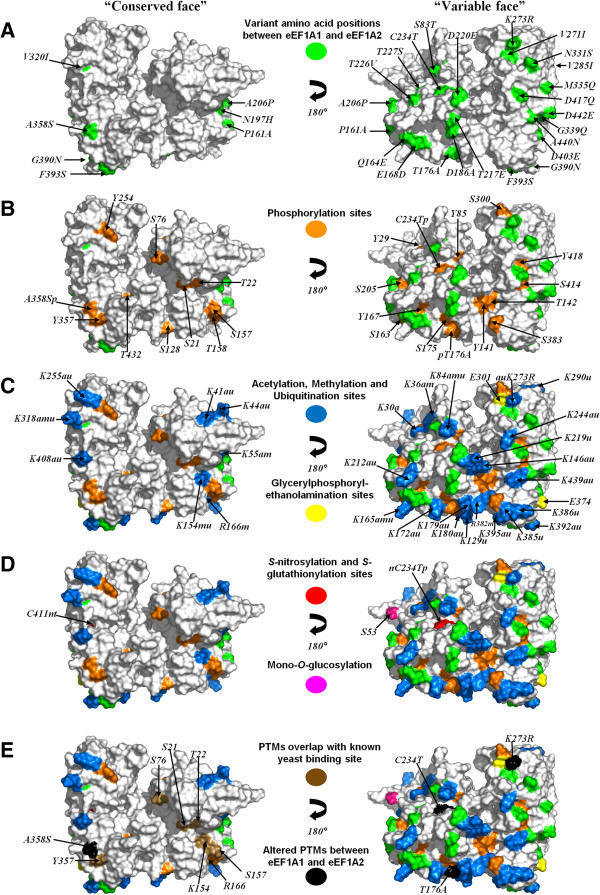
This article was reviewed by Frank Eisenhaber and Ramanathan Sowdhamini.Translation elongation factors eEF1A1 and eEF1A2 are 92% identical but exhibit non-overlapping expression patterns. While the two proteins are predicted to have similar tertiary structures, it is notable that the minor variations between their sequences are highly localised within their modelled structures. We used recently available high-throughput "omics" data to assess the spatial location of post-translational modifications and discovered that they are highly enriched on those surface regions of the protein that correspond to the clusters of sequence variation. This observation suggests how these two isoforms could be differentially regulated allowing them to perform distinct functions.
本文由弗兰克·艾森哈伯(Frank Eisenhaber)和拉马纳坦·索德哈米尼(Ramanathan Sowdhamini)审阅。翻译延伸因子eEF1A1和eEF1A2有92%的同源性,但表达模式并不重叠。虽然预测这两种蛋白质具有相似的三级结构,但值得注意的是,它们序列之间的微小差异高度集中在其模拟结构内。我们利用最近可得的高通量“组学”数据来评估翻译后修饰的空间位置,发现这些修饰高度富集于蛋白质表面那些与序列变异簇相对应的区域。这一观察结果提示了这两种异构体如何受到差异调节,从而使其能够执行不同的功能。