Lazar Jalana N, Johnson-Agbakwu Crista E, Davis Olga I, Shipp Michele P-L
Lifestages Samaritan Centers for Women, 2200 Philadelphia Drive, Suite 101, Dayton, OH 45406, USA.
Obstet Gynecol Int. 2013;2013:149640. doi: 10.1155/2013/149640. Epub 2013 Oct 7.
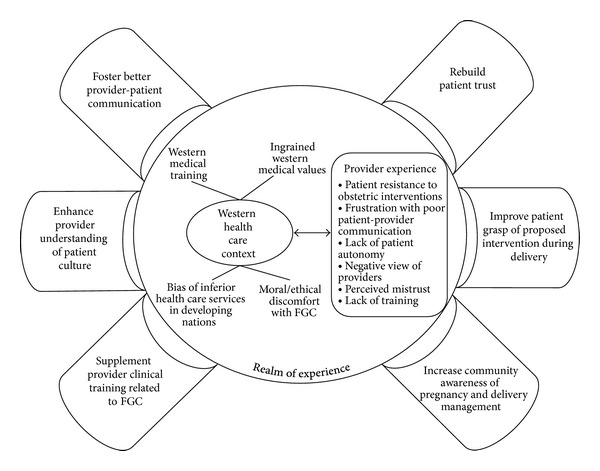
Background. This pilot study explored health care providers' perceptions of barriers to providing health care services to Somali refugee women. The specific aim was to obtain information about providers' experiences, training, practices and attitudes surrounding the prenatal care, delivery, and management of women with Female Genital Cutting (FGC). Methods. Individual semi-structured interviews were conducted with 14 obstetricians/gynecologists and nurse midwives in Columbus, Ohio. Results. While providers did not perceive FGC as a significant barrier in itself, they noted considerable challenges in communicating with their Somali patients and the lack of formal training or protocols guiding the management of circumcised women. Providers expressed frustration with what they perceived as Somali patients' resistance to obstetrical interventions and disappointment with a perception of mistrust from patients and their families. Conclusion. Improving the clinical encounter for both patients and providers entails establishing effective dialogue, enhancing clinical and cultural training of providers, improving health literacy, and developing trust through community engagement.
背景。这项试点研究探讨了医疗服务提供者对向索马里难民妇女提供医疗服务的障碍的看法。具体目标是获取有关提供者在产前护理、分娩以及女性生殖器切割(FGC)女性管理方面的经验、培训、做法和态度的信息。方法。对俄亥俄州哥伦布市的14名妇产科医生和助产护士进行了个人半结构化访谈。结果。虽然提供者本身并不认为女性生殖器切割是一个重大障碍,但他们指出在与索马里患者沟通方面存在相当大的挑战,并且缺乏指导接受割礼妇女管理的正规培训或规程。提供者对他们所认为的索马里患者对产科干预的抵触表示沮丧,对患者及其家人的不信任感感到失望。结论。改善患者和提供者双方的临床接触需要建立有效的对话,加强提供者的临床和文化培训,提高健康素养,并通过社区参与建立信任。