Laboratory of Molecular Genetics, Instituto de Tecnologia Química e Biológica (ITQB), Universidade Nova de Lisboa (UNL), Oeiras, Portugal.
PLoS One. 2013 Nov 6;8(11):e77812. doi: 10.1371/journal.pone.0077812. eCollection 2013.
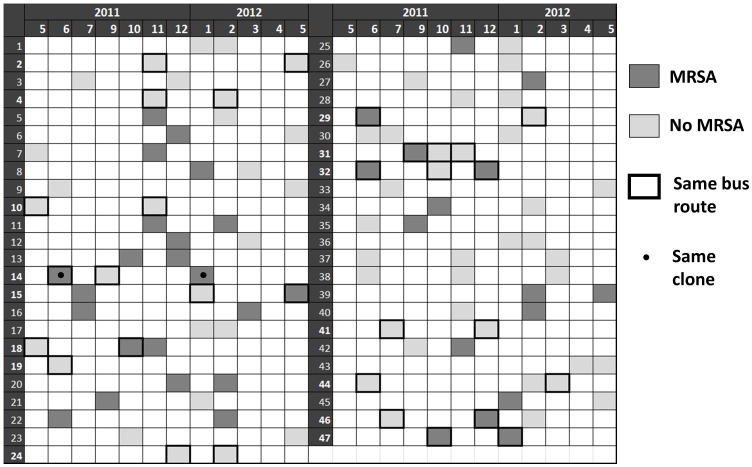
In a previous study we have shown that public buses in Oporto, the second largest city in Portugal, were highly contaminated with MRSA. Here we describe the results of a similar study performed in another urban area of Portugal-Lisbon, the capital. Between May 2011 and May 2012, hand touched surfaces of 199 public buses in Lisbon were screened for MRSA contamination. Subsequently, the hands of 575 passengers who frequently use these bus lines were also screened. All hand carriers of MRSA were further screened for nasal carriage. The isolates were characterized by PFGE, staphylococcal cassette chromosome (SCC) mec typing, spa typing, MLST and were tested for the presence of mecA, Panton-Valentine leukocidin and arginine catabolic mobile element genes. MRSA contamination was shown in 72 buses (36.2%). The majority of the isolates belonged to three major clones: Clone A was identified as EMRSA-15 defined by pattern PFGE A, spa types t2357/t747/t025/t379/t910, ST22, and SCCmec IVh (n = 21; 29%). Clone B was the New York/Japan clone characterized by PFGE B-t002/t10682-ST5-II (n = 15; 21%). Clone C included isolates with characteristics of the international community-acquired USA300 or related clones, PFGE C-t008-ST8-IVa/IVc/IVg/IVnt/VI (n = 19; 26%). The first two clones are currently the two major lineages circulating in Portuguese hospitals. The hands of 15 individuals were contaminated with MRSA belonging to the nosocomial clones A or B. Eleven of these individuals were not nasal carriers of MRSA and all but one had travelled by public transportation, namely by bus, prior to sampling. In conclusion, public buses in two major cities in Portugal are often contaminated with MRSA representing clones dominant in hospitals in the particular geographic area. MRSA contamination of public transport and the transfer of the bacteria to the hands of passengers may represent a route through which hospital-acquired MRSA clones may spread to the community.
在之前的一项研究中,我们已经表明,葡萄牙第二大城市波尔图的公共汽车受到了高度污染。在这里,我们描述了在葡萄牙首都里斯本进行的类似研究的结果。2011 年 5 月至 2012 年 5 月期间,对里斯本 199 辆公共汽车的手触摸表面进行了筛查,以确定耐甲氧西林金黄色葡萄球菌(MRSA)污染情况。随后,对经常使用这些公交线路的 575 名乘客的手部也进行了筛查。对所有 MRSA 手部携带者进一步进行了鼻腔携带筛查。对分离株进行了 PFGE、葡萄球菌盒染色体(SCC)mec 型、spa 型、MLST 分析,并检测了 mecA、Panton-Valentine 白细胞毒素和精氨酸代谢移动元件基因的存在情况。结果显示,72 辆公共汽车(36.2%)受到 MRSA 污染。大多数分离株属于三个主要克隆:克隆 A 被鉴定为 EMRSA-15,其 PFGE 模式为 A、spa 型为 t2357/t747/t025/t379/t910、ST22 和 SCCmec IVh(n = 21;29%)。克隆 B 是纽约/日本克隆,其特征为 PFGE B-t002/t10682-ST5-II(n = 15;21%)。克隆 C 包括具有国际社区获得性 USA300 或相关克隆特征的分离株,PFGE C-t008-ST8-IVa/IVc/IVg/IVnt/VI(n = 19;26%)。前两个克隆是目前在葡萄牙医院中循环的两个主要谱系。有 15 个人的手部受到了属于医院克隆 A 或 B 的耐甲氧西林金黄色葡萄球菌的污染。这些人中的 11 人不是耐甲氧西林金黄色葡萄球菌的鼻腔携带者,而且除了一人之外,所有人在采样前都曾乘坐公共交通工具,即公共汽车。综上所述,葡萄牙两个主要城市的公共汽车经常受到耐甲氧西林金黄色葡萄球菌的污染,这些细菌代表了特定地理区域医院中主要的克隆。公共交通的耐甲氧西林金黄色葡萄球菌污染以及细菌转移到乘客手部可能是医院获得性耐甲氧西林金黄色葡萄球菌克隆传播到社区的途径之一。