Taylor Roslyn A, Sansing Lauren H
Department of Immunology, University of Connecticut Health Center, Farmington, CT 06032, USA.
Clin Dev Immunol. 2013;2013:746068. doi: 10.1155/2013/746068. Epub 2013 Oct 10.
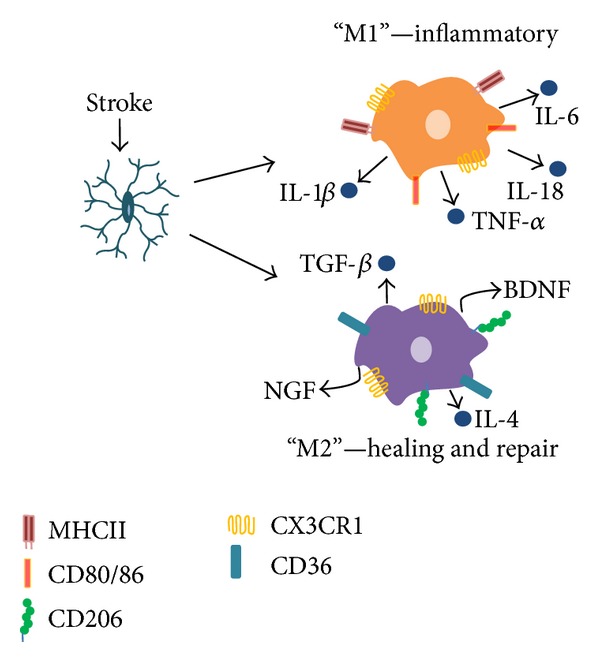
Stroke is a leading cause of death worldwide. Ischemic stroke is caused by blockage of blood vessels in the brain leading to tissue death, while intracerebral hemorrhage (ICH) occurs when a blood vessel ruptures, exposing the brain to blood components. Both are associated with glial toxicity and neuroinflammation. Microglia, as the resident immune cells of the central nervous system (CNS), continually sample the environment for signs of injury and infection. Under homeostatic conditions, they have a ramified morphology and phagocytose debris. After stroke, microglia become activated, obtain an amoeboid morphology, and release inflammatory cytokines (the M1 phenotype). However, microglia can also be alternatively activated, performing crucial roles in limiting inflammation and phagocytosing tissue debris (the M2 phenotype). In rodent models, microglial activation occurs very early after stroke and ICH; however, their specific roles in injury and repair remain unclear. This review summarizes the literature on microglial responses after ischemic stroke and ICH, highlighting the mediators of microglial activation and potential therapeutic targets for each condition.
中风是全球主要的死亡原因之一。缺血性中风是由大脑血管阻塞导致组织死亡引起的,而脑出血(ICH)则发生在血管破裂时,使大脑暴露于血液成分中。两者都与胶质细胞毒性和神经炎症有关。小胶质细胞作为中枢神经系统(CNS)的常驻免疫细胞,不断监测环境中的损伤和感染迹象。在稳态条件下,它们具有分支形态并吞噬碎片。中风后,小胶质细胞被激活,获得变形虫样形态,并释放炎性细胞因子(M1表型)。然而,小胶质细胞也可以被交替激活,在限制炎症和吞噬组织碎片方面发挥关键作用(M2表型)。在啮齿动物模型中,小胶质细胞在中风和脑出血后很早就被激活;然而,它们在损伤和修复中的具体作用仍不清楚。这篇综述总结了关于缺血性中风和脑出血后小胶质细胞反应的文献,强调了小胶质细胞激活的介质以及每种情况的潜在治疗靶点。