The Catholic University Liver Research Center, The Catholic University of Korea, Seoul, Republic of Korea ; Department of Internal Medicine College of Medicine, The Catholic University of Korea, Seoul, Republic of Korea.
PLoS One. 2013 Nov 1;8(11):e77899. doi: 10.1371/journal.pone.0077899. eCollection 2013.
Recent studies have revealed that branched-chain amino acids (BCAA) reduce the development of hepatocellular carcinoma (HCC) in patients with obesity and hepatitis C virus infection by improving insulin resistance (IR). The aim of this study was to examine the anti-cancer and anti-fibrotic effects of BCAA on the development of diethylnitrosamine (DEN)-induced HCC and liver cirrhosis in a rat model.
Male SD rats received weekly intraperitoneal injections of DEN (50 mg/kg of body weight) for 16 weeks to induce HCC. They were fed a diet containing 3% casein, 3% or 6% BCAA for 13 weeks beginning 6 weeks after DEN administration. DEN was used to induce HCC through stepwise development from cirrhosis to HCC. The effect of BCAA was evaluated in tumor tissues by histopathologic analyses, reverse transcription-polymerase chain reaction, and Western blotting.
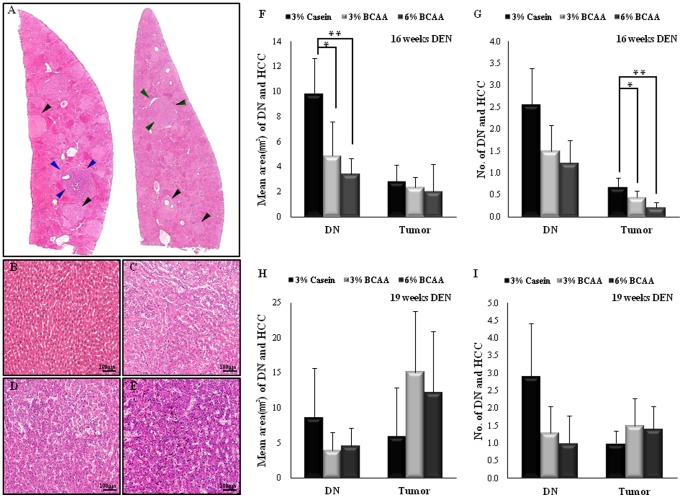
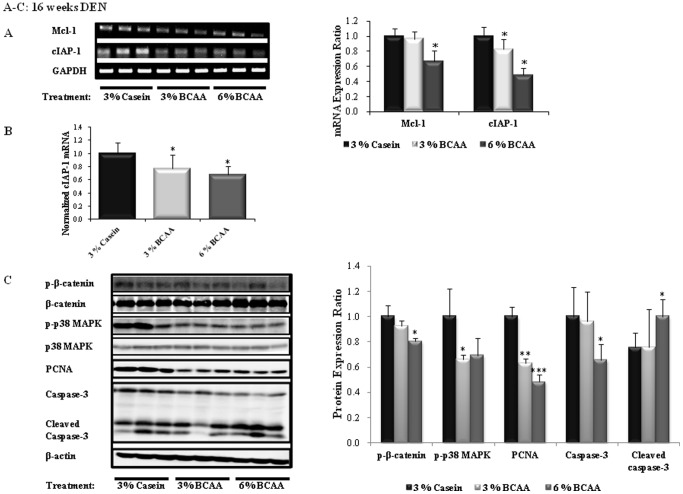
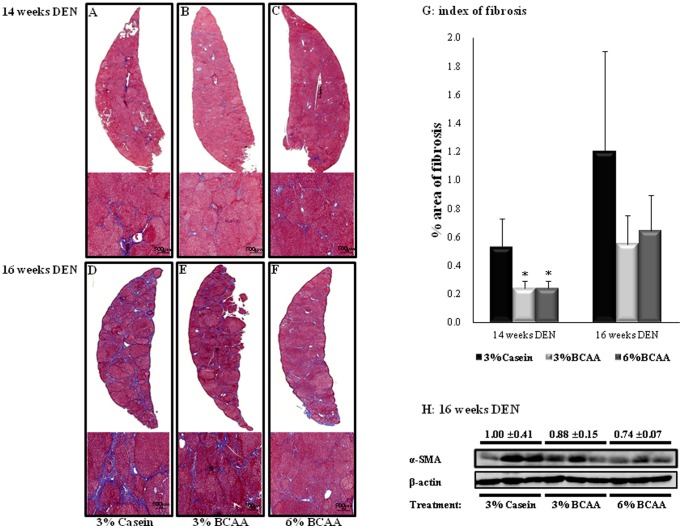
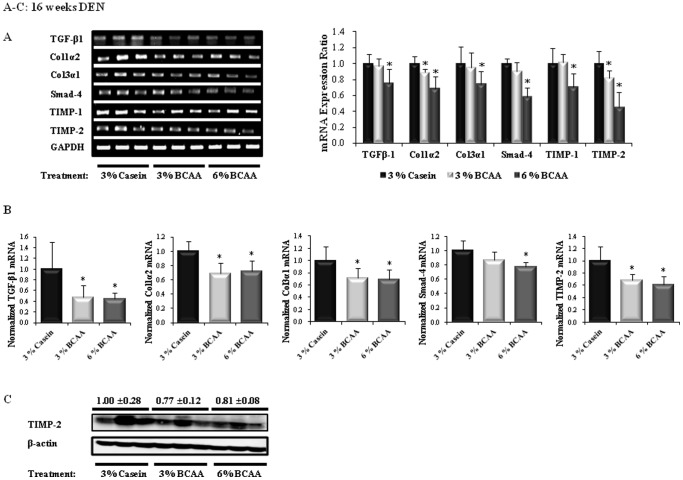
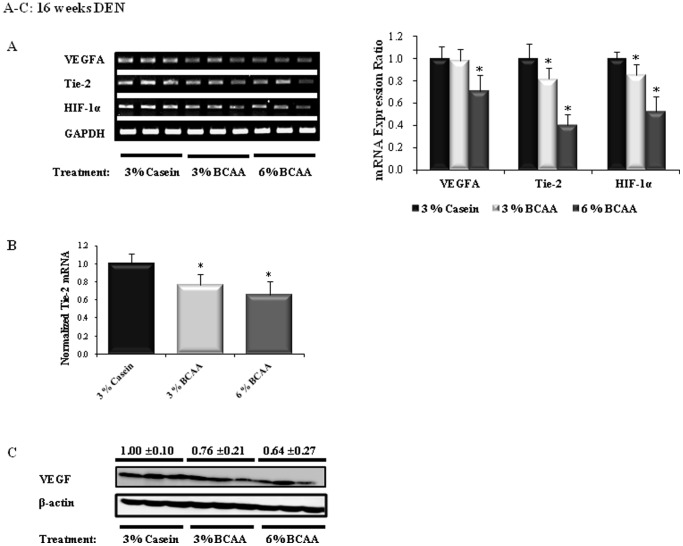
The mean area and number of dysplastic nodules (DNs) and tumors in the casein group tended to be larger than those in the BCAA group 16 weeks after DEN administration. The mean fibrotic area in the BCAA group was smaller than that in the casein group. The BCAA group showed decreased mRNA levels for markers of fibrosis, angiogenesis, and apoptosis inhibition. Compared with the casein group, the BCAA group had lower levels of α-smooth muscle actin, vascular endothelial growth factor, p-β-catenin, p-p38 mitogen-activated protein kinase, proliferating cell nuclear antigen, and caspase-3 protein expression, as well as a higher level of cleaved caspase-3 protein expression.
BCAA supplementation of the diet ameliorated liver fibrosis and HCC development in a DEN-induced rat model of HCC with liver cirrhosis, but not in the IR model. These results provide a rationale for anti-fibrosis and chemoprevention using BCAA treatment for HCC with liver cirrhosis, as well as decreasing the ammonia level.
最近的研究表明,支链氨基酸(BCAA)通过改善胰岛素抵抗(IR)来减少肥胖和丙型肝炎病毒感染患者肝细胞癌(HCC)的发展。本研究旨在检查 BCAA 对二乙基亚硝胺(DEN)诱导的 HCC 和肝硬化大鼠模型中 HCC 发展的抗癌和抗纤维化作用。
雄性 SD 大鼠每周接受腹腔注射 DEN(50mg/kg 体重)16 周,诱导 HCC。在 DEN 给药后 6 周开始,13 周内给予含 3%酪蛋白、3%或 6%BCAA 的饮食。DEN 通过从肝硬化到 HCC 的逐步发展诱导 HCC。通过组织病理学分析、逆转录聚合酶链反应和 Western blot 评估 BCAA 在肿瘤组织中的作用。
在 DEN 给药后 16 周,酪蛋白组的平均肿瘤和异型增生结节(DN)面积和数量趋于更大。BCAA 组的平均纤维化面积小于酪蛋白组。BCAA 组纤维化、血管生成和凋亡抑制标志物的 mRNA 水平降低。与酪蛋白组相比,BCAA 组的α-平滑肌肌动蛋白、血管内皮生长因子、p-β-catenin、p-p38 丝裂原活化蛋白激酶、增殖细胞核抗原和 caspase-3 蛋白表达水平降低,而 cleaved caspase-3 蛋白表达水平升高。
饮食中补充 BCAA 可改善 DEN 诱导的 HCC 肝硬化大鼠模型中的肝纤维化和 HCC 发展,但不能改善 IR 模型。这些结果为使用 BCAA 治疗肝硬化 HCC 提供了抗纤维化和化学预防的理由,同时降低了氨水平。