Department of Physics and Astronomy, University of Pennsylvania, Philadelphia, PA 19104, USA.
Phys Biol. 2013 Dec;10(6):066004. doi: 10.1088/1478-3975/10/6/066004. Epub 2013 Nov 14.
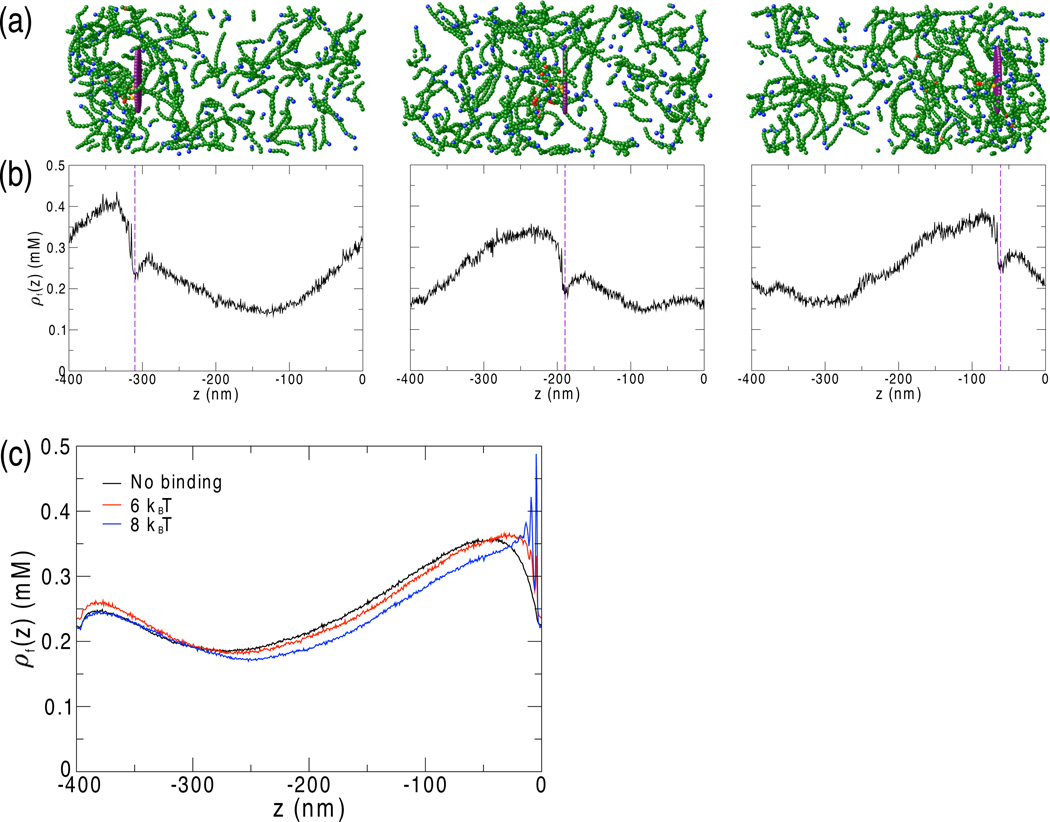
A wide variety of cell biological and biomimetic systems use actin polymerization to drive motility. It has been suggested that an object such as a bacterium can propel itself by self-assembling a high concentration of actin behind it, if it is repelled by actin. However, it is also known that it is essential for the moving object to bind actin. Therefore, a key question is how the actin tail can propel an object when it both binds and repels the object. We present a physically consistent Brownian dynamics model for actin-based motility that includes the minimal components of the dendritic nucleation model and allows for both attractive and repulsive interactions between actin and a moveable disc. We find that the concentration gradient of filamentous actin generated by polymerization is sufficient to propel the object, even with moderately strong binding interactions. Additionally, actin binding can act as a biophysical cap, and may directly control motility through modulation of network growth. Overall, this mechanism is robust in that it can drive motility against a load up to a stall pressure that depends on the Young's modulus of the actin network and can explain several aspects of actin-based motility.
多种细胞生物学和仿生系统利用肌动蛋白聚合来驱动运动。有人提出,如果一个物体(如细菌)受到肌动蛋白的排斥,它可以通过在自身后面自组装高浓度的肌动蛋白来推动自身。然而,人们也知道,运动物体与肌动蛋白结合是至关重要的。因此,一个关键问题是,当肌动蛋白既与物体结合又排斥物体时,肌动蛋白尾如何推动物体。我们提出了一个基于肌动蛋白的运动的物理一致的布朗动力学模型,该模型包含树突核化模型的最小组成部分,并允许肌动蛋白和可移动盘之间存在吸引和排斥相互作用。我们发现,聚合产生的丝状肌动蛋白浓度梯度足以推动物体,即使结合相互作用适中。此外,肌动蛋白结合可以作为一种生物物理帽,并通过调节网络生长直接控制运动。总的来说,这种机制具有很强的鲁棒性,它可以在一个取决于肌动蛋白网络的杨氏模量的失速压力下抵抗负载,推动运动,并可以解释肌动蛋白基运动的几个方面。