Division of Pharmacology and Toxicology, School of Pharmacy, University of Missouri, Kansas City, MO 64108, USA.
J Neuroinflammation. 2013 Nov 13;10:136. doi: 10.1186/1742-2094-10-136.
Neurocognitive impairments remain prevalent in HIV-1 infected individuals despite current antiretroviral therapies. It is increasingly becoming evident that astrocytes play a critical role in HIV-1 neuropathogenesis through the production of proinflammatory cytokines/chemokines. HIV-1 viral protein R (Vpr) plays an important role in neuronal dysfunction; however, its role in neuroinflammation is not well characterized. The major objective of this study was to determine the effect of Vpr in induction of proinflammatory chemokine CCL5 in astrocytes and to define the underlying mechanism(s).
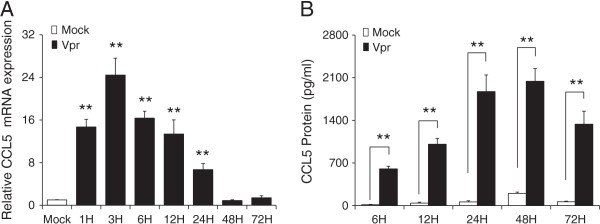
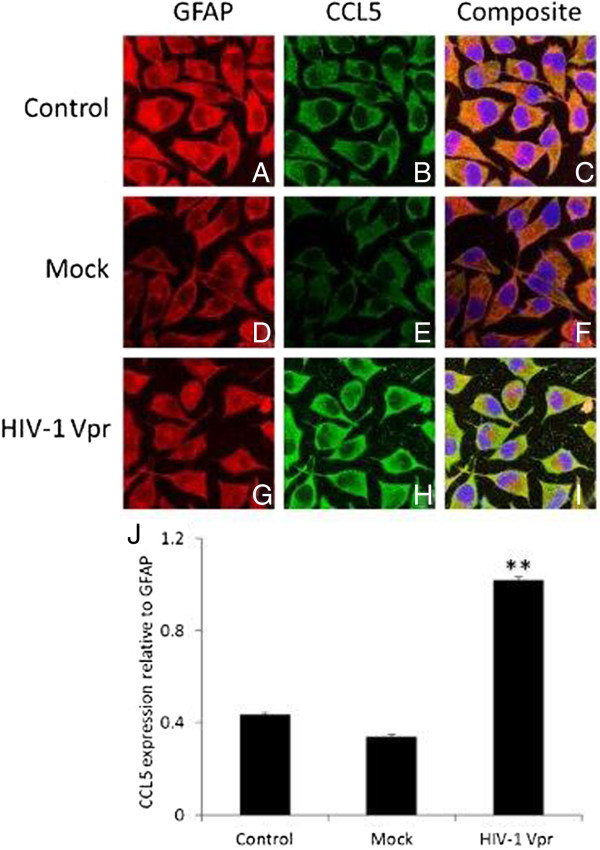
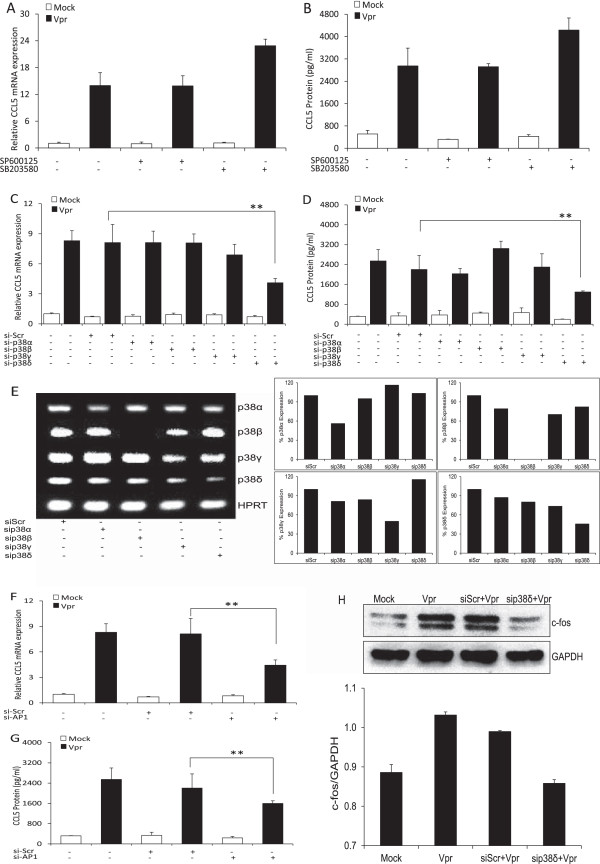
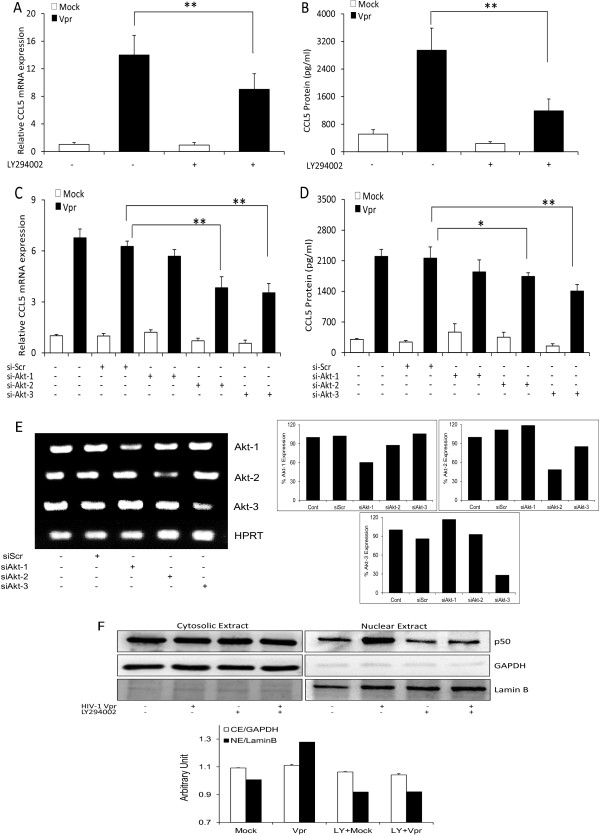
SVGA astrocytes were either mock transfected or were transfected with a plasmid encoding HIV-1 Vpr, and the cells were harvested at different time intervals. The mRNA level of CCL5 expression was quantified using real-time RT-PCR, and cell culture supernatants were assayed for CCL5 protein concentration. Immunocytochemistry was performed on HIV-1 Vpr transfected astrocytes to check CCL5 expression. Various signaling mechanisms such as p38 MAPK, PI3K/Akt, NF-κB and AP-1 were explored using specific chemical inhibitors and siRNAs.
HIV-1 Vpr transfected astrocytes exhibited time-dependent induction of CCL5 as compared to mock-transfected astrocytes at both the mRNA and protein level. Immunostained images of astrocytes transfected with HIV-1 Vpr also showed much higher accumulation of CCL5 in comparison to untransfected and mock-transfected astrocytes. Pre-treatment with NF-κB (SC514) and PI3K/Akt (LY294002) inhibitor partially abrogated CCL5 mRNA and protein expression levels as opposed to untreated controls after HIV-1 Vpr transfection. Specific siRNAs against p50 and p65 subunits of NF-κB, p38δ MAPK, Akt-2 and Akt-3, and AP-1 transcription factor substantially inhibited the production of CCL5 in HIV-1 Vpr transfected astrocytes.
These results demonstrate the ability of HIV-1 Vpr to induce CCL5 in astrocytes in a time-dependent manner. Furthermore, this effect was observed to be mediated by transcription factors NF-κB and AP-1 and involved the p38-MAPK and PI3K/Akt pathway.
尽管目前有抗逆转录病毒疗法,但 HIV-1 感染者仍普遍存在神经认知障碍。越来越明显的是,星形胶质细胞通过产生促炎细胞因子/趋化因子在 HIV-1 神经发病机制中起着关键作用。HIV-1 病毒蛋白 R(Vpr)在神经元功能障碍中起重要作用;然而,其在神经炎症中的作用尚未得到很好的描述。本研究的主要目的是确定 Vpr 在诱导星形胶质细胞中促炎趋化因子 CCL5 表达中的作用,并确定潜在的机制。
SVGA 星形胶质细胞进行 mock 转染或转染编码 HIV-1 Vpr 的质粒,并在不同时间间隔收获细胞。使用实时 RT-PCR 定量检测 CCL5 表达的 mRNA 水平,并测定细胞培养上清液中 CCL5 蛋白浓度。对 HIV-1 Vpr 转染的星形胶质细胞进行免疫细胞化学染色以检查 CCL5 表达。使用特定的化学抑制剂和 siRNA 探索各种信号转导机制,如 p38 MAPK、PI3K/Akt、NF-κB 和 AP-1。
与 mock 转染的星形胶质细胞相比,HIV-1 Vpr 转染的星形胶质细胞在 mRNA 和蛋白水平上均表现出时间依赖性的 CCL5 诱导。用 HIV-1 Vpr 转染的星形胶质细胞的免疫染色图像也显示与未转染和 mock 转染的星形胶质细胞相比,CCL5 的积累明显更高。与未经处理的对照相比,在用 HIV-1 Vpr 转染后,用 NF-κB(SC514)和 PI3K/Akt(LY294002)抑制剂预处理部分消除了 CCL5 mRNA 和蛋白表达水平。针对 NF-κB 的 p50 和 p65 亚基、p38δ MAPK、Akt-2 和 Akt-3 的特异性 siRNA 以及 AP-1 转录因子显著抑制了 HIV-1 Vpr 转染的星形胶质细胞中 CCL5 的产生。
这些结果表明 HIV-1 Vpr 能够以时间依赖性方式诱导星形胶质细胞中 CCL5 的产生。此外,观察到这种作用是由转录因子 NF-κB 和 AP-1 介导的,涉及 p38-MAPK 和 PI3K/Akt 途径。