Nookala Anantha Ram, Kumar Anil
Division of Pharmacology and Toxicology, UMKC-School of Pharmacy, 2464 Charlotte Street, Kansas City, MO, 64108, USA.
J Neuroinflammation. 2014 Dec 24;11:214. doi: 10.1186/s12974-014-0214-3.
HIV-associated neurocognitive disorders (HAND) exist in approximately 50% of infected individuals even after the introduction of highly active antiretroviral therapy. HIV-1 Tat has been implicated in HIV-associated neurotoxicity mediated through production of pro-inflammatory cytokines like IL-6 and IL-8 by astrocytes among others as well as oxidative stress. However, the underlying mechanism(s) in the up-regulation of IL-6 and IL-8 are not clearly understood. The present study was designed to determine the mechanism(s) responsible for IL-6 and IL-8 up-regulation by HIV-1 Tat.
SVG astrocytes were transiently transfected with a plasmid encoding HIV-1 Tat. The HIV-1 Tat-mediated mRNA and protein expression levels of both IL-6 and IL-8 in SVG astrocytes were quantified using real time RT-PCR and multiplex cytokine assay respectively. We also employed immunocytochemistry for staining of IL-6 and IL-8. The underlying signaling mechanism(s) were identified using pharmacological inhibitors and siRNA for different intermediate steps involved in PI3K/Akt, p38 MAPK and JNK MAPK pathways. Appropriate controls were used in the experiments and the effect of pharmacological antagonists and siRNA were observed on both mRNA expression and protein levels.
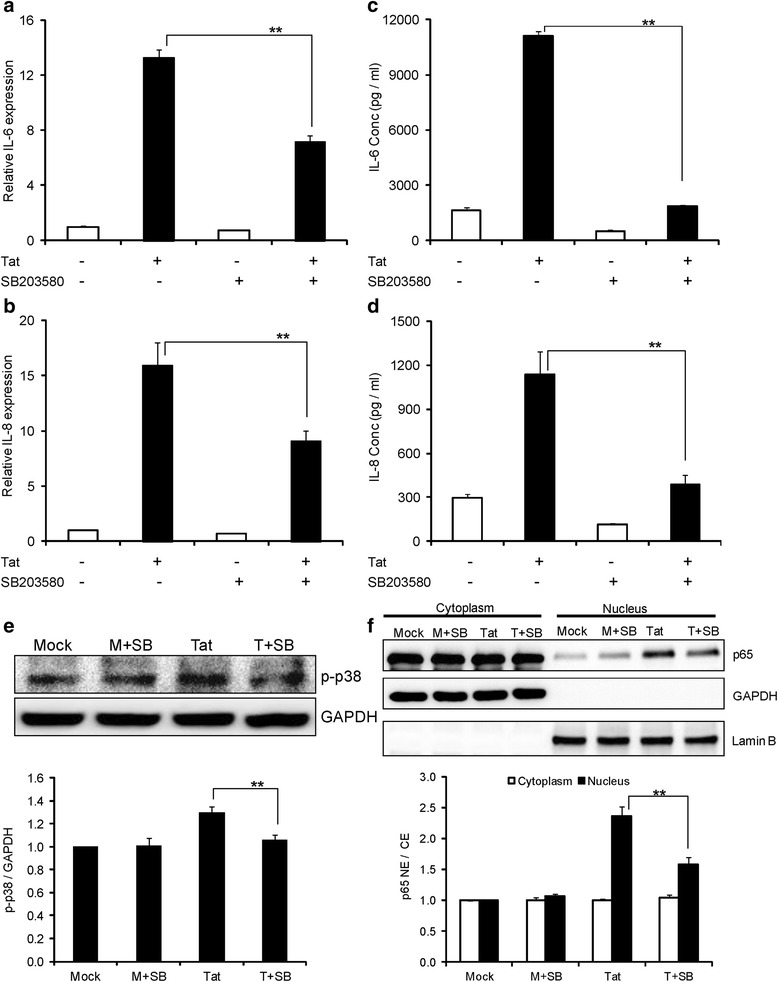
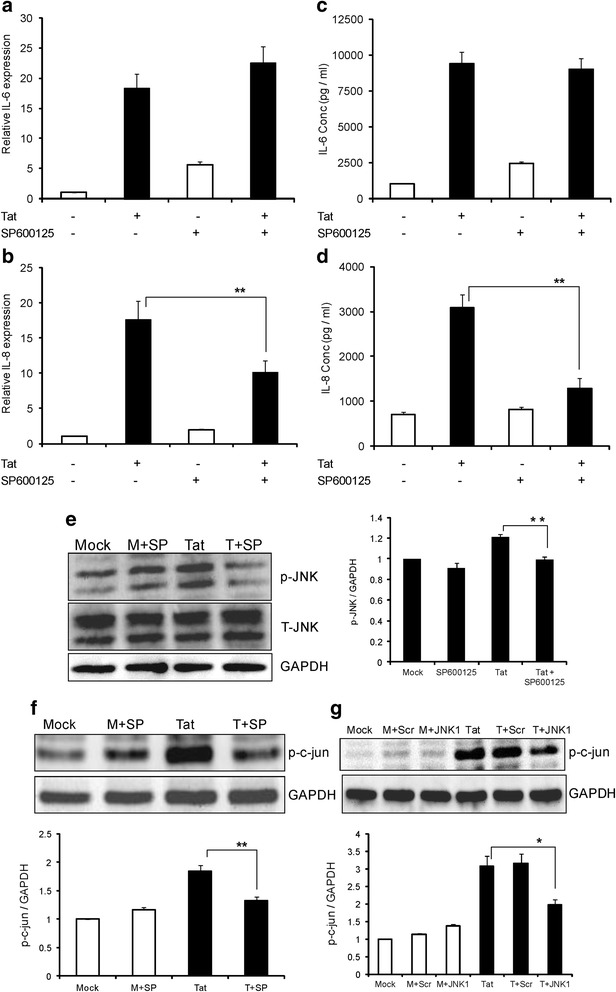
Both IL-6/IL-8 mRNA and protein showed peak expressions at 6 hours and 96 hours post-transfection, respectively. Elevated levels of IL-6/IL-8 were also confirmed by immunocytochemistry. Our studies indicated that both NF-kB and AP-1 transcription factors were involved in IL-6 and IL-8 expression mediated by HIV-1 Tat; however, AP-1 was differentially activated for either cytokine. In the case of IL-6, p38δ activated AP-1 whereas JNK but not p38 MAPK was involved in AP-1 activation for IL-8 production. On the other hand both PI3K/Akt and p38 MAPK (β subunit) were found to be involved in activation of NF-κB that led to IL-6 and IL-8 production.
Our results demonstrate HIV-1 Tat-mediated induction of both IL-6 and IL-8 in a time-dependent manner in SVG astrocytes. Furthermore, we also showed the involvement of NF-κB and AP-1 transcription factors regulated by PI3/Akt, p38 MAPK and JNK MAPK upstream signaling molecules. These results present new therapeutic targets that could be used in management of HAND.
即使在引入高效抗逆转录病毒疗法之后,约50%的HIV感染者仍存在与HIV相关的神经认知障碍(HAND)。HIV-1反式激活因子(Tat)与HIV相关神经毒性有关,其介导机制包括星形胶质细胞产生白细胞介素-6(IL-6)和白细胞介素-8(IL-8)等促炎细胞因子以及氧化应激。然而,IL-6和IL-8上调的潜在机制尚不清楚。本研究旨在确定HIV-1 Tat上调IL-6和IL-8的机制。
用编码HIV-1 Tat的质粒瞬时转染SVG星形胶质细胞。分别使用实时逆转录聚合酶链反应(RT-PCR)和多重细胞因子检测法定量HIV-1 Tat介导的SVG星形胶质细胞中IL-6和IL-8的mRNA和蛋白表达水平。我们还采用免疫细胞化学法对IL-6和IL-8进行染色。使用药理学抑制剂和针对磷脂酰肌醇-3激酶(PI3K)/蛋白激酶B(Akt)、p38丝裂原活化蛋白激酶(MAPK)和应激活化蛋白激酶(JNK) MAPK途径中不同中间步骤的小干扰RNA(siRNA)来确定潜在的信号传导机制。实验中使用了适当的对照,并观察了药理学拮抗剂和siRNA对mRNA表达和蛋白水平的影响。
IL-6/IL-8 mRNA和蛋白分别在转染后6小时和96小时显示出峰值表达。免疫细胞化学也证实了IL-6/IL-8水平升高。我们的研究表明,核因子κB(NF-κB)和激活蛋白-1(AP-1)转录因子均参与HIV-1 Tat介导的IL-6和IL-8表达;然而,AP-1对这两种细胞因子的激活存在差异。就IL-6而言,p38δ激活AP-1,而对于IL-8的产生,JNK而非p38 MAPK参与AP-1激活。另一方面,发现PI3K/Akt和p38 MAPK(β亚基)均参与NF-κB的激活,进而导致IL-6和IL-8的产生。
我们的结果表明,HIV-1 Tat在SVG星形胶质细胞中以时间依赖性方式介导IL-6和IL-8的诱导。此外,我们还表明PI3/Akt、p38 MAPK和JNK MAPK上游信号分子调节NF-κB和AP-1转录因子的参与。这些结果提出了可用于HAND管理的新治疗靶点。