Research Laboratory "Sport Performance Optimization", National Center of Medicine and Sciences in Sport (CNMSS), Tunis, Tunisia ; High Institute of Sport and Physical Education of Sfax, Sfax University, Sfax, Tunisia.
PLoS One. 2013 Nov 11;8(11):e79873. doi: 10.1371/journal.pone.0079873. eCollection 2013.
To examine the time-of-day and Ramadan fasting (RF) effects on serum apolipoprotein-AI (Apo-AI) and B (Apo-B), lipoprotein particles-a (Lp-a), high-sensitive C-reactive-protein (hs-CRP), and homocysteine (Hcy) during the Yo-Yo intermittent recovery test (YYIRT).
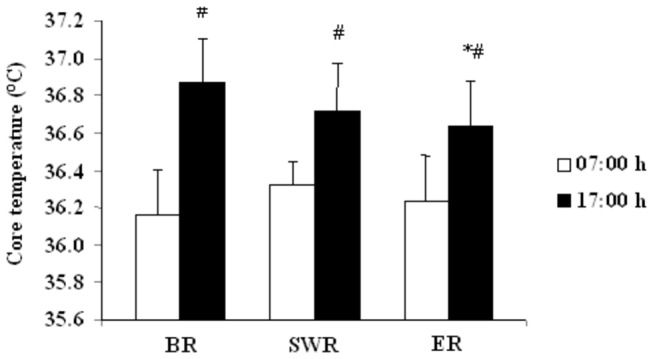
Performance and biochemical measures were completed at two times-of-day (07:00 and 17:00 h), 1-week before RF (BR), the second week of RF (SWR), and the fourth week of RF (ER).
For each session, subjects performed the YYIRT, and blood samples were taken before and 3-min after the test for biochemical measures.
Fifteen soccer players.
Total distance during the YYIRT, core temperature, body composition, dietary intakes, lipid (HDL-C, LDL-C, Apo-AI, B and Lp-a) and inflammatory (hs-CRP and Hcy) profiles.
Performances during the YYIRT were higher in the evening than the morning BR (P < 0.05), but this fluctuation was not observed during RF. Moreover, LDL-C, ApoB, and Lp-a were stable throughout the daytime BR. However, during RF, they decreased at 17:00 h (P < 0.05). Likewise, HDL-C and Apo-AI increased after the exercise and were higher at 17:00 h BR (P < 0.001). Moreover, these parameters increased during RF (P < 0.01). Furthermore, Hcy and hs-CRP increased during the exercise (P < 0.01) with higher evening levels BR. During ER, the diurnal pattern of Hcy was inversed (P < 0.001).
This study concluded that caloric restriction induced by RF seems to ameliorate lipid and inflammatory markers of cardiovascular health during intermittent exercise performed in the evening.
研究日间时间和斋月禁食(RF)对血清载脂蛋白-AI(Apo-AI)和 B(Apo-B)、脂蛋白颗粒-a(Lp-a)、高敏 C 反应蛋白(hs-CRP)和同型半胱氨酸(Hcy)在 Yo-Yo 间歇性恢复测试(YYIRT)期间的影响。
在 RF 前 1 周(BR)、RF 的第二周(SWR)和 RF 的第四周(ER),在两个时间点(07:00 和 17:00 h)完成性能和生化测量。
对于每个阶段,受试者都进行了 YYIRT,并且在测试前后 3 分钟内采集了血液样本进行生化测量。
15 名足球运动员。
YYIRT 期间的总距离、核心体温、身体成分、饮食摄入、血脂(HDL-C、LDL-C、Apo-AI、B 和 Lp-a)和炎症(hs-CRP 和 Hcy)指标。
在 BR 期间,YYIRT 的表现晚上比早上高(P < 0.05),但在 RF 期间没有观察到这种波动。此外,LDL-C、ApoB 和 Lp-a 在整个白天 BR 期间保持稳定。然而,在 RF 期间,它们在 17:00 h 时降低(P < 0.05)。同样,HDL-C 和 Apo-AI 在运动后增加,BR 时 17:00 h 更高(P < 0.001)。此外,这些参数在 RF 期间增加(P < 0.01)。此外,Hcy 和 hs-CRP 在运动时增加(P < 0.01),BR 时晚上水平更高。在 ER 期间,Hcy 的日变化模式相反(P < 0.001)。
本研究表明,RF 引起的热量限制似乎可以改善在晚上进行间歇性运动时心血管健康的血脂和炎症标志物。