Department of Environmental and Global Health, University of Florida, Gainesville, FL 32610, USA.
Malar J. 2013 Nov 19;12:426. doi: 10.1186/1475-2875-12-426.
In Haiti where chloroquine (CQ) is widely used for malaria treatment, reports of resistance are scarce. However, recent identification of CQ resistance genotypes in one site is suggestive of an emerging problem. Additional studies are needed to evaluate genetic mutations associated with CQ resistance, especially in the Plasmodium falciparum multi-drug resistance-1 gene (pfmdr1) while expanding the already available information on P. falciparum CQ transporter gene (pfcrt) in Haiti.
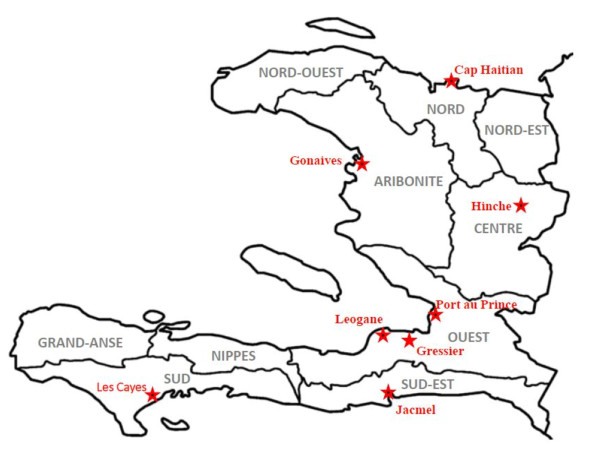
Blood samples were collected on Whatman filter cards (FTA) from eight clinics spread across Haiti. Following the confirmation of P. falciparum in the samples, PCR protocols were used to amplify regions of pfmdr1and pfcrt codons of interest, (86, 184, 1034, 1042, and 1246) and (72-76), respectively. Sequencing and site-specific restriction enzyme digestions were used to analyse these DNA fragments for the presence of single nucleotide polymorphisms (SNPs) known to confer resistance to anti-malarial drugs.
P. falciparum infection was confirmed in160 samples by amplifying a segment of the P. falciparum 18S small subunit ribosomal RNA gene (pfssurrna). The sequence of pfmdr1 in 54 of these samples was determined between codons 86,184 codons 1034, 1042 and 1246. No sequence differences from that of the NF54 clone 3D7 were found among the 54 samples except at codon 184, where a non-silent mutation was found in all samples predicted to alter the amino acid sequence replacing tyrosine with phenylalanine (Y184F). This altered sequence was also confirmed by restriction enzyme digestion. The sequence of pfmdr1 at codons 86, 184, 1034 and 1042 encoded the NFSN haplotype. The sequence of pfcrt codons 72-76 from 79 samples was determined and found to encode CVMNK, consistent with a CQ sensitive genotype.
The presence of the Y184F mutation in pfmdr1 of P. falciparum parasites in Haiti may have implications for resistance to antimalarial drugs. The absence of mutation in pfcrt at codon 76 among 79 isolates tested suggests that sensitivity to CQ in Haiti remains common. Wide-spread screening of the pfmdr1 and pfcrt especially among patients experiencing treatment failure may be a useful tool in early detection of the emergence of antimalarial drug resistance in Haiti.
在广泛使用氯喹(CQ)治疗疟疾的海地,有关耐药性的报告很少。然而,最近在一个地点发现了 CQ 耐药基因型,这表明存在新出现的问题。需要进一步研究来评估与 CQ 耐药性相关的基因突变,特别是在恶性疟原虫多药耐药 1 基因(pfmdr1)中,同时扩大海地恶性疟原虫 CQ 转运蛋白基因(pfcrt)的现有信息。
从海地各地的八个诊所采集载有血液样本的 Whatman 滤纸片(FTA)。在样本中确认存在恶性疟原虫后,使用聚合酶链反应(PCR)方案扩增 pfmdr1 和 pfcrt 感兴趣的密码子区域,分别为(86、184、1034、1042 和 1246)和(72-76)。使用测序和特定于位点的限制性内切酶消化来分析这些 DNA 片段中是否存在已知对抗疟药物产生耐药性的单核苷酸多态性(SNP)。
通过扩增恶性疟原虫 18S 小亚基核糖体 RNA 基因(pfssurrna)的一段序列,在 160 个样本中确认了恶性疟原虫感染。对其中 54 个样本的 pfmdr1 序列进行了测定,其序列位于 86、184、1034、1042 和 1246 密码子之间。除了在所有样本中发现的非沉默突变,即在密码子 184 处,预测该突变会改变氨基酸序列,将酪氨酸替换为苯丙氨酸(Y184F)外,在 54 个样本中未发现与 NF54 克隆 3D7 序列的差异。通过限制性内切酶消化也证实了该改变的序列。pfmdr1 密码子 86、184、1034 和 1042 编码的是 NFSN 单倍型。对 79 个样本的 pfcrt 密码子 72-76 序列进行了测定,发现编码 CVMNK,这与 CQ 敏感基因型一致。
在海地恶性疟原虫寄生虫中 pfmdr1 的 Y184F 突变的存在可能对抗疟药物的耐药性产生影响。在 79 个测试的分离株中,pfcrt 密码子 76 处没有突变,这表明海地对 CQ 的敏感性仍然很常见。对 pfmdr1 和 pfcrt 进行广泛筛查,特别是对治疗失败的患者进行筛查,可能是早期发现抗疟药物在海地耐药性出现的有用工具。