Department of Pathology & Laboratory Medicine, Institute on Aging, Center for Neurodegenerative Disease Research, University of Pennsylvania Perelman School of Medicine, Philadelphia, PA, USA.
Acta Neuropathol Commun. 2013 Oct 9;1:65. doi: 10.1186/2051-5960-1-65.
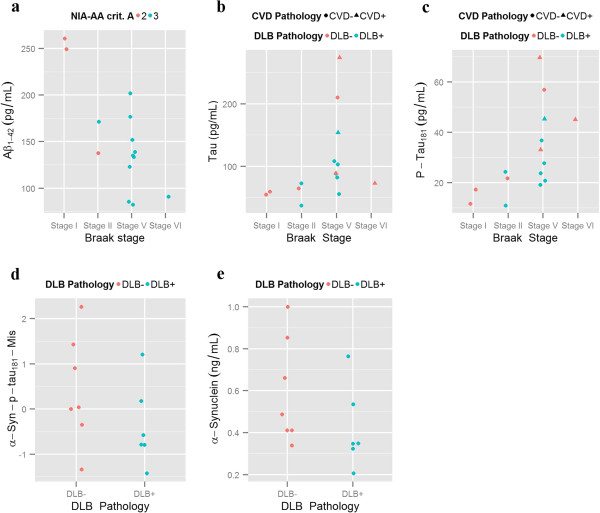
Autopsy series commonly report a high percentage of coincident pathologies in demented patients, including patients with a clinical diagnosis of dementia of the Alzheimer type (DAT). However many clinical and biomarker studies report cases with a single neurodegenerative disease. We examined multimodal biomarker correlates of the consecutive series of the first 22 Alzheimer's Disease Neuroimaging Initiative autopsies. Clinical data, neuropsychological measures, cerebrospinal fluid Aβ, total and phosphorylated tau and α-synuclein and MRI and FDG-PET scans.
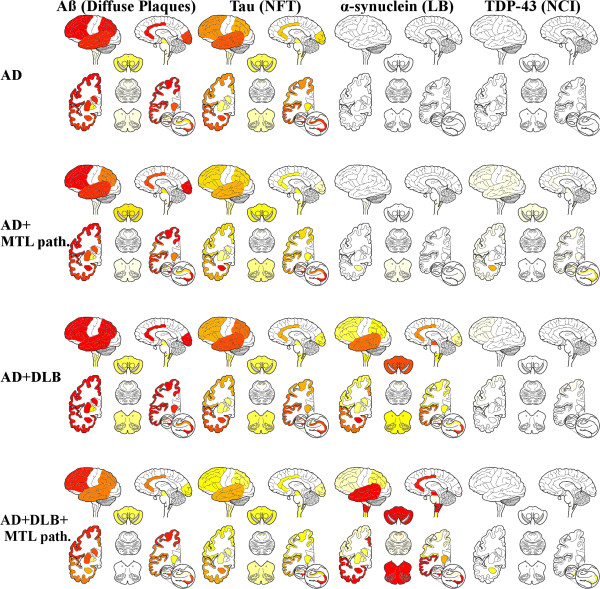
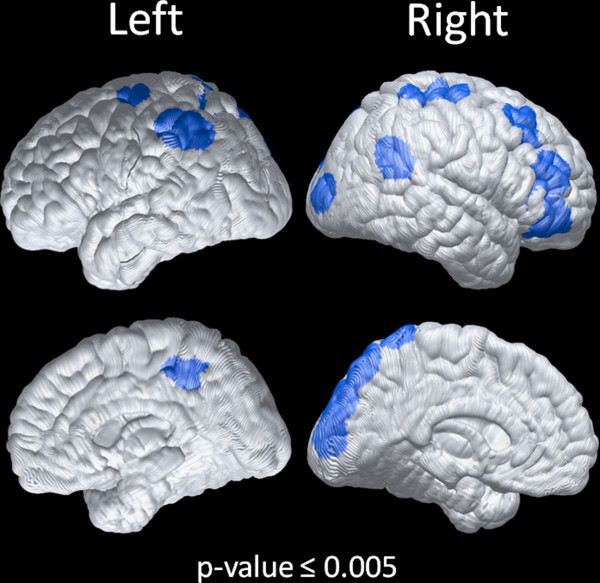
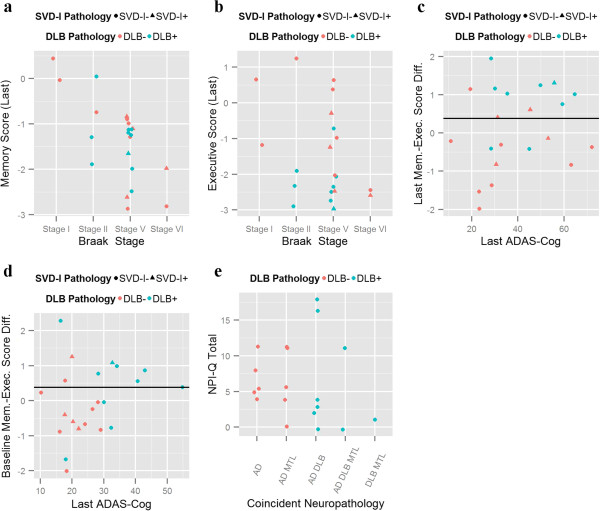
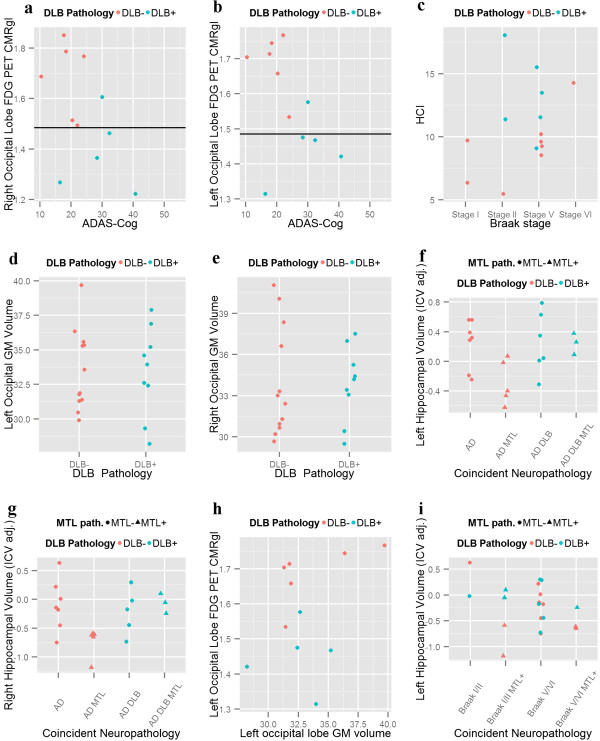
Clinical diagnosis was either probable DAT or Alzheimer's disease (AD)-type mild cognitive impairment (MCI) at last evaluation prior to death. All patients had a pathological diagnosis of AD, but only four had pure AD. A coincident pathological diagnosis of dementia with Lewy bodies (DLB), medial temporal lobe pathology (TDP-43 proteinopathy, argyrophilic grain disease and hippocampal sclerosis), referred to collectively here as MTL, and vascular pathology were present in 45.5%, 40.0% and 22.7% of these patients, respectively. Hallucinations were a strong predictor of coincident DLB (100% specificity) and a more severe dysexecutive profile was also a useful predictor of coincident DLB (80.0% sensitivity and 83.3% specificity). Occipital FDG-PET hypometabolism accurately classified coincident DLB (80% sensitivity and 100% specificity). Subjects with coincident MTL showed lower hippocampal volume.
Biomarkers can be used to independently predict coincident AD and DLB pathology, a common finding in amnestic MCI and DAT patients. Cohorts with comprehensive neuropathological assessments and multimodal biomarkers are needed to characterize independent predictors for the different neuropathological substrates of cognitive impairment.
尸检系列通常报告在痴呆患者中存在高比例的合并病理,包括临床诊断为阿尔茨海默病型痴呆(DAT)的患者。然而,许多临床和生物标志物研究报告了单一神经退行性疾病的病例。我们检查了连续的 22 例阿尔茨海默病神经影像学倡议尸检的第一个系列的多模态生物标志物相关性。临床数据、神经心理学测量、脑脊液 Aβ、总和磷酸化 tau 和α-突触核蛋白以及 MRI 和 FDG-PET 扫描。
临床诊断为死亡前最后一次评估时的可能 DAT 或阿尔茨海默病(AD)型轻度认知障碍(MCI)。所有患者均有 AD 的病理诊断,但仅有 4 例为单纯 AD。合并路易体痴呆(DLB)、内侧颞叶病理(TDP-43 蛋白病、颗粒性颗粒病和海马硬化)、这里统称为 MTL 的病理诊断以及血管病理在这些患者中分别占 45.5%、40.0%和 22.7%。幻觉是合并 DLB 的强烈预测因素(100%特异性),更严重的执行功能障碍特征也是合并 DLB 的有用预测因素(80.0%敏感性和 83.3%特异性)。枕部 FDG-PET 代谢低下可准确分类合并的 DLB(80%敏感性和 100%特异性)。合并 MTL 的受试者海马体积较低。
生物标志物可用于独立预测合并的 AD 和 DLB 病理,这在遗忘型 MCI 和 DAT 患者中很常见。需要有全面的神经病理学评估和多模态生物标志物的队列来描述认知障碍不同神经病理学底物的独立预测因素。