Berlin Ultrahigh Field Facility, Max-Delbrueck Center for Molecular Medicine, Berlin, Germany.
J Cardiovasc Magn Reson. 2010 Nov 16;12(1):67. doi: 10.1186/1532-429X-12-67.
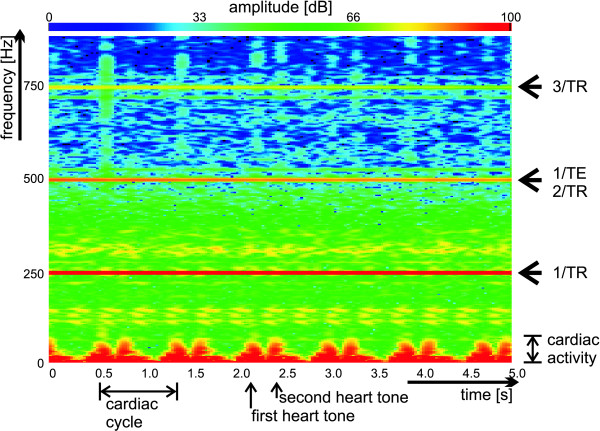
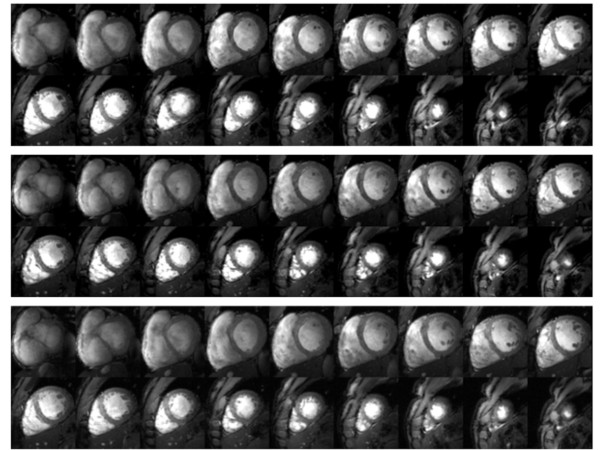
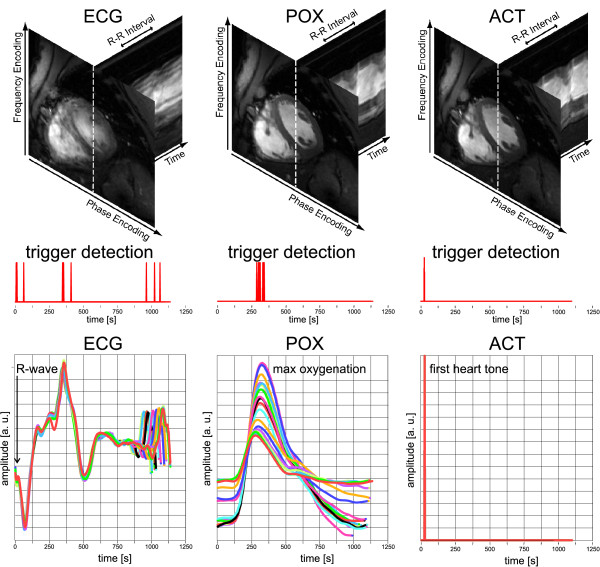
To demonstrate the applicability of acoustic cardiac triggering (ACT) for imaging of the heart at ultrahigh magnetic fields (7.0 T) by comparing phonocardiogram, conventional vector electrocardiogram (ECG) and traditional pulse oximetry (POX) triggered 2D CINE acquisitions together with (i) a qualitative image quality analysis, (ii) an assessment of the left ventricular function parameter and (iii) an examination of trigger reliability and trigger detection variance derived from the signal waveforms.
ECG was susceptible to severe distortions at 7.0 T. POX and ACT provided waveforms free of interferences from electromagnetic fields or from magneto-hydrodynamic effects. Frequent R-wave mis-registration occurred in ECG-triggered acquisitions with a failure rate of up to 30% resulting in cardiac motion induced artifacts. ACT and POX triggering produced images free of cardiac motion artefacts. ECG showed a severe jitter in the R-wave detection. POX also showed a trigger jitter of approximately Δt = 72 ms which is equivalent to two cardiac phases. ACT showed a jitter of approximately Δt = 5 ms only. ECG waveforms revealed a standard deviation for the cardiac trigger offset larger than that observed for ACT or POX waveforms.Image quality assessment showed that ACT substantially improved image quality as compared to ECG (image quality score at end-diastole: ECG = 1.7 ± 0.5, ACT = 2.4 ± 0.5, p = 0.04) while the comparison between ECG vs. POX gated acquisitions showed no significant differences in image quality (image quality score: ECG = 1.7 ± 0.5, POX = 2.0 ± 0.5, p = 0.34).
The applicability of acoustic triggering for cardiac CINE imaging at 7.0 T was demonstrated. ACT's trigger reliability and fidelity are superior to that of ECG and POX. ACT promises to be beneficial for cardiovascular magnetic resonance at ultra-high field strengths including 7.0 T.
通过比较心音图、传统向量心电图(ECG)和传统脉搏血氧饱和度(POX)触发的 2D CINE 采集,以及(i)定性图像质量分析,(ii)评估左心室功能参数,(iii)从信号波形检查触发可靠性和触发检测方差,来证明在超高磁场(7.0T)下声学心脏触发(ACT)对心脏成像的适用性。
ECG 在 7.0T 时容易受到严重的扭曲。POX 和 ACT 提供了不受电磁场或磁流体动力效应干扰的波形。ECG 触发采集中经常出现 R 波注册错误,失败率高达 30%,导致心脏运动诱导的伪影。ACT 和 POX 触发产生的图像没有心脏运动伪影。ECG 在 R 波检测中显示出严重的抖动。POX 也显示出大约Δt = 72ms 的触发抖动,相当于两个心动周期。ACT 仅显示出大约Δt = 5ms 的抖动。ECG 波形显示出心脏触发偏移的标准偏差大于 ACT 或 POX 波形。图像质量评估表明,与 ECG 相比,ACT 显著提高了图像质量(舒张末期的图像质量评分:ECG = 1.7 ± 0.5,ACT = 2.4 ± 0.5,p = 0.04),而 ECG 与 POX 门控采集之间的比较显示图像质量没有显著差异(图像质量评分:ECG = 1.7 ± 0.5,POX = 2.0 ± 0.5,p = 0.34)。
证明了声学触发在 7.0T 心脏 CINE 成像中的适用性。ACT 的触发可靠性和保真度优于 ECG 和 POX。ACT 有望在超高磁场强度(包括 7.0T)下对心血管磁共振成像有益。