• 文献检索
  • 文档翻译
  • 深度研究
  • 学术资讯
  • Suppr Zotero 插件Zotero 插件
  • 邀请有礼
  • 套餐&价格
  • 历史记录
应用&插件
Suppr Zotero 插件Zotero 插件浏览器插件Mac 客户端Windows 客户端微信小程序
定价
高级版会员购买积分包购买API积分包
服务
文献检索文档翻译深度研究API 文档MCP 服务
关于我们
关于 Suppr公司介绍联系我们用户协议隐私条款
关注我们

Suppr 超能文献

核心技术专利:CN118964589B侵权必究
粤ICP备2023148730 号-1Suppr @ 2026

文献检索

告别复杂PubMed语法,用中文像聊天一样搜索,搜遍4000万医学文献。AI智能推荐,让科研检索更轻松。

立即免费搜索

文件翻译

保留排版,准确专业,支持PDF/Word/PPT等文件格式,支持 12+语言互译。

免费翻译文档

深度研究

AI帮你快速写综述,25分钟生成高质量综述,智能提取关键信息,辅助科研写作。

立即免费体验

尿液中无细胞的微小RNA-214作为非肌层浸润性膀胱癌的生物标志物

Cell-Free microRNA-214 From Urine as a Biomarker for Non-Muscle-Invasive Bladder Cancer.

作者信息

Kim Sung Min, Kang Ho Won, Kim Won Tae, Kim Yong-June, Yun Seok Joong, Lee Sang-Cheol, Kim Wun-Jae

机构信息

Department of Urology, Chungbuk National University College of Medicine, Cheongju, Korea.

出版信息

Korean J Urol. 2013 Nov;54(11):791-6. doi: 10.4111/kju.2013.54.11.791. Epub 2013 Nov 6.

DOI:10.4111/kju.2013.54.11.791
PMID:24255763
原文链接:https://pmc.ncbi.nlm.nih.gov/articles/PMC3830974/
Abstract

PURPOSE

MicroRNAs are small noncoding RNAs and microRNA-214 (miR-214) has been associated with the inhibition of cancer cell growth, migration, and invasion. The aim of this study was to investigate whether cell-free miR-214 isolated from urine could be used as a biomarker for non-muscle-invasive bladder cancer (NMIBC).

MATERIALS AND METHODS

A total of 138 patients with primary NMIBC and 144 healthy normal controls were enrolled in this study. By use of quantitative polymerase chain reaction (PCR), the urinary levels of cell-free miR-214 were measured and the clinicopathological parameters of patients with NMIBC were compared with those of the controls.

RESULTS

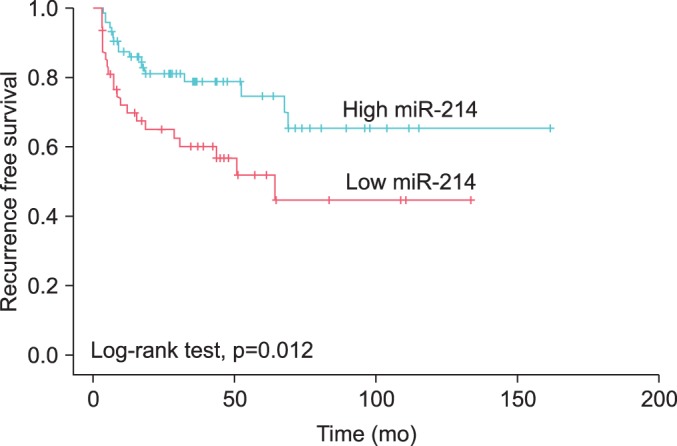
The urinary levels of cell-free miR-214 were significantly higher in the NMIBC patients than in the controls (20.08±3.21 vs. 18.96±2.68, p=0.002). However, the urinary levels of cell-free miR-214 were neither graded nor staged for the NMIBC patients (p>0.05, each). When we compared the urinary levels of cell-free miR-214 according to clinical outcomes, patients with recurrence had lower levels of miR-214 than did those with no recurrence (19.24±2.67 vs. 20.41±3.41, p=0.023). By contrast, there were no significant differences in the urinary level of cell-free miR-214 between the NMIBC patients showing progression and those showing no progression (p=0.919). Multivariate Cox regression analysis revealed that urinary levels of cell-free miR-214 were an independent predictor of NMIBC recurrence (hazard ratio, 2.011; 95% confidence interval, 1.027 to 3.937; p=0.041).

CONCLUSIONS

Urinary levels of cell-free miR-214 could be an independent prognostic parameter for NMIBC recurrence. Thus, urinary cell-free microRNA-214 might be a useful prognostic marker for NMI BC.

摘要

目的

微小RNA是一类小的非编码RNA,微小RNA-214(miR-214)与抑制癌细胞生长、迁移和侵袭有关。本研究旨在探讨从尿液中分离出的游离miR-214是否可作为非肌层浸润性膀胱癌(NMIBC)的生物标志物。

材料与方法

本研究共纳入138例原发性NMIBC患者和144例健康正常对照者。采用定量聚合酶链反应(PCR)检测游离miR-214的尿液水平,并将NMIBC患者的临床病理参数与对照组进行比较。

结果

NMIBC患者尿液中游离miR-214水平显著高于对照组(20.08±3.21对18.96±2.68,p=0.002)。然而,NMIBC患者尿液中游离miR-根据临床结局比较游离miR-214的尿液水平时,复发患者的miR-214水平低于未复发患者(19.24±2.67对20.41±3.41,p=0.023)。相比之下,出现进展的NMIBC患者与未出现进展的患者之间,尿液中游离miR-214水平无显著差异(p=0.919)。多因素Cox回归分析显示,尿液中游离miR-214水平是NMIBC复发的独立预测因子(风险比,2.011;95%置信区间,1.027至3.937;p=0.041)。

结论

尿液中游离miR-214水平可能是NMIBC复发的独立预后参数。因此,尿液中游离微小RNA-214可能是NMIBC的有用预后标志物。 4的水平在NMIBC患者中既不分级也不分期(p>0.05,各项)。
https://cdn.ncbi.nlm.nih.gov/pmc/blobs/9a14/3830974/740866d7085b/kju-54-791-g001.jpg

相似文献

1
Cell-Free microRNA-214 From Urine as a Biomarker for Non-Muscle-Invasive Bladder Cancer.尿液中无细胞的微小RNA-214作为非肌层浸润性膀胱癌的生物标志物
Korean J Urol. 2013 Nov;54(11):791-6. doi: 10.4111/kju.2013.54.11.791. Epub 2013 Nov 6.
2
Tumor expression of miR-34a-3p is an independent predictor of recurrence in non-muscle-invasive bladder cancer and promising additional factor to improve predictive value of EORTC nomogram.miR-34a-3p 在肿瘤中的表达是非肌层浸润性膀胱癌复发的独立预测因子,有望成为提高 EORTC 列线图预测价值的附加因素。
Urol Oncol. 2019 Mar;37(3):184.e1-184.e7. doi: 10.1016/j.urolonc.2018.10.014. Epub 2018 Nov 13.
3
Direct quantitative detection for cell-free miR-155 in urine: a potential role in diagnosis and prognosis for non-muscle invasive bladder cancer.尿液中游离miR-155的直接定量检测:在非肌层浸润性膀胱癌诊断和预后中的潜在作用
Oncotarget. 2016 Jan 19;7(3):3255-66. doi: 10.18632/oncotarget.6487.
4
Urinary expression of let-7c cluster as non-invasive tool to assess the risk of disease progression in patients with high grade non-muscle invasive bladder Cancer: a pilot study.尿中 let-7c 簇的表达作为一种非侵入性工具,用于评估高级别非肌肉浸润性膀胱癌患者疾病进展的风险:一项初步研究。
J Exp Clin Cancer Res. 2020 Apr 17;39(1):68. doi: 10.1186/s13046-020-01550-w.
5
Circulating miR-205: a promising biomarker for the detection and prognosis evaluation of bladder cancer.循环miR-205:一种用于膀胱癌检测和预后评估的有前景的生物标志物。
Tumour Biol. 2016 Jun;37(6):8075-82. doi: 10.1007/s13277-015-4698-y. Epub 2015 Dec 29.
6
Cell-free microRNAs in urine as diagnostic and prognostic biomarkers of bladder cancer.尿中无细胞微小 RNA 作为膀胱癌的诊断和预后生物标志物。
Int J Oncol. 2012 Nov;41(5):1871-8. doi: 10.3892/ijo.2012.1622. Epub 2012 Sep 6.
7
Downregulation of urinary cell-free microRNA-214 as a diagnostic and prognostic biomarker in bladder cancer.尿游离微小RNA-214的下调作为膀胱癌的诊断和预后生物标志物
J Surg Oncol. 2015 Jun;111(8):992-9. doi: 10.1002/jso.23937. Epub 2015 May 14.
8
Urinary Cell-Free DNA IQGAP3/BMP4 Ratio as a Prognostic Marker for Non-Muscle-Invasive Bladder Cancer.尿液细胞游离 DNA IQGAP3/BMP4 比值作为非肌肉浸润性膀胱癌的预后标志物。
Clin Genitourin Cancer. 2019 Jun;17(3):e704-e711. doi: 10.1016/j.clgc.2019.04.001. Epub 2019 Apr 9.
9
Cell-free microRNA expression signatures in urine serve as novel noninvasive biomarkers for diagnosis and recurrence prediction of bladder cancer.尿液中无细胞微小RNA表达特征可作为膀胱癌诊断和复发预测的新型非侵入性生物标志物。
Oncotarget. 2017 Jun 20;8(25):40832-40842. doi: 10.18632/oncotarget.16586.
10
Circulating microRNAs in serum: novel biomarkers for patients with bladder cancer?血清中的循环微小RNA:膀胱癌患者的新型生物标志物?
World J Urol. 2014 Apr;32(2):353-8. doi: 10.1007/s00345-012-1010-2. Epub 2012 Dec 25.

引用本文的文献

1
Exosomes: Toward a potential application in bladder cancer diagnosis and treatment.外泌体:迈向膀胱癌诊断与治疗的潜在应用
Smart Med. 2023 Oct 30;3(1):e20230027. doi: 10.1002/SMMD.20230027. eCollection 2024 Feb.
2
Urinary miRNAs: Technical Updates.尿液微小RNA:技术更新
Microrna. 2024;13(2):110-123. doi: 10.2174/0122115366305985240502094814.
3
The Emerging Role of Exosomal miRNAs as Biomarkers for Early Cancer Detection: A Comprehensive Literature Review.外泌体 miRNA 作为癌症早期检测生物标志物的新兴作用:全面文献综述。

本文引用的文献

1
Cell-free microRNAs in urine as diagnostic and prognostic biomarkers of bladder cancer.尿中无细胞微小 RNA 作为膀胱癌的诊断和预后生物标志物。
Int J Oncol. 2012 Nov;41(5):1871-8. doi: 10.3892/ijo.2012.1622. Epub 2012 Sep 6.
2
Cancer statistics in Korea: incidence, mortality, survival, and prevalence in 2009.韩国癌症统计数据:2009 年的发病率、死亡率、生存率和患病率。
Cancer Res Treat. 2012 Mar;44(1):11-24. doi: 10.4143/crt.2012.44.1.11. Epub 2012 Mar 31.
3
Cancer statistics, 2012.癌症统计数据,2012 年。
Technol Cancer Res Treat. 2023 Jan-Dec;22:15330338231205999. doi: 10.1177/15330338231205999.
4
Urinary MicroRNAs as Biomarkers of Urological Cancers: A Systematic Review.尿 MicroRNAs 作为泌尿系统癌症的生物标志物:系统评价。
Int J Mol Sci. 2023 Jun 29;24(13):10846. doi: 10.3390/ijms241310846.
5
The Roles of miRNAs in Predicting Bladder Cancer Recurrence and Resistance to Treatment.miRNAs 在预测膀胱癌复发和治疗耐药中的作用。
Int J Mol Sci. 2023 Jan 4;24(2):964. doi: 10.3390/ijms24020964.
6
Exosomal miR-214-3p as a potential novel biomarker for rhabdoid tumor of the kidney.外泌体 miR-214-3p 作为肾横纹肌样瘤的潜在新型生物标志物。
Pediatr Surg Int. 2021 Dec;37(12):1783-1790. doi: 10.1007/s00383-021-04989-w. Epub 2021 Sep 7.
7
Prominence of urinary biomarkers for bladder cancer in the COVID-19 era: From the commercially available to new prospective candidates.在 COVID-19 时代,膀胱癌尿液生物标志物的重要性:从市售到新的有前景的候选物。
Investig Clin Urol. 2021 Sep;62(5):500-519. doi: 10.4111/icu.20210194.
8
MicroRNAs: Their Role in Metastasis, Angiogenesis, and the Potential for Biomarker Utility in Bladder Carcinomas.微小RNA:它们在膀胱癌转移、血管生成中的作用以及作为生物标志物的应用潜力
Cancers (Basel). 2021 Feb 20;13(4):891. doi: 10.3390/cancers13040891.
9
Role of Exosomal miRNA in Bladder Cancer: A Promising Liquid Biopsy Biomarker.外泌体 miRNA 在膀胱癌中的作用:一种有前途的液体活检生物标志物。
Int J Mol Sci. 2021 Feb 8;22(4):1713. doi: 10.3390/ijms22041713.
10
Epigenetics of Bladder Cancer: Where Biomarkers and Therapeutic Targets Meet.膀胱癌的表观遗传学:生物标志物与治疗靶点的交汇之处
Front Genet. 2019 Nov 18;10:1125. doi: 10.3389/fgene.2019.01125. eCollection 2019.
CA Cancer J Clin. 2012 Jan-Feb;62(1):10-29. doi: 10.3322/caac.20138. Epub 2012 Jan 4.
4
MicroRNA expression signatures of bladder cancer revealed by deep sequencing.深度测序揭示膀胱癌的 microRNA 表达特征。
PLoS One. 2011 Mar 28;6(3):e18286. doi: 10.1371/journal.pone.0018286.
5
MiR-96 and miR-183 detection in urine serve as potential tumor markers of urothelial carcinoma: correlation with stage and grade, and comparison with urinary cytology.尿中 miR-96 和 miR-183 的检测可作为尿路上皮癌的潜在肿瘤标志物:与分期和分级的相关性,并与尿细胞学的比较。
Cancer Sci. 2011 Mar;102(3):522-9. doi: 10.1111/j.1349-7006.2010.01816.x. Epub 2010 Dec 19.
6
Dysregulation of miR-15a and miR-214 in human pancreatic cancer.miR-15a 和 miR-214 在人胰腺癌细胞中的失调。
J Hematol Oncol. 2010 Nov 24;3:46. doi: 10.1186/1756-8722-3-46.
7
The microRNA spectrum in 12 body fluids.12 种体液中的 microRNA 图谱。
Clin Chem. 2010 Nov;56(11):1733-41. doi: 10.1373/clinchem.2010.147405. Epub 2010 Sep 16.
8
mRNA Expression of S100A8 as a Prognostic Marker for Progression of Non-Muscle-Invasive Bladder Cancer.S100A8的mRNA表达作为非肌层浸润性膀胱癌进展的预后标志物
Korean J Urol. 2010 Jan;51(1):15-20. doi: 10.4111/kju.2010.51.1.15. Epub 2010 Jan 21.
9
MicroRNA-214 is aberrantly expressed in cervical cancers and inhibits the growth of HeLa cells.miR-214 在宫颈癌中表达异常,并抑制 HeLa 细胞的生长。
IUBMB Life. 2009 Nov;61(11):1075-82. doi: 10.1002/iub.252.
10
Bladder cancer.膀胱癌
Lancet. 2009 Jul 18;374(9685):239-49. doi: 10.1016/S0140-6736(09)60491-8. Epub 2009 Jun 10.