Department of Biomedical Engineering, University of Texas at Austin, Austin, Texas 78712, USA.
Nat Chem. 2013 Dec;5(12):1000-5. doi: 10.1038/nchem.1764. Epub 2013 Sep 29.
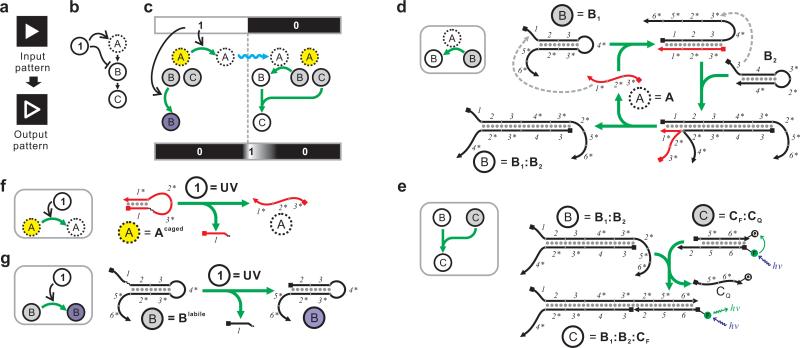
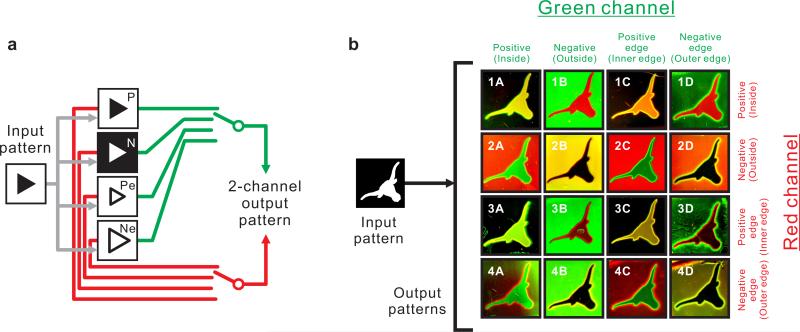
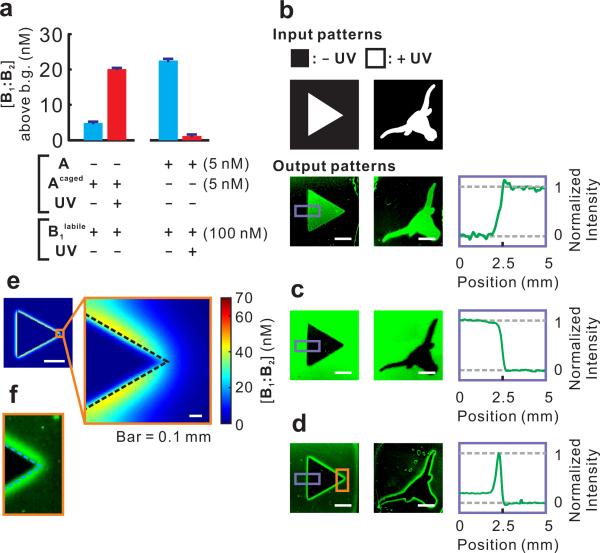
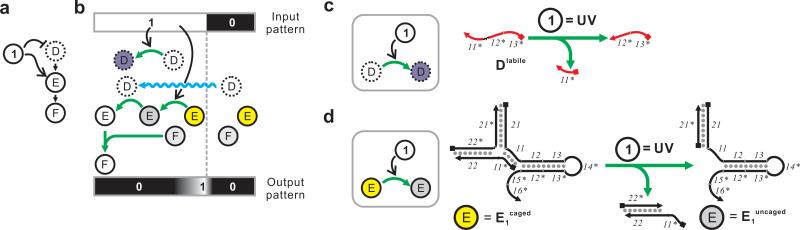
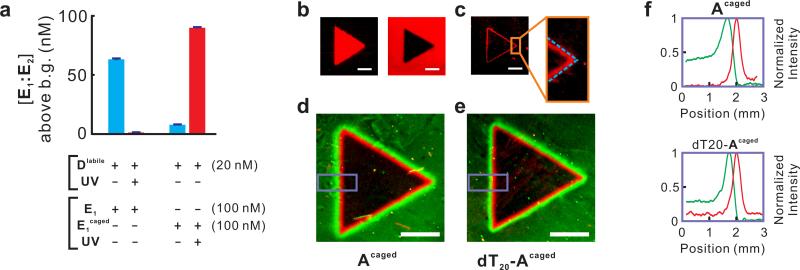
Readily programmable chemical networks are important tools as the scope of chemistry expands from individual molecules to larger molecular systems. Although many complex systems are constructed using conventional organic and inorganic chemistry, the programmability of biological molecules such as nucleic acids allows for precise, high-throughput and automated design, as well as simple, rapid and robust implementation. Here we show that systematic and quantitative control over the diffusivity and reactivity of DNA molecules yields highly programmable chemical reaction networks (CRNs) that execute at the macroscale. In particular, we designed and implemented non-enzymatic DNA circuits capable of performing pattern-transformation algorithms such as edge detection. We also showed that it is possible to fine-tune and multiplex such circuits. We believe these strategies will provide programmable platforms on which to prototype CRNs, discover bottom-up construction principles and generate patterns in materials.
易于编程的化学网络是重要的工具,因为化学的范围从单个分子扩展到更大的分子系统。尽管许多复杂的系统都是使用传统的有机和无机化学构建的,但生物分子(如核酸)的可编程性允许进行精确、高通量和自动化的设计,以及简单、快速和稳健的实现。在这里,我们展示了对 DNA 分子扩散率和反应性的系统和定量控制,可以产生在宏观尺度上执行的高度可编程化学反应网络(CRN)。具体来说,我们设计并实现了非酶 DNA 电路,能够执行诸如边缘检测等模式转换算法。我们还表明,可以对这种电路进行微调并进行多路复用。我们相信,这些策略将为原型 CRN、发现自下而上的构建原则以及在材料中生成图案提供可编程平台。