García-Orenes Fuensanta, Morugán-Coronado Alicia, Zornoza Raul, Cerdà Artemi, Scow Kate
Department of Agrochemistry and Environment, University Miguel HernándezElche, Alicante, Spain.
PLoS One. 2013 Nov 18;8(11):e80522. doi: 10.1371/journal.pone.0080522. eCollection 2013.
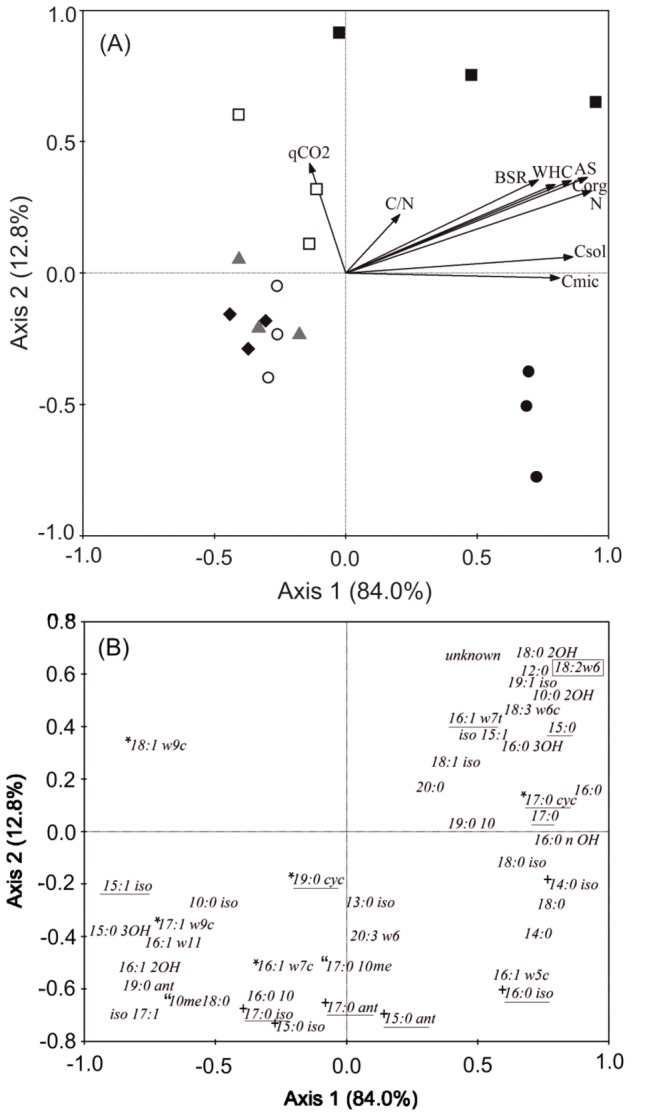
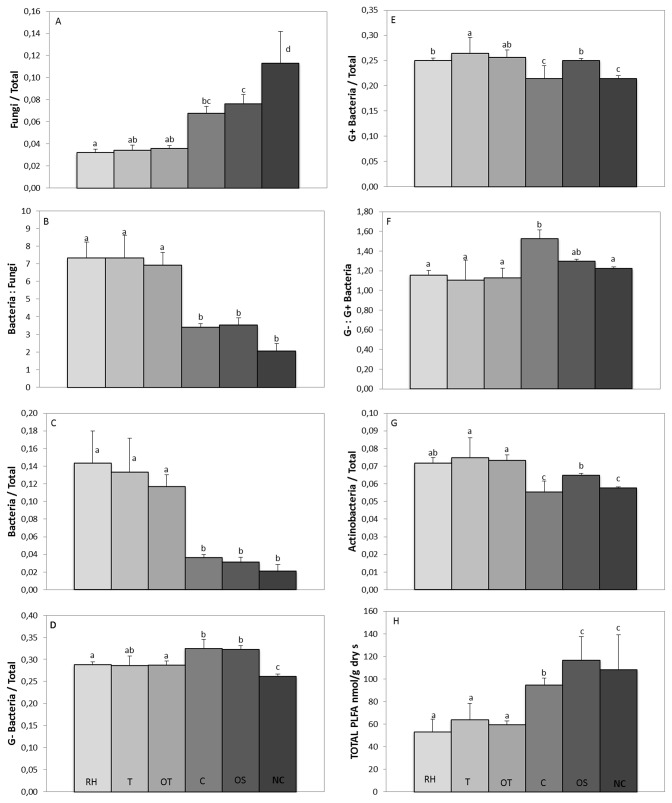
Agricultural practices have proven to be unsuitable in many cases, causing considerable reductions in soil quality. Land management practices can provide solutions to this problem and contribute to get a sustainable agriculture model. The main objective of this work was to assess the effect of different agricultural management practices on soil microbial community structure (evaluated as abundance of phospholipid fatty acids, PLFA). Five different treatments were selected, based on the most common practices used by farmers in the study area (eastern Spain): residual herbicides, tillage, tillage with oats and oats straw mulching; these agricultural practices were evaluated against an abandoned land after farming and an adjacent long term wild forest coverage. The results showed a substantial level of differentiation in the microbial community structure, in terms of management practices, which was highly associated with soil organic matter content. Addition of oats straw led to a microbial community structure closer to wild forest coverage soil, associated with increases in organic carbon, microbial biomass and fungal abundances. The microbial community composition of the abandoned agricultural soil was characterised by increases in both fungal abundances and the metabolic quotient (soil respiration per unit of microbial biomass), suggesting an increase in the stability of organic carbon. The ratio of bacteria:fungi was higher in wild forest coverage and land abandoned systems, as well as in the soil treated with oat straw. The most intensively managed soils showed higher abundances of bacteria and actinobacteria. Thus, the application of organic matter, such as oats straw, appears to be a sustainable management practice that enhances organic carbon, microbial biomass and activity and fungal abundances, thereby changing the microbial community structure to one more similar to those observed in soils under wild forest coverage.
农业实践在许多情况下已被证明是不合适的,会导致土壤质量大幅下降。土地管理实践可以为这个问题提供解决方案,并有助于建立可持续农业模式。这项工作的主要目的是评估不同农业管理实践对土壤微生物群落结构的影响(以磷脂脂肪酸(PLFA)丰度来评估)。根据研究区域(西班牙东部)农民最常用的实践,选择了五种不同的处理方式:残留除草剂、耕作、燕麦耕作及燕麦秸秆覆盖;这些农业实践与一块弃耕农田及相邻的长期野生森林覆盖区域进行对比评估。结果表明,就管理实践而言,微生物群落结构存在显著差异,这与土壤有机质含量高度相关。添加燕麦秸秆导致微生物群落结构更接近野生森林覆盖土壤,这与有机碳、微生物生物量和真菌丰度的增加有关。弃耕农田土壤的微生物群落组成特征是真菌丰度和代谢商(单位微生物生物量的土壤呼吸)均增加,这表明有机碳稳定性增加。细菌与真菌的比例在野生森林覆盖区域和弃耕系统以及用燕麦秸秆处理的土壤中更高。管理最集约的土壤中细菌和放线菌的丰度更高。因此,施用有机物质,如燕麦秸秆,似乎是一种可持续管理实践,可提高有机碳、微生物生物量和活性以及真菌丰度,从而将微生物群落结构转变为更类似于野生森林覆盖土壤中观察到的结构。