Department of Botany and Plant Pathology, Oregon State University, 2082-Cordley Hall, Corvallis, OR 97331, USA.
Rice (N Y). 2013 May 29;6(1):15. doi: 10.1186/1939-8433-6-15.
Functional annotations of large plant genome projects mostly provide information on gene function and gene families based on the presence of protein domains and gene homology, but not necessarily in association with gene expression or metabolic and regulatory networks. These additional annotations are necessary to understand the physiology, development and adaptation of a plant and its interaction with the environment.
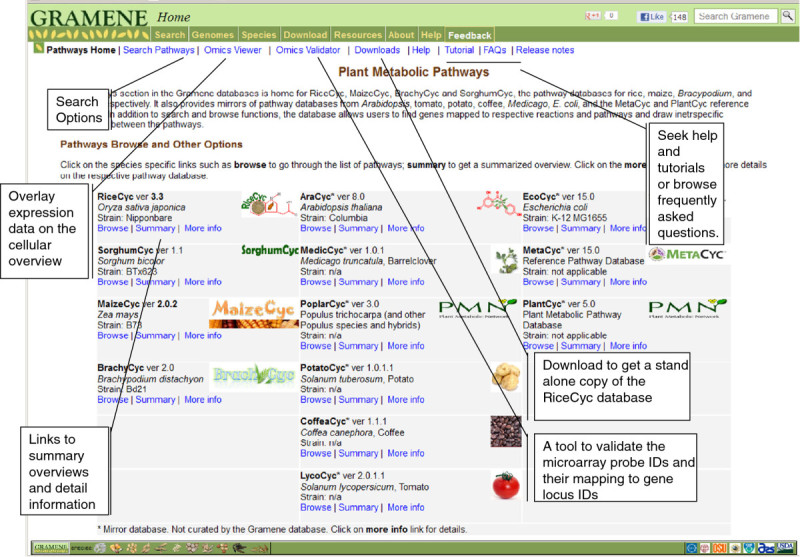
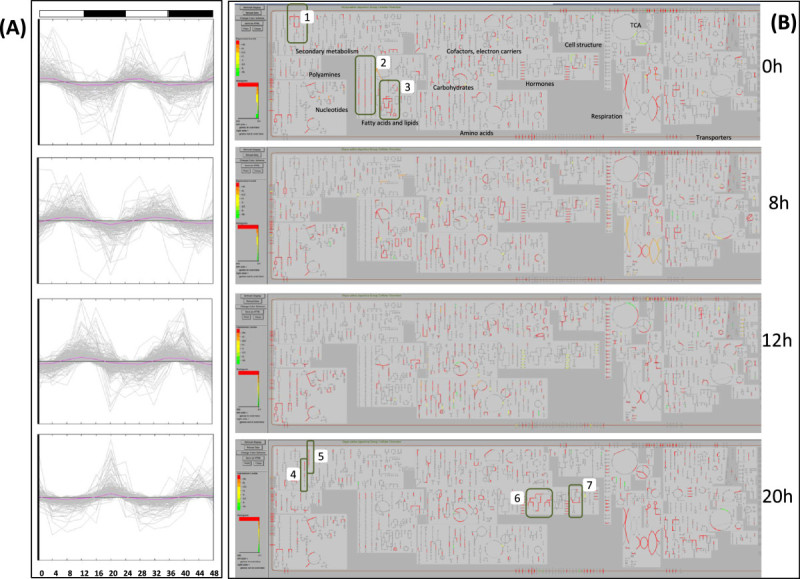
RiceCyc is a metabolic pathway networks database for rice. It is a snapshot of the substrates, metabolites, enzymes, reactions and pathways of primary and intermediary metabolism in rice. RiceCyc version 3.3 features 316 pathways and 6,643 peptide-coding genes mapped to 2,103 enzyme-catalyzed and 87 protein-mediated transport reactions. The initial functional annotations of rice genes with InterPro, Gene Ontology, MetaCyc, and Enzyme Commission (EC) numbers were enriched with annotations provided by KEGG and Gramene databases. The pathway inferences and the network diagrams were first predicted based on MetaCyc reference networks and plant pathways from the Plant Metabolic Network, using the Pathologic module of Pathway Tools. This was enriched by manually adding metabolic pathways and gene functions specifically reported for rice. The RiceCyc database is hierarchically browsable from pathway diagrams to the associated genes, metabolites and chemical structures. Through the integrated tool OMICs Viewer, users can upload transcriptomic, proteomic and metabolomic data to visualize expression patterns in a virtual cell. RiceCyc, along with additional species-specific pathway databases hosted in the Gramene project, facilitates comparative pathway analysis.
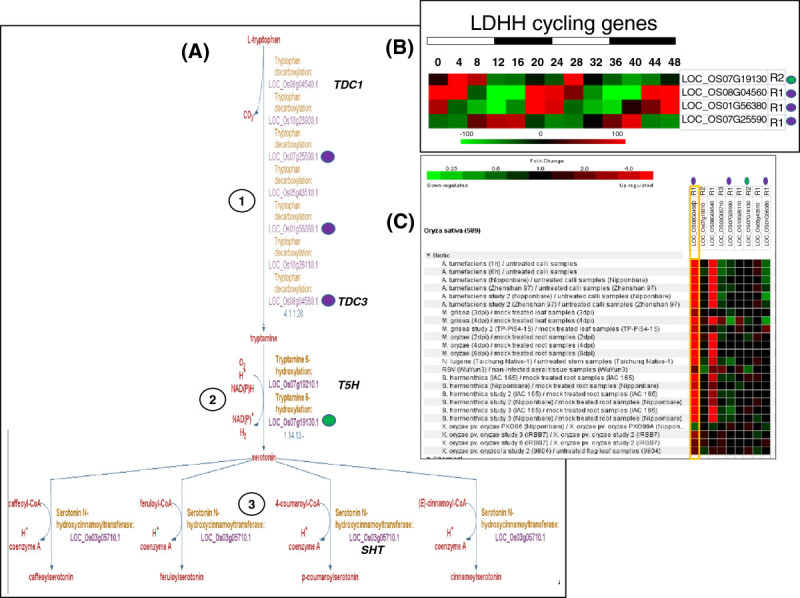
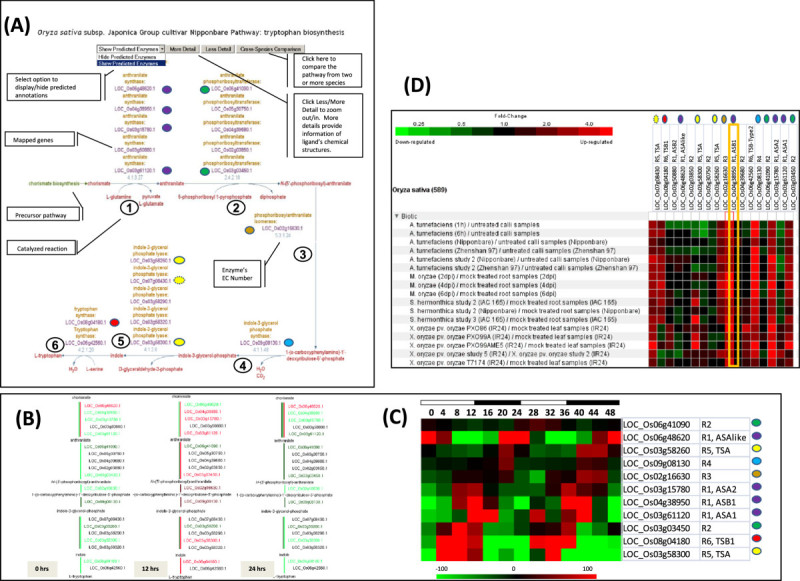
Here we describe the RiceCyc network development and discuss its contribution to rice genome annotations. As a case study to demonstrate the use of RiceCyc network as a discovery environment we carried out an integrated bioinformatic analysis of rice metabolic genes that are differentially regulated under diurnal photoperiod and biotic stress treatments. The analysis of publicly available rice transcriptome datasets led to the hypothesis that the complete tryptophan biosynthesis and its dependent metabolic pathways including serotonin biosynthesis are induced by taxonomically diverse pathogens while also being under diurnal regulation. The RiceCyc database is available online for free access at http://www.gramene.org/pathway/.
大型植物基因组项目的功能注释主要提供基于蛋白质结构域和基因同源性的基因功能和基因家族信息,但不一定与基因表达或代谢和调控网络相关。这些额外的注释对于理解植物的生理学、发育和适应及其与环境的相互作用是必要的。
RiceCyc 是一个水稻代谢途径网络数据库。它是水稻初级和中间代谢物的底物、代谢物、酶、反应和途径的快照。RiceCyc 版本 3.3 包含 316 条途径和 6643 个编码肽的基因,映射到 2103 个酶催化和 87 个蛋白介导的运输反应。通过 KEGG 和 Gramene 数据库提供的注释,丰富了初始功能注释,包括 InterPro、GO、MetaCyc 和 EC 编号的水稻基因。基于 MetaCyc 参考网络和 Plant Metabolic Network 中的植物途径,使用 Pathway Tools 的 Pathologic 模块,首次预测了途径推断和网络图。通过手动添加专门针对水稻的代谢途径和基因功能进行了丰富。RiceCyc 数据库可以从途径图到相关基因、代谢物和化学结构进行层次浏览。通过集成的 OMICs Viewer 工具,用户可以上传转录组、蛋白质组和代谢组数据,以可视化虚拟细胞中的表达模式。RiceCyc 以及 Gramene 项目中托管的其他物种特异性途径数据库,促进了比较途径分析。
在这里,我们描述了 RiceCyc 网络的开发,并讨论了它对水稻基因组注释的贡献。作为一个案例研究,我们进行了水稻代谢基因的综合生物信息学分析,这些基因在昼夜光周期和生物胁迫处理下差异调节。对公开可用的水稻转录组数据集的分析导致了这样的假设,即完整的色氨酸生物合成及其依赖的代谢途径,包括血清素生物合成,被分类上不同的病原体诱导,同时也受到昼夜调节。RiceCyc 数据库可免费在线访问,网址为 http://www.gramene.org/pathway/。