School of Agriculture, Food and Wine, Waite Research Institute, The University of Adelaide, Glen Osmond SA 5064, Australia.
BMC Plant Biol. 2013 Nov 28;13:191. doi: 10.1186/1471-2229-13-191.
Climacteric fruit exhibit high ethylene and respiration levels during ripening but these levels are limited in non-climacteric fruit. Even though capsicum is in the same family as the well-characterised climacteric tomato (Solanaceae), it is non-climacteric and does not ripen normally in response to ethylene or if harvested when mature green. However, ripening progresses normally in capsicum fruit when they are harvested during or after what is called the 'Breaker stage'. Whether ethylene, and components of the ethylene pathway such as 1-aminocyclopropane 1-carboxylate (ACC) oxidase (ACO), ACC synthase (ACS) and the ethylene receptor (ETR), contribute to non-climacteric ripening in capsicum has not been studied in detail. To elucidate the behaviour of ethylene pathway components in capsicum during ripening, further analysis is therefore needed. The effects of ethylene or inhibitors of ethylene perception, such as 1-methylcyclopropene, on capsicum fruit ripening and the ethylene pathway components may also shed some light on the role of ethylene in non-climacteric ripening.
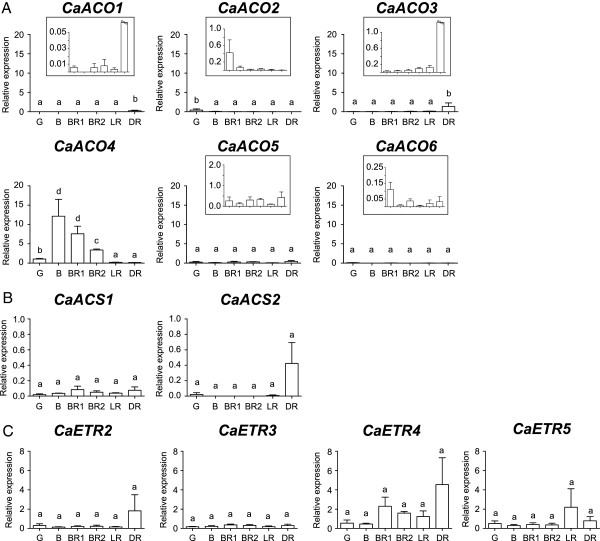
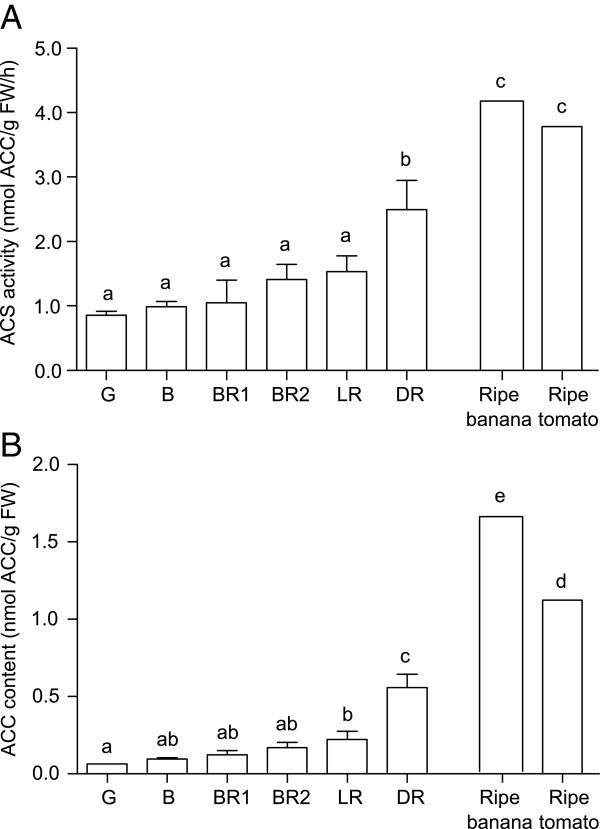
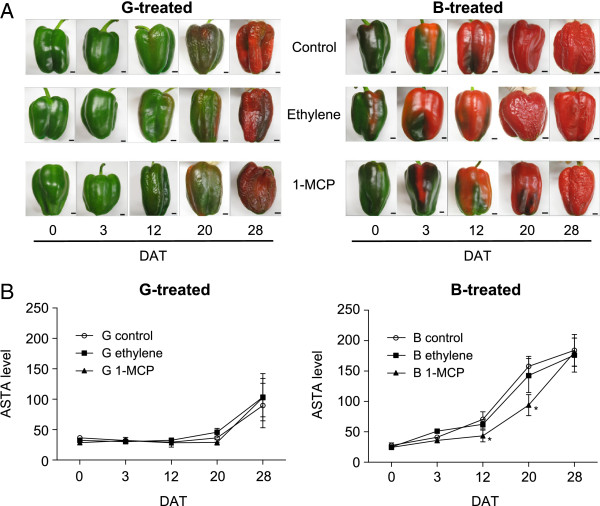
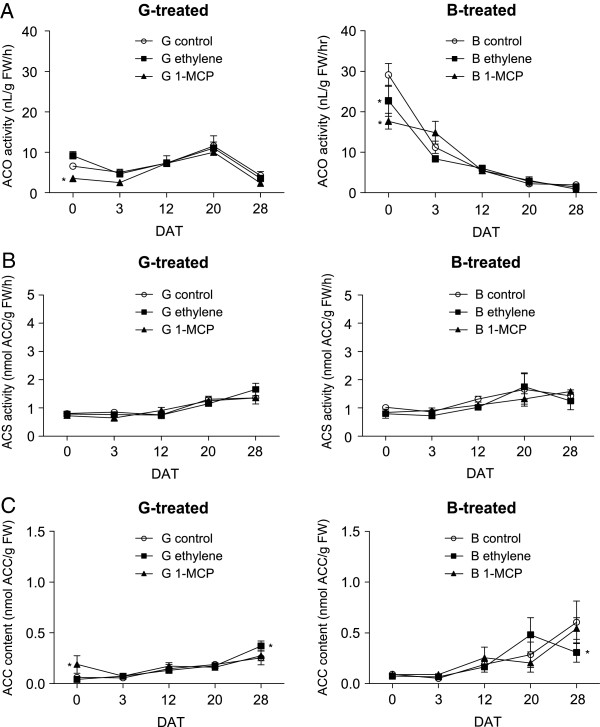
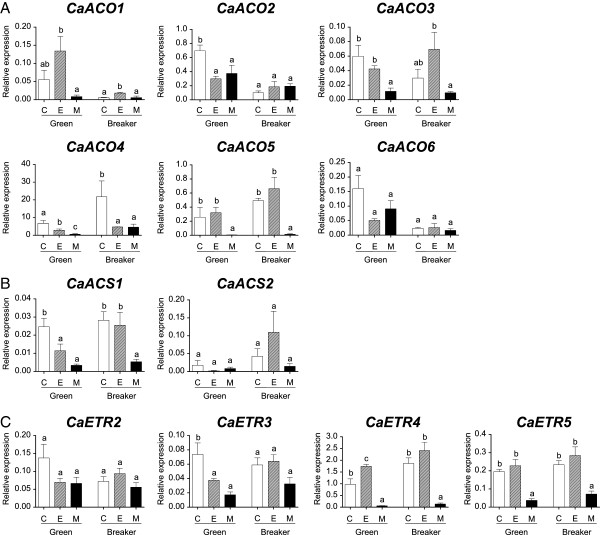
The expression of several isoforms of ACO, ACS and ETR were limited during capsicum ripening except one ACO isoform (CaACO4). ACS activity and ACC content were also low in capsicum despite the increase in ACO activity during the onset of ripening. Ethylene did not stimulate capsicum ripening but 1-methylcyclopropene treatment delayed the ripening of Breaker-harvested fruit. Some of the ACO, ACS and ETR isoforms were also differentially expressed upon treatment with ethylene or 1-methylcyclopropene.
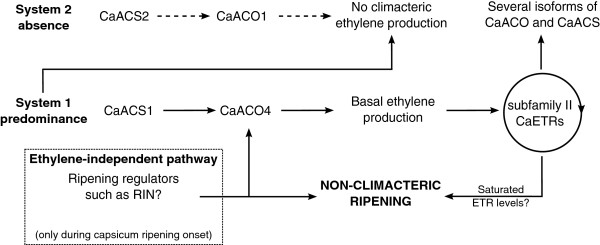
ACS activity may be the rate limiting step in the ethylene pathway of capsicum which restricts ACC content. The differential expression of several ethylene pathway components during ripening and upon ethylene or 1-methylclopropene treatment suggests that the ethylene pathway may be regulated differently in non-climacteric capsicum compared to the climacteric tomato. Ethylene independent pathways may also exist in non-climacteric ripening as evidenced by the up-regulation of CaACO4 during ripening onset despite being negatively regulated by ethylene exposure. However, some level of ethylene perception may still be needed to induce ripening especially during the Breaker stage. A model of capsicum ripening is also presented to illustrate the probable role of ethylene in this non-climacteric fruit.
在成熟过程中,更年期果实表现出高乙烯和呼吸水平,但这些水平在非更年期果实中受到限制。尽管辣椒与特征明显的更年期番茄(茄科)同属一科,但它是非更年期的,如果在成熟绿色时用乙烯或收获时不能正常成熟。然而,当它们在所谓的“破色期”期间或之后收获时,辣椒果实的成熟过程会正常进行。乙烯以及乙烯途径的组成部分,如 1-氨基环丙烷 1-羧酸(ACC)氧化酶(ACO)、ACC 合酶(ACS)和乙烯受体(ETR),是否有助于辣椒的非更年期成熟,尚未进行详细研究。因此,需要进一步分析来阐明乙烯途径成分在辣椒成熟过程中的行为。乙烯或乙烯感知抑制剂(如 1-甲基环丙烯)对辣椒果实成熟和乙烯途径成分的影响,也可能揭示乙烯在非更年期成熟中的作用。
除了一种 ACO 同工型(CaACO4)外,几种 ACS、ACO 和 ETR 的同工型在辣椒成熟过程中的表达受到限制。尽管在成熟开始时 ACO 活性增加,但 ACS 活性和 ACC 含量在辣椒中也很低。乙烯不会刺激辣椒成熟,但 1-甲基环丙烯处理会延迟破色期收获果实的成熟。乙烯或 1-甲基环丙烯处理也会导致一些 ACO、ACS 和 ETR 同工型的差异表达。
ACS 活性可能是限制辣椒乙烯途径中 ACC 含量的限速步骤。在成熟过程中以及在乙烯或 1-甲基环丙烯处理时,几种乙烯途径成分的差异表达表明,与更年期番茄相比,非更年期辣椒的乙烯途径可能受到不同的调控。非更年期成熟过程中可能也存在乙烯独立途径,因为尽管受到乙烯暴露的负调控,但 CaACO4 在成熟开始时的上调表明了这一点。然而,在 Breaker 阶段,特别是在这个阶段,可能仍然需要一定程度的乙烯感知来诱导成熟。还提出了一个辣椒成熟模型,以说明乙烯在这种非更年期果实中的可能作用。