Arthritis Res Ther. 2013 Oct 20;15(5):R155. doi: 10.1186/ar4338.
Myeloid dendritic cells (mDCs) are potent T cell-activating antigen-presenting cells that have been suggested to play a crucial role in the regulation of immune responses in many disease states, including rheumatoid arthritis (RA). Despite this, studies that have reported on the capacity of naturally occurring circulating mDCs to regulate T cell activation in RA are still lacking. This study aimed to evaluate the phenotypic and functional properties of naturally occurring CD1c (BDCA-1)+ mDCs from synovial fluid (SF) compared to those from peripheral blood (PB) of RA patients.
CD1c+ mDC numbers and expression of costimulatory molecules were assessed by fluorescence-activated cell sorting (FACS) analysis in SF and PB from RA patients. Ex vivo secretion of 45 inflammatory mediators by mDCs from SF and PB of RA patients was determined by multiplex immunoassay. The capacity of mDCs from SF to activate autologous CD4+ T cells was measured.
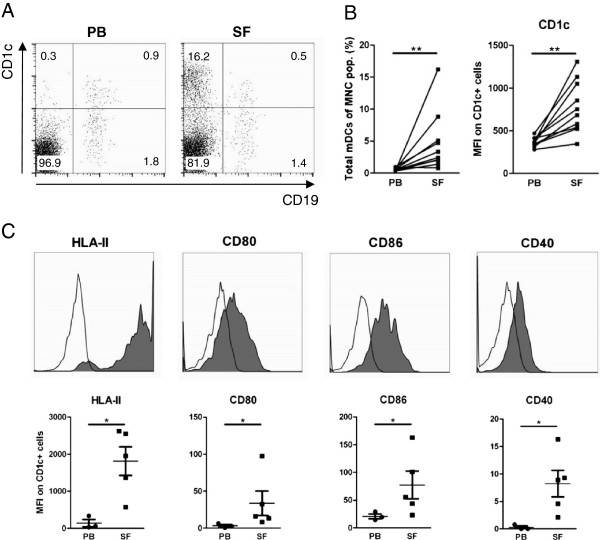
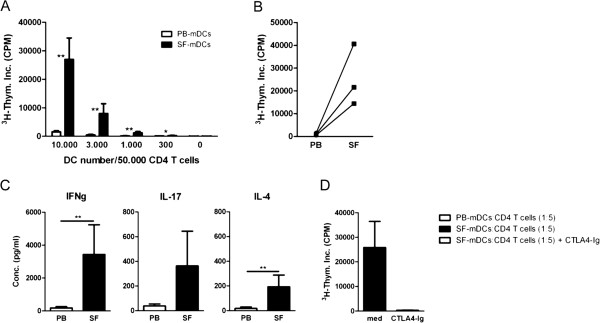
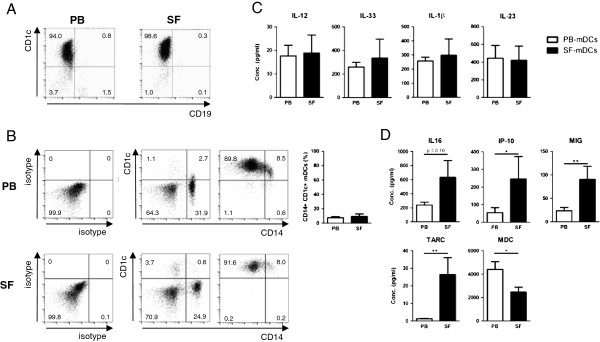
CD1c+ mDC numbers were significantly increased in SF versus PB of RA patients (mean 4.7% vs. 0.6%). mDCs from SF showed increased expression of antigen-presenting (human leukocyte antigen (HLA) class II, CD1c) and costimulatory molecules (CD80, CD86 and CD40). Numerous cytokines were equally abundantly produced by mDCs from both PB and SF (including IL-12, IL-23, IL-13, IL-21). SF mDCs secreted higher levels of interferon γ-inducible protein-10 (IP-10), monokine induced by interferon γ (MIG) and, thymus and activation-regulated chemokine (TARC), but lower macrophage-derived chemokine (MDC) levels compared to mDCs from PB. mDCs from SF displayed a strongly increased capacity to induce proliferation of CD4+ T cells associated with a strongly augmented IFNγ, IL-17, and IL-4 production.
This study suggests that increased numbers of CD1c+ mDCs in SF are involved in the inflammatory cascade intra-articularly by the secretion of specific T cell-attracting chemokines and the activation of self-reactive T cells.
髓系树突状细胞(mDC)是一种强大的 T 细胞激活抗原呈递细胞,据报道,其在许多疾病状态下的免疫反应调节中发挥着至关重要的作用,包括类风湿关节炎(RA)。尽管如此,目前仍缺乏关于滑膜液(SF)中天然存在的循环 mDC 调节 RA 中 T 细胞活化能力的研究报告。本研究旨在评估 SF 与 RA 患者外周血(PB)中天然存在的 CD1c(BDCA-1)+ mDC 的表型和功能特性。
通过流式细胞术(FACS)分析评估 SF 和 RA 患者 PB 中 CD1c+mDC 的数量和共刺激分子的表达。通过多重免疫分析测定 RA 患者 SF 和 PB 中 mDC 体外分泌的 45 种炎症介质。测量 SF 中 mDC 激活自体 CD4+T 细胞的能力。
RA 患者 SF 中 CD1c+mDC 的数量明显高于 PB(平均 4.7% vs. 0.6%)。SF 中的 mDC 表达增加了抗原呈递(人类白细胞抗原(HLA)II 类、CD1c)和共刺激分子(CD80、CD86 和 CD40)。mDC 从 PB 和 SF 中同样大量产生各种细胞因子(包括 IL-12、IL-23、IL-13、IL-21)。SF mDC 分泌的干扰素 γ 诱导蛋白-10(IP-10)、干扰素 γ 诱导的单核细胞趋化因子(MIG)和胸腺激活调节趋化因子(TARC)水平较高,但巨噬细胞衍生趋化因子(MDC)水平较低与 PB 中的 mDC 相比。SF 中的 mDC 显示出强烈增加的诱导 CD4+T 细胞增殖的能力,与强烈增强的 IFNγ、IL-17 和 IL-4 产生相关。
本研究表明,SF 中 CD1c+ mDC 的数量增加,通过分泌特定的 T 细胞吸引趋化因子和激活自身反应性 T 细胞,在关节内参与炎症级联反应。