Faculty of Medicine, Dentistry and Health Sciences, University of Western Australia, 35 Stirling Hwy, Crawley, WA 6009, Australia.
BMC Med Educ. 2013 Nov 29;13:155. doi: 10.1186/1472-6920-13-155.
Entry from secondary school to Australian and New Zealand undergraduate medical schools has since the late 1990's increasingly relied on the Undergraduate Medicine and Health Sciences Admission Test (UMAT) as one of the selection factors. The UMAT consists of 3 sections - logical reasoning and problem solving (UMAT-1), understanding people (UMAT-2) and non-verbal reasoning (UMAT-3). One of the goals of using this test has been to enhance equity in the selection of students with the anticipation of an increase in the socioeconomic diversity in student cohorts. However there has been limited assessment as to whether UMAT performance itself might be influenced by socioeconomic background.
Between 2000 and 2012, 158,909 UMAT assessments were completed. From these, 118,085 cases have been identified where an Australian candidate was sitting for the first time during that period. Predictors of the total UMAT score, UMAT-1, UMAT-2 and UMAT-3 scores were entered into regression models and included gender, age, school type, language used at home, deciles for the Index of Relative Socioeconomic Advantage and Disadvantage score, the Accessibility/Remoteness Index of Australia (ARIA), self-identification as being of Aboriginal or Torres Strait Islander origin (ATSI) and current Australian state or territory of abode.
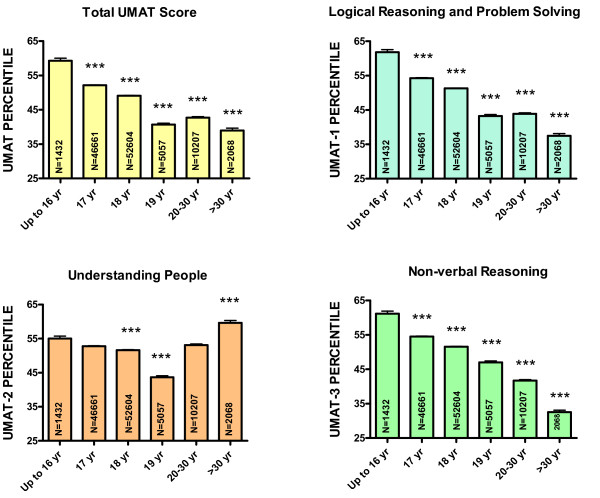
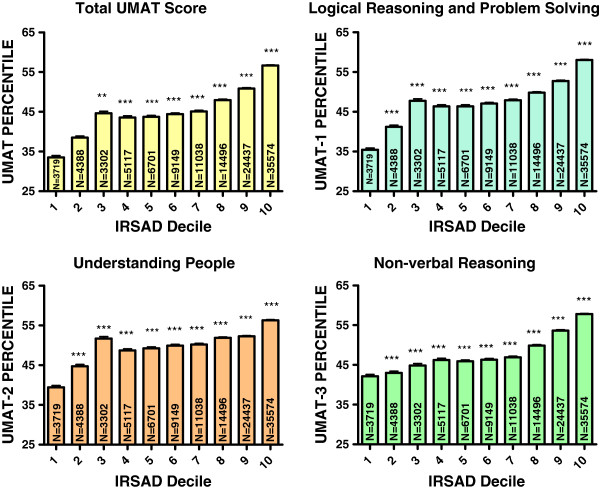
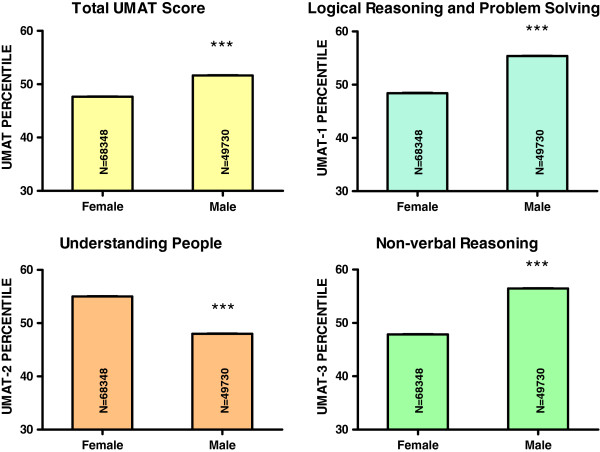
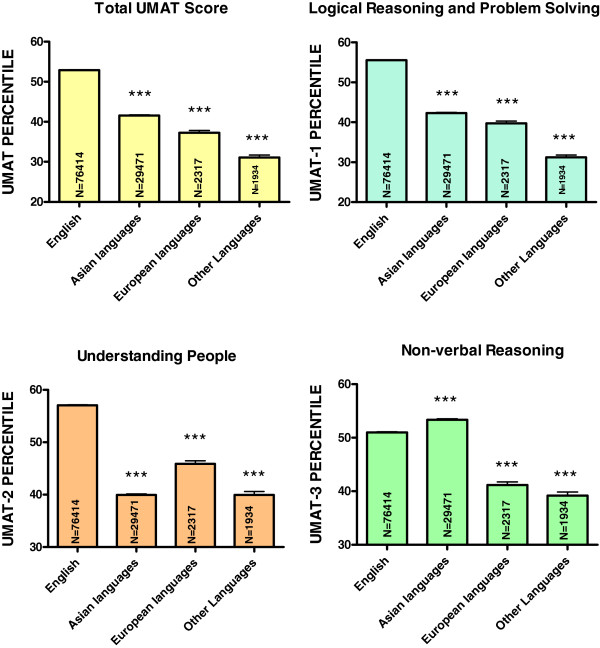
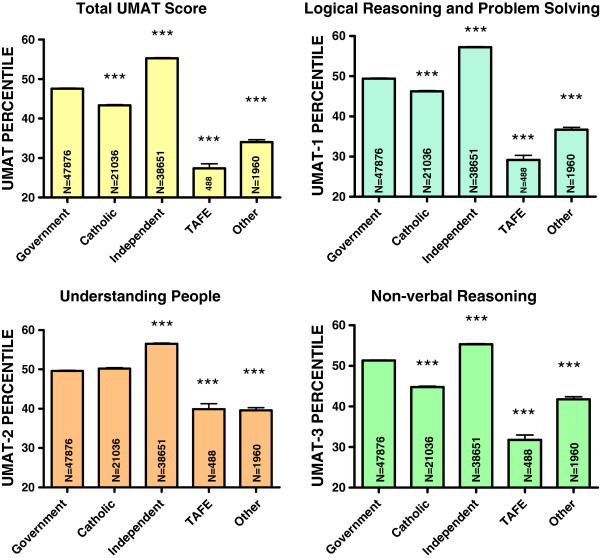
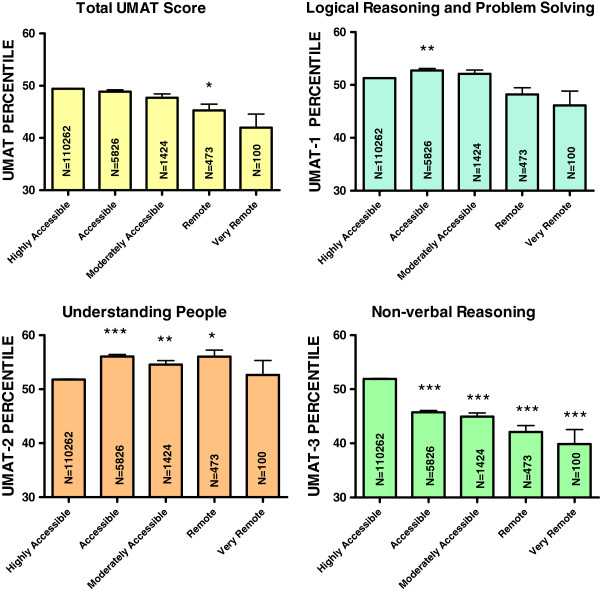
A lower UMAT score was predicted by living in an area of relatively higher social disadvantage and lower social advantage. Other socioeconomic indicators were consistent with this observation with lower scores in those who self-identified as being of ATSI origin and higher scores evident in those from fee-paying independent school backgrounds compared to government schools. Lower scores were seen with increasing age, female gender and speaking any language other than English at home. Divergent effects of rurality were observed, with increased scores for UMAT-1 and UMAT-2, but decreasing UMAT-3 scores with increasing ARIA score. Significant state-based differences largely reflected substantial socio-demographic differences across Australian states and territories.
Better performance by Australian candidates in the UMAT is linked to an increase in socio-economic advantage and reduced disadvantage.This observation provides a firm foundation for selection processes at medical schools in Australia that have incorporated affirmative action pathways to quarantine places for students from areas of socio-economic disadvantage.
自 20 世纪 90 年代末以来,澳大利亚和新西兰本科医学院的入学途径越来越依赖于本科医学和健康科学入学考试(UMAT)作为选拔因素之一。UMAT 由 3 个部分组成——逻辑推理和解决问题(UMAT-1)、了解他人(UMAT-2)和非语言推理(UMAT-3)。使用该考试的目标之一是提高学生群体的社会经济多样性,从而增强选拔的公平性。然而,对于 UMAT 成绩本身是否可能受到社会经济背景的影响,评估的范围有限。
在 2000 年至 2012 年间,完成了 158909 次 UMAT 评估。在这些评估中,有 118085 例案例是在那段时间内首次参加考试的澳大利亚考生。将总 UMAT 分数、UMAT-1、UMAT-2 和 UMAT-3 分数的预测因子输入回归模型,其中包括性别、年龄、学校类型、家庭使用的语言、相对社会经济优势和劣势指数的十分位数、澳大利亚可及性/偏远指数 (ARIA)、自我认定为原住民或托雷斯海峡岛民(ATSI)原籍以及当前澳大利亚州或领地的住所。
居住在社会劣势相对较高且社会优势较低的地区,UMAT 分数较低。其他社会经济指标与这一观察结果一致,即自我认定为 ATIS 原籍的人分数较低,而来自付费独立学校背景的人分数较高,与政府学校相比。年龄越大、女性性别和在家中说任何其他语言而非英语,分数越低。农村地区的影响存在分歧,UMAT-1 和 UMAT-2 的分数增加,而 UMAT-3 的分数随着 ARIA 分数的增加而降低。基于州的显著差异主要反映了澳大利亚各州和领地之间存在的大量社会人口差异。
澳大利亚考生在 UMAT 中的表现更好与社会经济优势的增加和劣势的减少有关。这一观察结果为澳大利亚医学院的选拔过程提供了坚实的基础,这些过程已经纳入了平权行动途径,为来自社会经济劣势地区的学生保留了名额。