College of Life Sciences, Shangqiu Normal University, Shangqiu, Henan, China. ; College of Life Sciences, State Key Laboratory of Crop Stress Biology in Arid Areas, Northwest A & F University, Yangling, Shaanxi, China.
Braz J Microbiol. 2013 Oct 30;44(2):623-31. doi: 10.1590/S1517-83822013000200043. eCollection 2013.
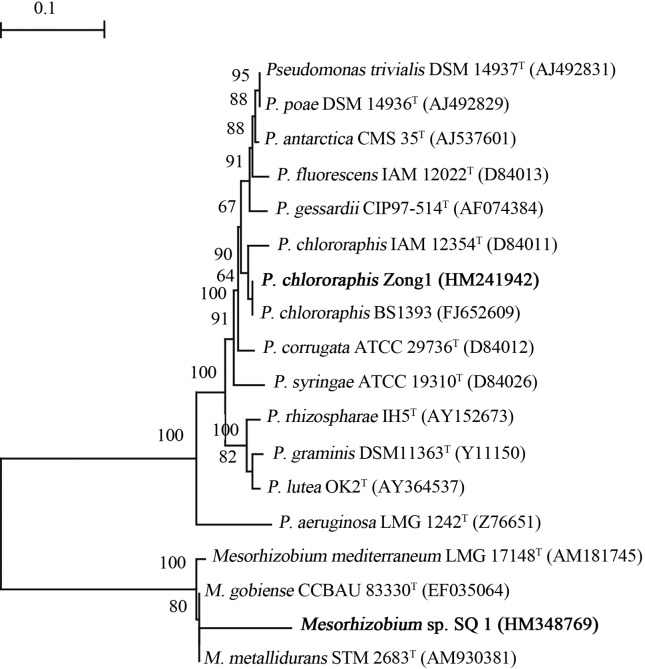
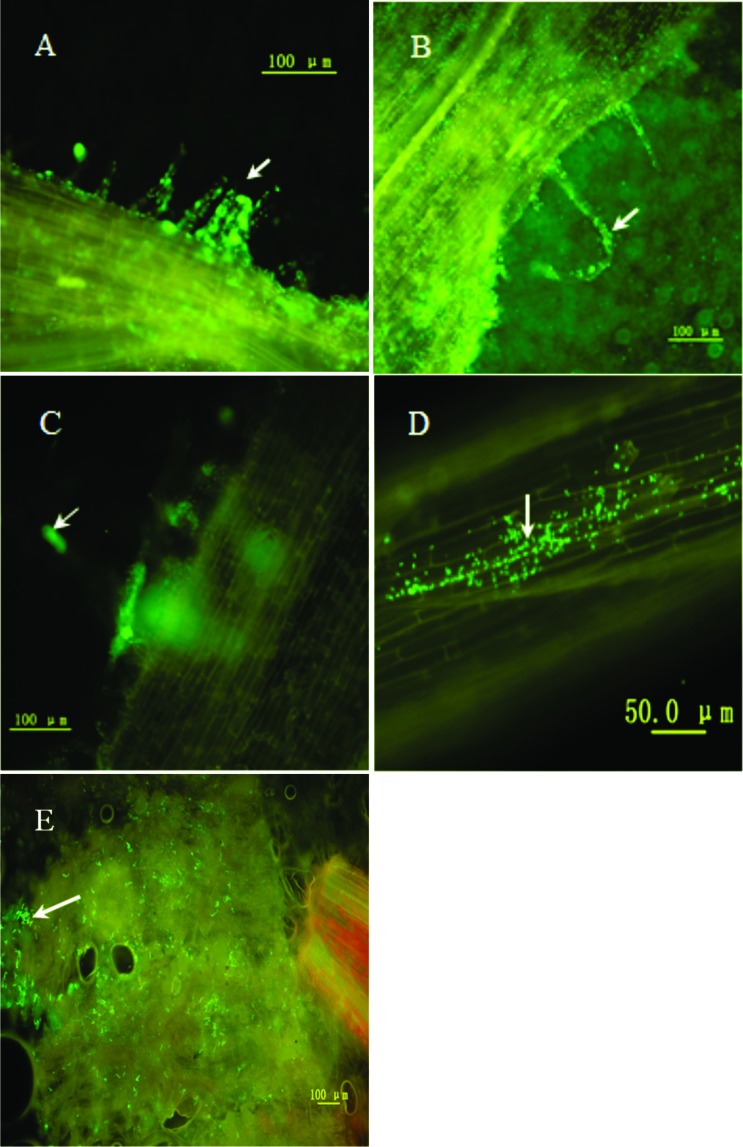
The endophytic strain Zong1 isolated from root nodules of the legume Sophora alopecuroides was characterized by conducting physiological and biochemical tests employing gfp-marking, observing their plant growth promoting characteristics (PGPC) and detecting plant growth parameters of inoculation assays under greenhouse conditions. Results showed that strain Zong1 had an effective growth at 28 ºC after placed at 4-60 ºC for 15 min, had a wide range pH tolerance of 6.0-11.0 and salt tolerance up to 5% of NaCl. Zong1 was resistant to the following antibiotics (μg/mL): Phosphonomycin (100), Penicillin (100) and Ampicillin (100). It could grow in the medium supplemented with 1.2 mmol/L Cu, 0.1% (w/v) methylene blue and 0.1-0.2% (w/v) methyl red, respectively. Zong1 is closely related to Pseudomonas chlororaphis based on analysis the sequence of 16S rRNA gene. Its expression of the gfp gene indicated that strain Zong1 may colonize in root or root nodules and verified by microscopic observation. Furthermore, co-inoculation with Zong1 and SQ1 (Mesorhizobium sp.) showed significant effects compared to single inoculation for the following PGPC parameters: siderophore production, phosphate solubilization, organic acid production, IAA production and antifungal activity in vitro. These results suggest strains P. chlororaphi Zong1 and Mesorhizobium sp. SQ1 have better synergistic or addictive effect. It was noteworthy that each growth index of co-inoculated Zong1+SQ1 in growth assays under greenhouse conditions is higher than those of single inoculation, and showed a significant difference (p < 0.05) when compared to a negative control. Therefore, as an endophyte P. chlororaphis Zong1 may play important roles as a potential plant-growth promoting agent.
从豆科植物苦参的根瘤中分离到的内生菌株 Zong1 通过 GFP 标记进行生理生化试验、观察其植物促生特性(PGPC)和检测温室条件下接种试验的植物生长参数来进行表征。结果表明,菌株 Zong1 在 28°C 下有效生长,在 4-60°C 下放置 15 分钟后,具有广泛的 pH 耐受范围(6.0-11.0)和高达 5%的 NaCl 耐盐性。Zong1 对以下抗生素(μg/mL)具有抗性:膦霉素(100)、青霉素(100)和氨苄青霉素(100)。它可以在补充 1.2 mmol/L Cu、0.1%(w/v)亚甲蓝和 0.1-0.2%(w/v)甲红的培养基中生长。根据 16S rRNA 基因序列分析,Zong1 与 Pseudomonas chlororaphis 密切相关。其 gfp 基因的表达表明,菌株 Zong1 可能在根或根瘤中定植,并通过显微镜观察得到验证。此外,与单独接种相比,Zong1 和 SQ1(Mesorhizobium sp.)共接种对以下 PGPC 参数表现出显著影响:铁载体生产、磷酸盐溶解、有机酸生产、IAA 生产和体外抗真菌活性。这些结果表明,P. chlororaphi Zong1 和 Mesorhizobium sp. SQ1 菌株具有更好的协同或增效作用。值得注意的是,温室条件下共接种 Zong1+SQ1 的每个生长指标均高于单独接种,与阴性对照相比差异显著(p<0.05)。因此,作为一种内生菌,P. chlororaphis Zong1 可能作为一种潜在的植物生长促进剂发挥重要作用。