Department of Virology, Immunobiology and Parasitology (VIP), National Veterinary Institute (SVA), Uppsala, Sweden.
Department of Infectious Diseases/Section of Clinical Virology, Institute of Biomedicine, University of Gothenburg, Gothenburg, Sweden.
J Gen Virol. 2014 Mar;95(Pt 3):557-570. doi: 10.1099/vir.0.059238-0. Epub 2013 Dec 2.
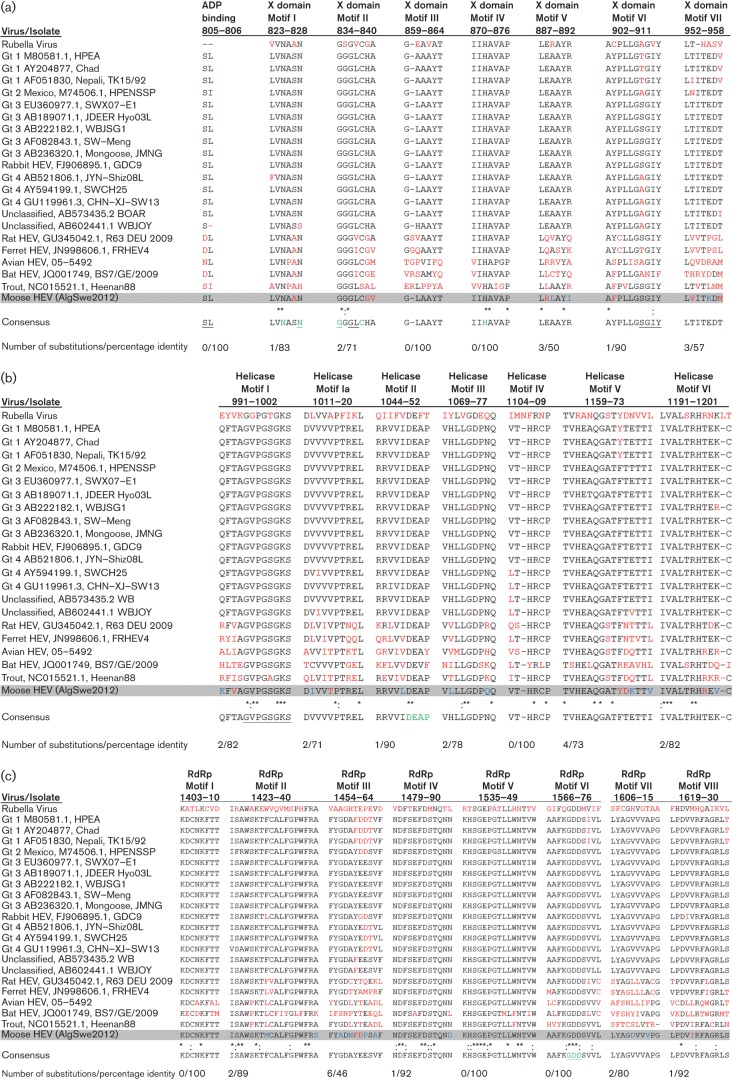
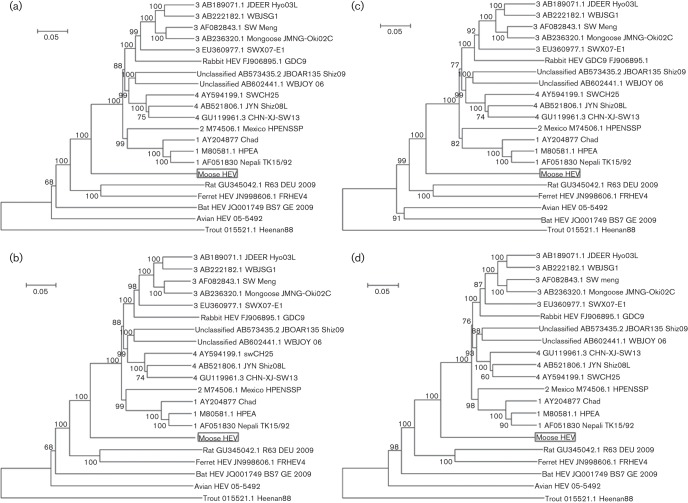
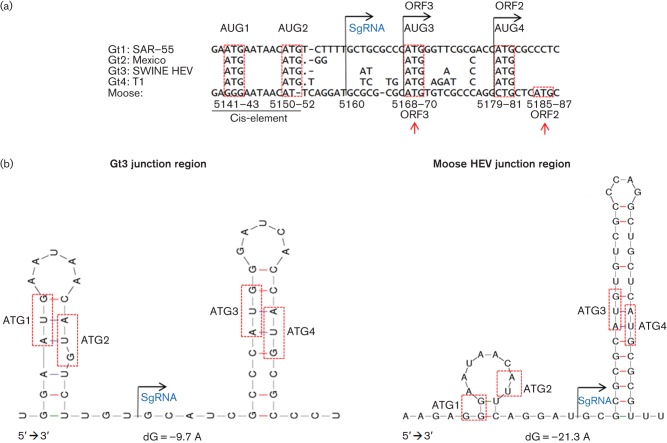
A novel virus was detected in a sample collected from a Swedish moose (Alces alces). The virus was suggested as a member of the Hepeviridae family, although it was found to be highly divergent from the known four genotypes (gt1-4) of hepatitis E virus (HEV). Moose are regularly hunted for consumption in the whole of Scandinavia. Thus, the finding of this virus may be important from several aspects: (a) as a new diverged HEV in a new animal species, and (b) potential unexplored HEV transmission pathways for human infections. Considering these aspects, we have started the molecular characterization of this virus. A 5.1 kb amplicon was sequenced, and corresponded to the partial ORF1, followed by complete ORF2, ORF3 and poly(A) sequence. In comparison with existing HEVs, the moose HEV genome showed a general nucleotide sequence similarity of 37-63% and an extensively divergent putative ORF3 sequence. The junction region between the ORFs was also highly divergent; however, two putative secondary stem-loop structures were retained when compared to gt1-4, but with altered structural appearance. In the phylogenetic analysis, the moose HEV deviated and formed its own branch between the gt1-4 and other divergent animal HEVs. The characterization of this highly divergent genome provides important information regarding the diversity of HEV infecting various mammalian species. However, further studies are needed to investigate its prevalence in the moose populations and possibly in other host species, including the risk for human infection.
一种新型病毒在从瑞典驼鹿(Alces alces)采集的样本中被检测到。该病毒被认为是肝炎病毒(HEV)科的一员,尽管它与已知的四种基因型(gt1-4)高度不同。在整个斯堪的纳维亚地区,驼鹿经常被猎捕食用。因此,这种病毒的发现可能具有几个方面的重要意义:(a)作为一种新的在新动物物种中发生分化的 HEV,以及(b)可能是人类感染的未知 HEV 传播途径。考虑到这些方面,我们已经开始对这种病毒进行分子特征描述。我们对一个 5.1kb 的扩增子进行了测序,该扩增子对应于部分 ORF1,随后是完整的 ORF2、ORF3 和 poly(A)序列。与现有的 HEV 相比,驼鹿 HEV 基因组显示出 37-63%的一般核苷酸序列相似性,以及广泛分化的假定 ORF3 序列。ORF 之间的连接区也高度分化;然而,与 gt1-4 相比,保留了两个假定的二级茎环结构,但结构外观发生了改变。在系统发育分析中,驼鹿 HEV 与 gt1-4 和其他分化的动物 HEV 之间发生分化并形成了自己的分支。该高度分化基因组的特征描述提供了有关感染各种哺乳动物物种的 HEV 多样性的重要信息。然而,还需要进一步研究来调查其在驼鹿种群中的流行情况以及可能在其他宿主物种中的流行情况,包括人类感染的风险。