Department of Neurology, University of California Irvine, Irvine, California, U.S.A.
Epilepsia. 2013 Dec;54(12):2116-24. doi: 10.1111/epi.12428. Epub 2013 Nov 8.
Neurobehavioral comorbidities are common in pediatric epilepsy with enduring adverse effects on functioning, but their neuroanatomic underpinning is unclear. Striatal and thalamic abnormalities have been associated with childhood-onset epilepsies, suggesting that epilepsy-related changes in the subcortical circuit might be associated with the comorbidities of children with epilepsy. We aimed to compare subcortical volumes and their relationship with age in children with complex partial seizures (CPS), childhood absence epilepsy (CAE), and healthy controls (HC). We examined the shared versus unique structural-functional relationships of these volumes with behavior problems, intelligence, language, peer interaction, and epilepsy variables in these two epilepsy syndromes.
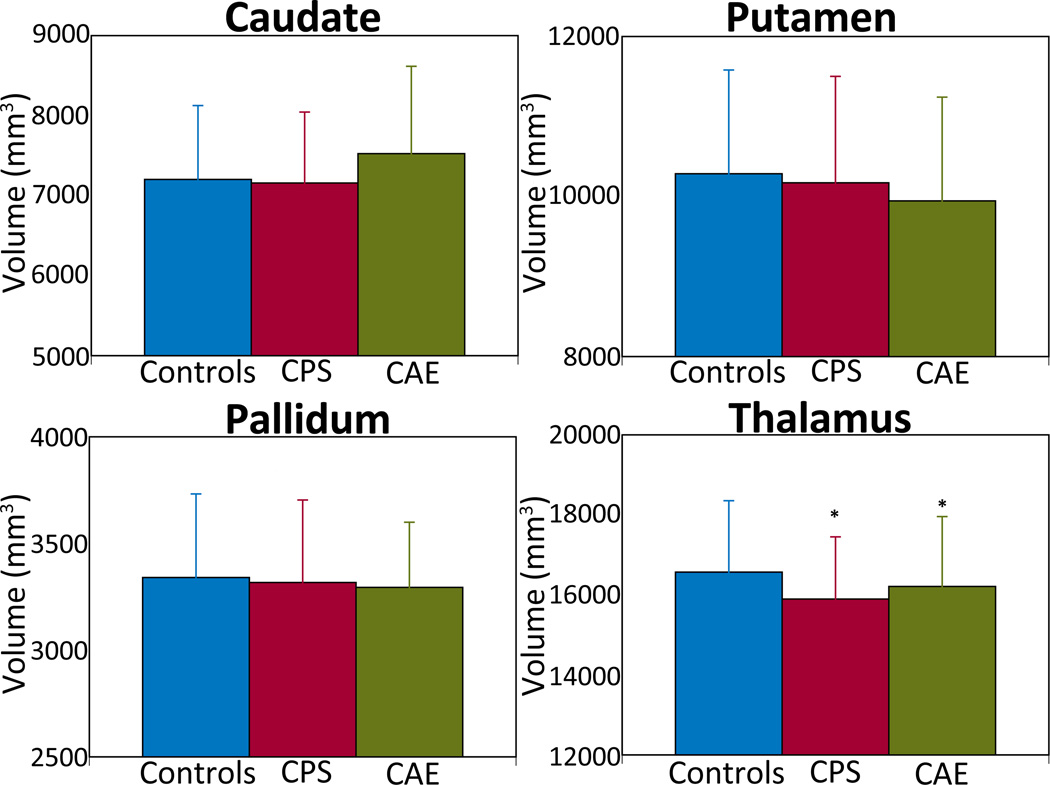
We investigated volumetric differences of caudate, putamen, pallidum, and thalamus in children with CPS (N = 21), CAE (N = 20), and HC (N = 27). Study subjects underwent structural magnetic resonance imaging (MRI), intelligence, and language testing. Parent-completed Child Behavior Checklists provided behavior problem and peer interaction scores. We examined the association of age, intelligence quotient (IQ), language, behavioral problems, and epilepsy variables with subcortical volumes that were significantly different between the children with epilepsy and HC.
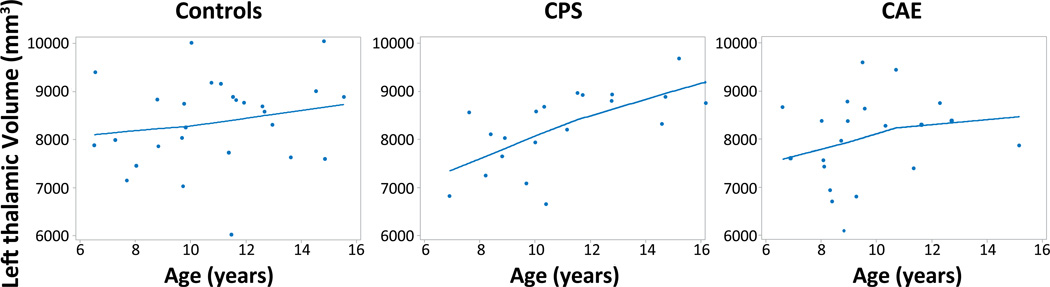
Both children with CPS and CAE exhibited significantly smaller left thalamic volume compared to HC. In terms of developmental trajectory, greater thalamic volume was significantly correlated with increasing age in children with CPS and CAE but not in HC. With regard to the comorbidities, reduced left thalamic volumes were related to more social problems in children with CPS and CAE. Smaller left thalamic volumes in children with CPS were also associated with poor attention, lower IQ and language scores, and impaired peer interaction.
Our study is the first to directly compare and detect shared thalamic structural abnormalities in children with CPS and CAE. These findings highlight the vulnerability of the thalamus and provide important new insights on its possible role in the neurobehavioral comorbidities of childhood-onset epilepsy.
神经行为合并症在小儿癫痫中很常见,对功能有持久的不良影响,但它们的神经解剖基础尚不清楚。纹状体和丘脑异常与儿童期起病的癫痫有关,这表明与皮质下回路相关的癫痫变化可能与癫痫患儿的合并症有关。我们旨在比较复杂部分性发作(CPS)、儿童失神癫痫(CAE)和健康对照组(HC)儿童的皮质下体积及其与年龄的关系。我们检查了这些体积与这两种癫痫综合征中行为问题、智力、语言、同伴互动和癫痫变量的共享和独特的结构-功能关系。
我们研究了 21 例 CPS 患儿、20 例 CAE 患儿和 27 例 HC 患儿的尾状核、壳核、苍白球和丘脑的体积差异。研究对象接受了结构磁共振成像(MRI)、智力和语言测试。父母完成的儿童行为检查表提供了行为问题和同伴互动评分。我们检查了年龄、智商(IQ)、语言、行为问题和癫痫变量与皮质下体积之间的关系,皮质下体积在癫痫患儿和 HC 之间存在显著差异。
CPS 和 CAE 患儿的左侧丘脑体积均明显小于 HC。就发育轨迹而言,CPS 和 CAE 患儿的丘脑体积与年龄呈显著正相关,但 HC 患儿则无。就合并症而言,CPS 和 CAE 患儿的左侧丘脑体积较小与更多的社会问题有关。CPS 患儿的左侧丘脑体积较小还与注意力不集中、智商和语言评分较低以及同伴互动受损有关。
我们的研究首次直接比较和检测了 CPS 和 CAE 患儿的丘脑结构异常。这些发现强调了丘脑的脆弱性,并为其在儿童期起病的癫痫的神经行为合并症中的可能作用提供了重要的新见解。