Department of Clinical Sciences, Lund University, Malmö, Sweden.
BMC Public Health. 2013 Dec 5;13:1133. doi: 10.1186/1471-2458-13-1133.
Type 2 diabetes is highly prevalent in immigrants to Sweden from Iraq, but the prevalence of cardiovascular disease (CVD) and its risk factors are not known. In this survey we aimed to compare the prevalence of CVD and CVD-associated risk factors between a population born in Iraq and individuals born in Sweden.
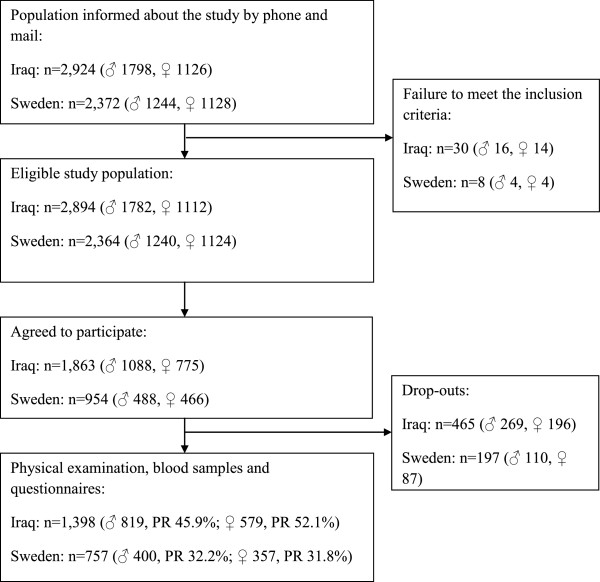
This population-based, cross-sectional study comprised 1,365 Iraqi immigrants and 739 Swedes (age 30-75 years) residing in the same socioeconomic area in Malmö, Sweden. Blood tests were performed and socio-demography and lifestyles were characterized. To investigate potential differences in CVD, odds ratios (ORs) with 95% confidence intervals (CIs) were estimated by multivariate logistic regression analysis with adjustment for metabolic, lifestyle and psychosocial risk factors for CVD. Outcome measures were odds of CVD.
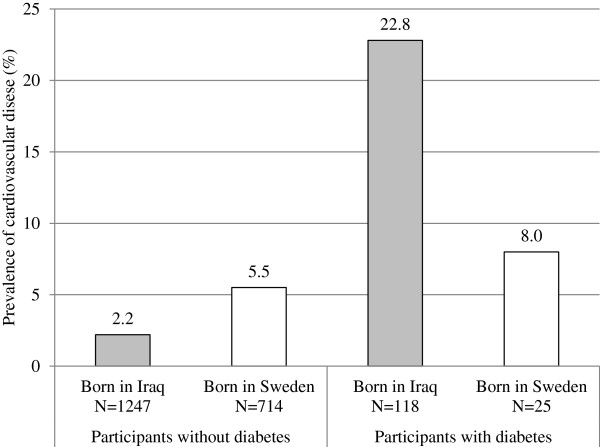
There were no differences in self-reported prevalence of CVD between Iraqi- and Swedish-born individuals (4.0 vs. 5.5%, OR 0.9, 95% CI 0.4-1.8). However, the prevalence of type 2 diabetes was higher in Iraqi compared to Swedish participants (8.4 vs. 3.3%, OR = 4.2, 95% CI 2.6-6.7). Moreover, among individuals with type 2 diabetes, Iraqis had a higher prevalence of CVD (22.8 vs. 8.0%, OR = 4.2, 95% CI 0.9-20.0), after adjustment for age and sex. By contrast, among those without diabetes, immigrants from Iraq had a lower prevalence of CVD than Swedes (2.2 vs. 5.5%, OR = 0.6, 95% CI 0.3-0.9).Type 2 diabetes was an independent risk factor for CVD in Iraqis only (OR = 6.8, 95% CI 2.8-16.2). This was confirmed by an interaction between country of birth and diabetes (p = 0.010). In addition, in Iraqis, type 2 diabetes contributed to CVD risk to a higher extent than history of hypertension (standardized OR 1.5 vs. 1.4).
This survey indicates that the odds of CVD in immigrants from Iraq are highly dependent on the presence or absence of type 2 diabetes and that type 2 diabetes contributes with higher odds of CVD in Iraqi immigrants compared to native Swedes. Our study suggests that CVD prevention in immigrants from the Middle East would benefit from prevention of type 2 diabetes.
2 型糖尿病在从伊拉克移民到瑞典的人群中高度流行,但心血管疾病(CVD)及其危险因素的流行情况尚不清楚。在这项调查中,我们旨在比较在伊拉克出生的人群和在瑞典出生的个体之间 CVD 及相关危险因素的患病率。
这是一项基于人群的横断面研究,共纳入 1365 名伊拉克移民和 739 名瑞典人(年龄 30-75 岁),他们居住在瑞典马尔默的同一社会经济区域。进行了血液检查,并描述了社会人口统计学和生活方式。为了研究 CVD 方面的潜在差异,通过多变量 logistic 回归分析估计了比值比(OR)及其 95%置信区间(CI),并对 CVD 的代谢、生活方式和心理社会危险因素进行了调整。结局指标为 CVD 的发生几率。
在自我报告的 CVD 患病率方面,伊拉克出生者和瑞典出生者之间没有差异(4.0% vs. 5.5%,OR 0.9,95%CI 0.4-1.8)。然而,与瑞典参与者相比,伊拉克参与者的 2 型糖尿病患病率更高(8.4% vs. 3.3%,OR=4.2,95%CI 2.6-6.7)。此外,在患有 2 型糖尿病的个体中,伊拉克人 CVD 的患病率更高(22.8% vs. 8.0%,OR=4.2,95%CI 0.9-20.0),调整年龄和性别后结果仍然如此。相比之下,在没有糖尿病的个体中,伊拉克移民的 CVD 患病率低于瑞典人(2.2% vs. 5.5%,OR=0.6,95%CI 0.3-0.9)。2 型糖尿病是伊拉克人 CVD 的独立危险因素(OR=6.8,95%CI 2.8-16.2)。这一结果通过出生国和糖尿病之间的交互作用得到了证实(p=0.010)。此外,在伊拉克人中,2 型糖尿病对 CVD 风险的贡献程度高于高血压病史(标准化 OR 1.5 比 1.4)。
本研究表明,来自伊拉克的移民的 CVD 发生几率高度依赖于 2 型糖尿病的存在与否,与瑞典本地人相比,2 型糖尿病使伊拉克移民的 CVD 发生几率更高。我们的研究表明,从中东移民到的 CVD 预防应侧重于预防 2 型糖尿病。