Grupo de Genómica, Proteómica y vacunas, Instituto de Investigación y Formación Marqués de Valdecilla (IFIMAV), Primera Planta-Laboratorio 124, Avda. de Cardenal Herrera Oria, s/n, 39011, Santander, Spain.
Glia. 2014 Feb;62(2):233-46. doi: 10.1002/glia.22602. Epub 2013 Dec 6.
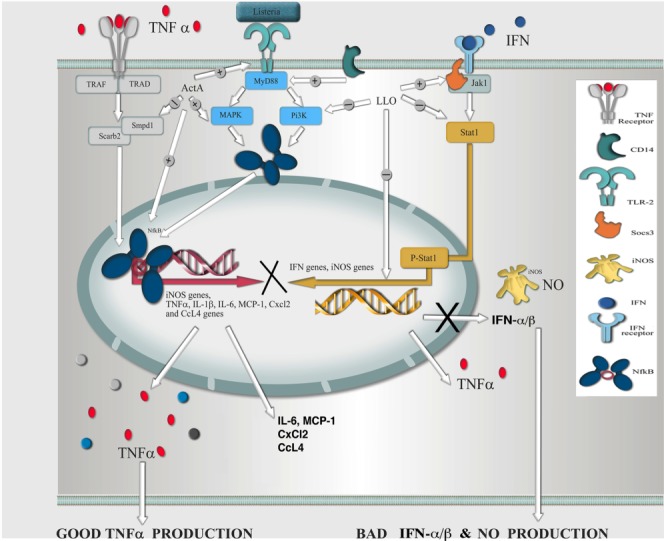
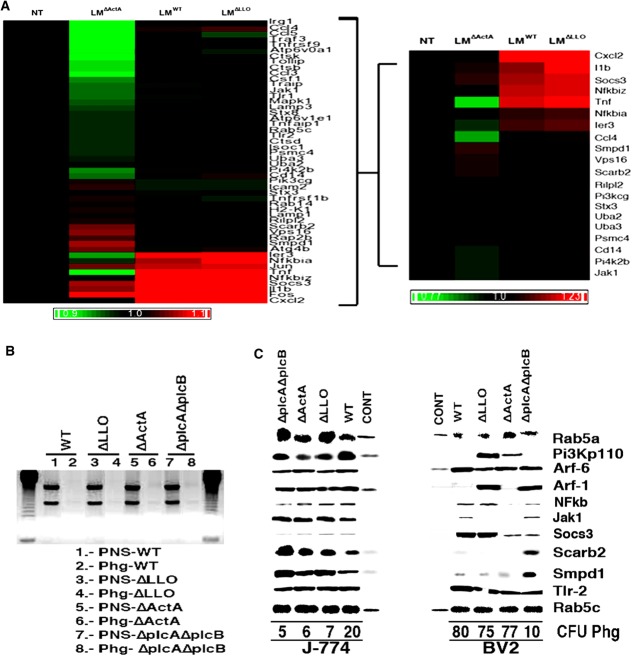
Microglia, the innate immune cells of the brain, plays a central role in cerebral listeriosis. Here, we present evidence that microglia control Listeria infection differently than macrophages. Infection of primary microglial cultures and murine cell lines with Listeria resulted in a dual function of the two gene expression programmes involved in early and late immune responses in macrophages. Whereas the bacterial gene hly seems responsible for both transcriptional programmes in macrophages, Listeria induces in microglia only the tumor necrosis factor (TNF)-regulated transcriptional programme. Listeria also represses in microglia the late immune response gathered in two clusters, microbial degradation, and interferon (IFN)-inducible genes. The bacterial gene actA was required in microglia to induce TNF-regulated responses and to repress the late response. Isolation of microglial phagosomes revealed a phagosomal environment unable to destroy Listeria. Microglial phagosomes were also defective in several signaling and trafficking components reported as relevant for Listeria innate immune responses. This transcriptional strategy in microglia induced high levels of TNF-α and monocyte chemotactic protein-1 and low production of other neurotoxic compounds such as nitric oxide, hydrogen peroxide, and Type I IFNs. These cytokines and toxic microglial products are also released by primary microglia, and this cytokine and chemokine cocktail display a low potential to trigger neuronal apoptosis. This overall bacterial strategy strongly suggests that microglia limit Listeria inflammation pattern exclusively through TNF-mediated responses to preserve brain integrity.
小胶质细胞是大脑中的固有免疫细胞,在大脑李斯特菌病中发挥核心作用。在这里,我们提供的证据表明,小胶质细胞控制李斯特菌感染的方式与巨噬细胞不同。李斯特菌感染原代小胶质细胞培养物和鼠细胞系,导致涉及巨噬细胞中早期和晚期免疫反应的两个基因表达程序的双重功能。虽然细菌基因 hly 似乎负责巨噬细胞中这两个转录程序,但李斯特菌仅在小胶质细胞中诱导肿瘤坏死因子 (TNF) 调节的转录程序。李斯特菌还在小胶质细胞中抑制聚集在两个簇中的晚期免疫反应,即微生物降解和干扰素 (IFN)-诱导基因。细菌基因 actA 在小胶质细胞中被要求诱导 TNF 调节的反应并抑制晚期反应。小胶质细胞吞噬体的分离揭示了一种不能破坏李斯特菌的吞噬体环境。小胶质细胞吞噬体在几个信号转导和运输成分中也存在缺陷,这些成分被报道与李斯特菌先天免疫反应有关。这种小胶质细胞中的转录策略诱导高水平的 TNF-α 和单核细胞趋化蛋白-1,而低产生其他神经毒性化合物,如一氧化氮、过氧化氢和 I 型 IFN。这些细胞因子和趋化因子鸡尾酒也由原代小胶质细胞释放,这种细胞因子和趋化因子鸡尾酒显示出触发神经元凋亡的低潜力。这种整体细菌策略强烈表明,小胶质细胞通过 TNF 介导的反应来限制李斯特菌炎症模式,以保护大脑完整性。