Nguyen Hau B, Hung Li-Wei, Yeates Todd O, Terwilliger Thomas C, Waldo Geoffrey S
Bioscience Division, Los Alamos National Laboratory, MS M888, Los Alamos, NM 87545, USA.
Acta Crystallogr D Biol Crystallogr. 2013 Dec;69(Pt 12):2513-23. doi: 10.1107/S0907444913024608. Epub 2013 Nov 19.
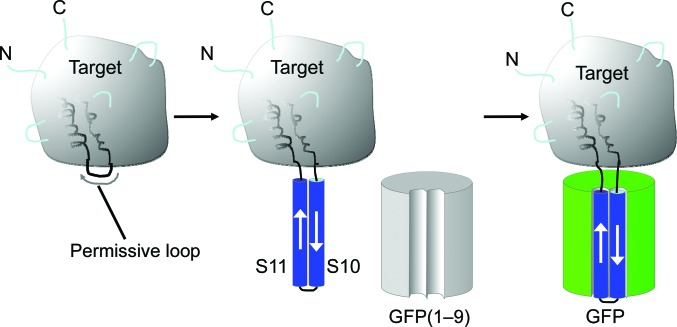
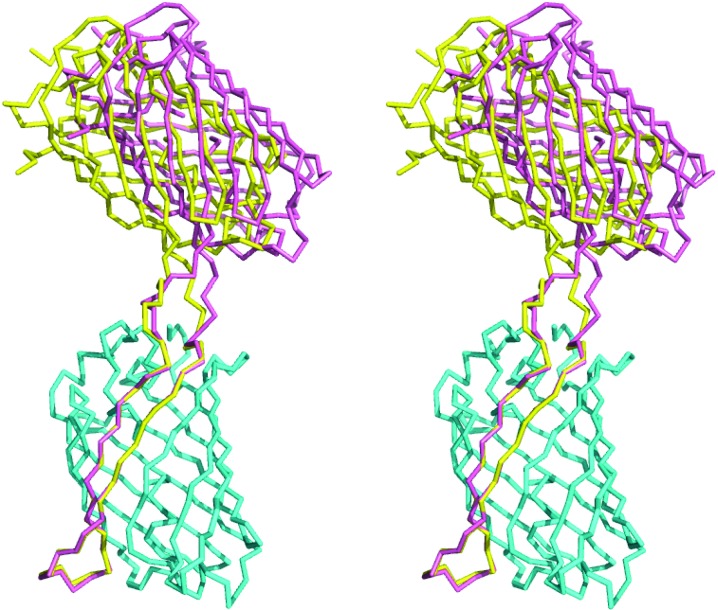
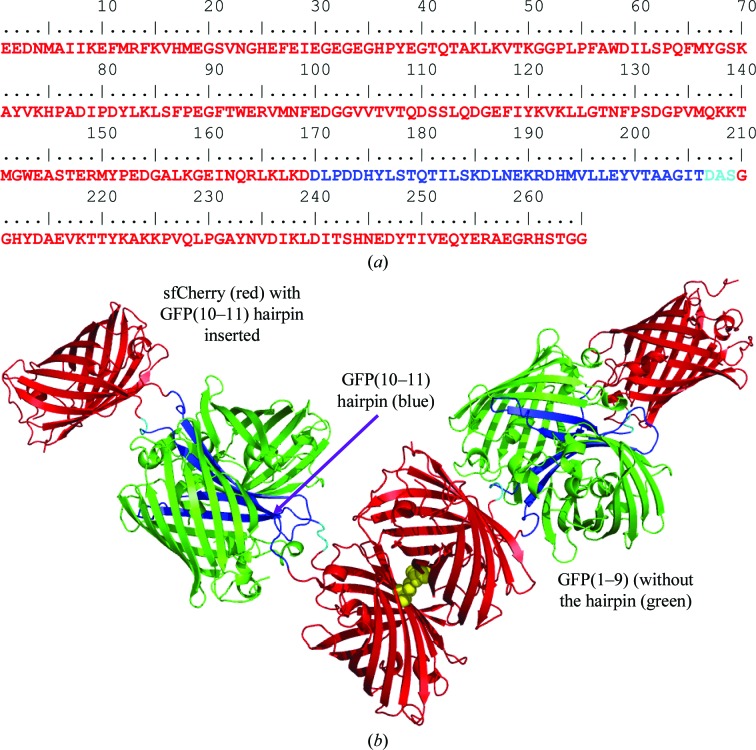
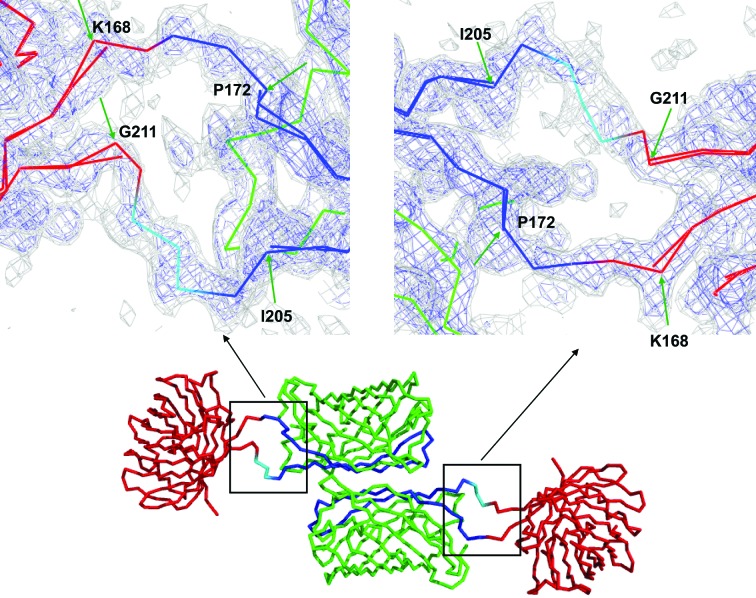
A modular strategy for protein crystallization using split green fluorescent protein (GFP) as a crystallization partner is demonstrated. Insertion of a hairpin containing GFP β-strands 10 and 11 into a surface loop of a target protein provides two chain crossings between the target and the reconstituted GFP compared with the single connection afforded by terminal GFP fusions. This strategy was tested by inserting this hairpin into a loop of another fluorescent protein, sfCherry. The crystal structure of the sfCherry-GFP(10-11) hairpin in complex with GFP(1-9) was determined at a resolution of 2.6 Å. Analysis of the complex shows that the reconstituted GFP is attached to the target protein (sfCherry) in a structurally ordered way. This work opens the way to rapidly creating crystallization variants by reconstituting a target protein bearing the GFP(10-11) hairpin with a variety of GFP(1-9) mutants engineered for favorable crystallization.
展示了一种使用分裂型绿色荧光蛋白(GFP)作为结晶伴侣进行蛋白质结晶的模块化策略。将包含GFPβ链10和11的发夹插入目标蛋白的表面环中,与末端GFP融合提供的单一连接相比,在目标蛋白和重组GFP之间提供了两个链交叉点。通过将该发夹插入另一种荧光蛋白sfCherry的环中来测试该策略。测定了与GFP(1-9)复合的sfCherry-GFP(10-11)发夹的晶体结构,分辨率为2.6Å。对复合物的分析表明,重组的GFP以结构有序的方式附着在目标蛋白(sfCherry)上。这项工作为通过将带有GFP(10-11)发夹的目标蛋白与为有利于结晶而设计的各种GFP(1-9)突变体重组来快速创建结晶变体开辟了道路。