Umeano Odera, Phillips-Bute Barbara, Hailey Claire E, Sun Wei, Gray Marisa C, Roulhac-Wilson Briana, McDonagh David L, Kranz Peter G, Laskowitz Daniel T, James Michael L
School of Medicine, Duke University, Durham, North Carolina, United States of America.
PLoS One. 2013 Nov 27;8(11):e81664. doi: 10.1371/journal.pone.0081664. eCollection 2013.
Intracerebral hemorrhage (ICH) is a common and devastating form of cerebrovascular disease. In ICH, gender differences in outcomes remain relatively understudied but have been examined in other neurological emergencies. Further, a potential effect of age and gender on outcomes after ICH has not been explored. This study was designed to test the hypothesis that age and gender interact to modify neurological outcomes after ICH.
Adult patients admitted with spontaneous primary supratentorial ICH from July 2007 through April 2010 were assessed via retrospective analysis of an existing stroke database at Duke University. Univariate analysis of collected variables was used to compare gender and outcome. Unfavorable outcome was defined as discharge to hospice or death. Using multivariate regression, the combined effect of age and gender on outcome after ICH was analyzed.
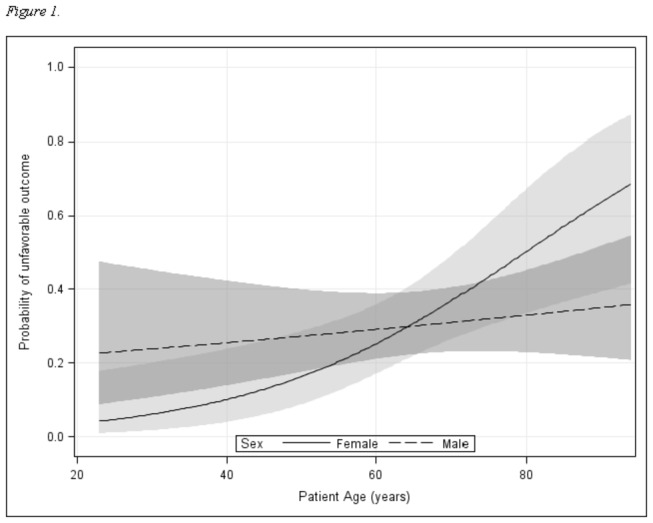
In this study population, women were younger (61.1+14.5 versus 65.8+17.3 years, p=0.03) and more likely to have a history of substance abuse (35% versus 8.9%, p<0.0001) compared to men. Multivariable models demonstrated that advancing age had a greater effect on predicting discharge outcome in women compared to men (p=0.02). For younger patients, female sex was protective; however, at ages greater than 60 years, female sex was a risk factor for discharge to hospice or death.
While independently associated with discharge to hospice or death after ICH, the interaction effect between gender and age demonstrated significantly stronger correlation with early outcome after ICH in a single center cohort. Prospective study is required to verify these findings.
脑出血(ICH)是一种常见且具有毁灭性的脑血管疾病形式。在脑出血中,结局方面的性别差异研究相对较少,但已在其他神经系统急症中进行了探讨。此外,年龄和性别对脑出血后结局的潜在影响尚未得到研究。本研究旨在检验年龄和性别相互作用以改变脑出血后神经学结局的假设。
对2007年7月至2010年4月因自发性原发性幕上脑出血入院的成年患者,通过对杜克大学现有的卒中数据库进行回顾性分析进行评估。对收集的变量进行单因素分析以比较性别和结局。不良结局定义为出院至临终关怀机构或死亡。使用多因素回归分析年龄和性别对脑出血后结局的综合影响。
在本研究人群中,与男性相比,女性更年轻(61.1±14.5岁对65.8±17.3岁,p = 0.03),且更有可能有药物滥用史(35%对8.9%,p<0.0001)。多变量模型表明,与男性相比,年龄增长对预测女性出院结局的影响更大(p = 0.02)。对于年轻患者,女性性别具有保护作用;然而,在60岁以上的年龄组中,女性性别是出院至临终关怀机构或死亡的危险因素。
虽然性别独立与脑出血后出院至临终关怀机构或死亡相关,但在单中心队列中,性别和年龄之间的相互作用效应与脑出血后的早期结局显示出显著更强的相关性。需要进行前瞻性研究以验证这些发现。