• 文献检索
  • 文档翻译
  • 深度研究
  • 学术资讯
  • Suppr Zotero 插件Zotero 插件
  • 邀请有礼
  • 套餐&价格
  • 历史记录
应用&插件
Suppr Zotero 插件Zotero 插件浏览器插件Mac 客户端Windows 客户端微信小程序
定价
高级版会员购买积分包购买API积分包
服务
文献检索文档翻译深度研究API 文档MCP 服务
关于我们
关于 Suppr公司介绍联系我们用户协议隐私条款
关注我们

Suppr 超能文献

核心技术专利:CN118964589B侵权必究
粤ICP备2023148730 号-1Suppr @ 2026

文献检索

告别复杂PubMed语法,用中文像聊天一样搜索,搜遍4000万医学文献。AI智能推荐,让科研检索更轻松。

立即免费搜索

文件翻译

保留排版,准确专业,支持PDF/Word/PPT等文件格式,支持 12+语言互译。

免费翻译文档

深度研究

AI帮你快速写综述,25分钟生成高质量综述,智能提取关键信息,辅助科研写作。

立即免费体验

饮料中用无热量甜味剂替代糖对重复暴露后奖励价值的影响。

Effect of replacing sugar with non-caloric sweeteners in beverages on the reward value after repeated exposure.

机构信息

Division of Human Nutrition, Wageningen University, Wageningen, The Netherlands.

出版信息

PLoS One. 2013 Nov 28;8(11):e81924. doi: 10.1371/journal.pone.0081924. eCollection 2013.

DOI:10.1371/journal.pone.0081924
PMID:24312382
原文链接:https://pmc.ncbi.nlm.nih.gov/articles/PMC3842969/
Abstract

BACKGROUND

The reward value of food is partly dependent on learned associations. It is not yet known whether replacing sugar with non-caloric sweeteners in food is affecting long-term acceptance.

OBJECTIVE

To determine the effect of replacing sugar with non-caloric sweeteners in a nutrient-empty drink (soft drink) versus nutrient-rich drink (yoghurt drink) on reward value after repeated exposure.

DESIGN

We used a randomized crossover design whereby forty subjects (15 men, 25 women) with a mean ± SD age of 21 ± 2 y and BMI of 21.5 ± 1.7 kg/m(2) consumed a fixed portion of a non-caloric sweetened (NS) and sugar sweetened (SS) versions of either a soft drink or a yoghurt drink (counterbalanced) for breakfast which were distinguishable by means of colored labels. Each version of a drink was offered 10 times in semi-random order. Before and after conditioning the reward value of the drinks was assessed using behavioral tasks on wanting, liking, and expected satiety. In a subgroup (n=18) fMRI was performed to assess brain reward responses to the drinks.

RESULTS

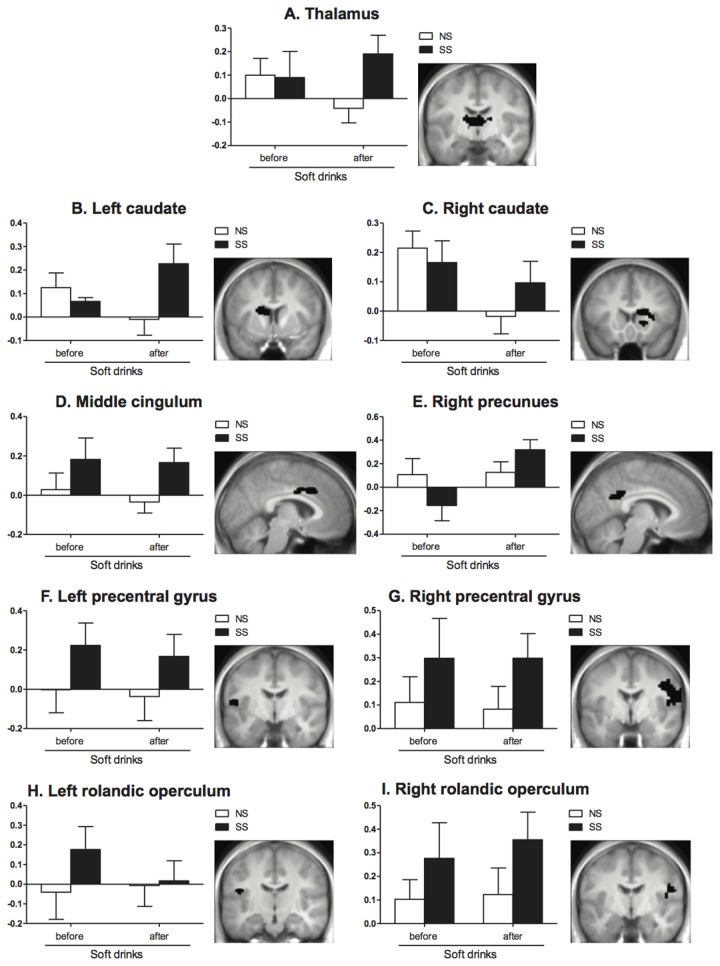
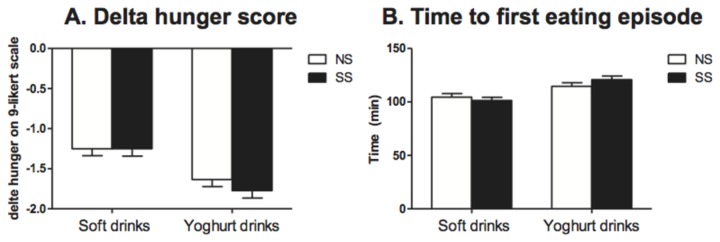
Outcomes of both the behavioral tasks and fMRI showed that conditioning did not affect the reward value of the NS and SS versions of the drinks significantly. Overall, subjects preferred the yoghurt drinks to the soft drinks and the ss drinks to the NS drinks. In addition, they expected the yoghurt drinks to be more satiating, they reduced hunger more, and delayed the first eating episode more. Conditioning did not influence these effects.

CONCLUSION

Our study showed that repeated consumption of a non-caloric sweetened beverage, instead of a sugar sweetened version, appears not to result in changes in the reward value. It cannot be ruled out that learned associations between sensory attributes and food satiating capacity which developed preceding the conditioning period, during lifetime, affected the reward value of the drinks.

摘要

背景

食物的奖励价值部分取决于习得的关联。目前尚不清楚在食物中用无热量甜味剂替代糖是否会影响长期接受度。

目的

确定在反复暴露于用无热量甜味剂替代营养空虚饮料(软饮料)和营养丰富饮料(酸奶饮料)中的糖后,对奖励价值的影响。

设计

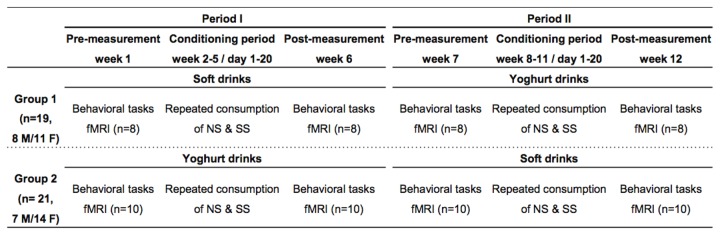
我们采用随机交叉设计,其中 40 名受试者(15 名男性,25 名女性)的平均年龄 ± SD 为 21 ± 2 岁,BMI 为 21.5 ± 1.7 kg/m(2),早餐分别摄入固定份量的无热量甜味剂(NS)和糖甜味剂(SS)的软饮料或酸奶饮料(平衡),通过彩色标签区分。每种饮料的版本以半随机顺序提供 10 次。在调节前后,使用行为任务评估饮料的想要、喜欢和预期饱腹感的奖励价值。在亚组(n=18)中进行 fMRI 以评估大脑对饮料的奖励反应。

结果

行为任务和 fMRI 的结果均表明,调节不会显著影响 NS 和 SS 饮料版本的奖励价值。总体而言,与软饮料相比,受试者更喜欢酸奶饮料,与 NS 饮料相比,更喜欢 SS 饮料。此外,他们预计酸奶饮料更有饱腹感,能减少饥饿感,并且能延迟第一次进食时间。调节没有影响这些效果。

结论

我们的研究表明,反复摄入无热量甜味剂饮料而不是糖甜味剂版本似乎不会导致奖励价值的变化。不能排除在调节期之前、一生中发展起来的感官属性和食物饱腹感之间的习得关联会影响饮料的奖励价值。
https://cdn.ncbi.nlm.nih.gov/pmc/blobs/abc3/3842969/e50187be60aa/pone.0081924.g004.jpg
https://cdn.ncbi.nlm.nih.gov/pmc/blobs/abc3/3842969/1763f7591a68/pone.0081924.g001.jpg
https://cdn.ncbi.nlm.nih.gov/pmc/blobs/abc3/3842969/5d59b02f3674/pone.0081924.g002.jpg
https://cdn.ncbi.nlm.nih.gov/pmc/blobs/abc3/3842969/6ed7e95e62d9/pone.0081924.g003.jpg
https://cdn.ncbi.nlm.nih.gov/pmc/blobs/abc3/3842969/e50187be60aa/pone.0081924.g004.jpg
https://cdn.ncbi.nlm.nih.gov/pmc/blobs/abc3/3842969/1763f7591a68/pone.0081924.g001.jpg
https://cdn.ncbi.nlm.nih.gov/pmc/blobs/abc3/3842969/5d59b02f3674/pone.0081924.g002.jpg
https://cdn.ncbi.nlm.nih.gov/pmc/blobs/abc3/3842969/6ed7e95e62d9/pone.0081924.g003.jpg
https://cdn.ncbi.nlm.nih.gov/pmc/blobs/abc3/3842969/e50187be60aa/pone.0081924.g004.jpg

相似文献

1
Effect of replacing sugar with non-caloric sweeteners in beverages on the reward value after repeated exposure.饮料中用无热量甜味剂替代糖对重复暴露后奖励价值的影响。
PLoS One. 2013 Nov 28;8(11):e81924. doi: 10.1371/journal.pone.0081924. eCollection 2013.
2
Obesity and Sex-Related Associations With Differential Effects of Sucralose vs Sucrose on Appetite and Reward Processing: A Randomized Crossover Trial.肥胖与性别相关因素对三氯蔗糖和蔗糖的食欲和奖赏处理的差异影响:一项随机交叉试验。
JAMA Netw Open. 2021 Sep 1;4(9):e2126313. doi: 10.1001/jamanetworkopen.2021.26313.
3
Satiety scores and satiety hormone response after sucrose-sweetened soft drink compared with isocaloric semi-skimmed milk and with non-caloric soft drink: a controlled trial.与等热量半脱脂牛奶和无热量软饮料相比,含糖软饮料后的饱腹感评分和饱腹感激素反应:一项对照试验。
Eur J Clin Nutr. 2012 Apr;66(4):523-9. doi: 10.1038/ejcn.2011.223. Epub 2012 Jan 18.
4
Sweet satiation: Acute effects of consumption of sweet drinks on appetite for and intake of sweet and non-sweet foods.甜味满足感:饮用甜饮料对甜食和非甜食食欲和摄入量的急性影响。
Appetite. 2020 Jun 1;149:104631. doi: 10.1016/j.appet.2020.104631. Epub 2020 Feb 11.
5
Consumption of caloric and non-caloric versions of a soft drink differentially affects brain activation during tasting.饮用含热量和无热量软饮料的版本会对品尝过程中的大脑激活产生不同影响。
Neuroimage. 2011 Jan 15;54(2):1367-74. doi: 10.1016/j.neuroimage.2010.08.054. Epub 2010 Sep 8.
6
The Impact of Caloric and Non-Caloric Sweeteners on Food Intake and Brain Responses to Food: A Randomized Crossover Controlled Trial in Healthy Humans.热量和非热量甜味剂对食物摄入和大脑对食物反应的影响:健康人类的随机交叉对照试验。
Nutrients. 2018 May 15;10(5):615. doi: 10.3390/nu10050615.
7
Effects of high and low sucrose-containing beverages on blood glucose and hypoglycemic-like symptoms.含高糖和低糖饮料对血糖及类低血糖症状的影响。
Physiol Behav. 2020 Aug 1;222:112916. doi: 10.1016/j.physbeh.2020.112916. Epub 2020 May 13.
8
Neural responses to oral administration of erythritol vs. sucrose and sucralose explain differences in subjective liking ratings.口服赤藓糖醇与蔗糖和三氯蔗糖的神经反应解释了主观喜好评分的差异。
Appetite. 2024 Sep 1;200:107422. doi: 10.1016/j.appet.2024.107422. Epub 2024 May 22.
9
Effects of hunger state on flavour pleasantness conditioning at home: flavour-nutrient learning vs. flavour-flavour learning.饥饿状态对在家进行的味道愉悦度条件反射的影响:味道-营养学习与味道-味道学习
Appetite. 2007 Jan;48(1):20-8. doi: 10.1016/j.appet.2006.05.017. Epub 2006 Jul 17.
10
The relative reinforcing value of sweet versus savory snack foods after consumption of sugar- or non-nutritive sweetened beverages.饮用含糖或非营养性甜味饮料后,甜味零食与咸味零食的相对强化价值。
Appetite. 2017 May 1;112:143-149. doi: 10.1016/j.appet.2017.01.028. Epub 2017 Jan 23.

引用本文的文献

1
Neural Mechanisms and Alterations of Sweet Sensing: Insights from Functional Magnetic Resonance Imaging Studies.甜味感知的神经机制与改变:来自功能磁共振成像研究的见解
Life (Basel). 2025 Jul 5;15(7):1075. doi: 10.3390/life15071075.
2
Carrots for the donkey: Influence of evaluative conditioning and training on self-paced exercise intensity and delay discounting of exercise in healthy adults.给驴胡萝卜:评价性条件作用和训练对健康成年人自主运动强度和运动延迟折扣的影响。
PLoS One. 2021 Oct 6;16(10):e0257953. doi: 10.1371/journal.pone.0257953. eCollection 2021.
3
The Effects of Non-Nutritive Sweetener Consumption in the Pediatric Populations: What We Know, What We Don't, and What We Need to Learn.

本文引用的文献

1
A trial of sugar-free or sugar-sweetened beverages and body weight in children.含糖饮料和无糖饮料对儿童体重影响的临床试验。
N Engl J Med. 2012 Oct 11;367(15):1397-406. doi: 10.1056/NEJMoa1203034. Epub 2012 Sep 21.
2
Regional brain response to visual food cues is a marker of satiety that predicts food choice.区域大脑对视觉食物线索的反应是饱腹感的标志物,可预测食物选择。
Am J Clin Nutr. 2012 Nov;96(5):989-99. doi: 10.3945/ajcn.112.042341. Epub 2012 Sep 18.
3
Altered processing of sweet taste in the brain of diet soda drinkers.饮用无糖汽水的人群大脑中甜味处理过程发生改变。
非营养性甜味剂摄入对儿科人群的影响:已知、未知和需要了解的内容。
Front Endocrinol (Lausanne). 2021 Apr 1;12:625415. doi: 10.3389/fendo.2021.625415. eCollection 2021.
4
How Does Our Brain Process Sugars and Non-Nutritive Sweeteners Differently: A Systematic Review on Functional Magnetic Resonance Imaging Studies.我们的大脑如何不同地处理糖和非营养性甜味剂:功能磁共振成像研究的系统评价。
Nutrients. 2020 Sep 30;12(10):3010. doi: 10.3390/nu12103010.
5
A Systematic Review and Activation Likelihood Estimation Meta-Analysis of fMRI Studies on Sweet Taste in Humans.一项关于人类甜味感知的 fMRI 研究的系统评价和激活似然估计元分析。
J Nutr. 2020 Jun 1;150(6):1619-1630. doi: 10.1093/jn/nxaa071.
6
Low Calorie Sweeteners Differ in Their Physiological Effects in Humans.低卡路里甜味剂在人体中的生理效应存在差异。
Nutrients. 2019 Nov 9;11(11):2717. doi: 10.3390/nu11112717.
7
CROCUFID: A Cross-Cultural Food Image Database for Research on Food Elicited Affective Responses.CROCUFID:一个用于研究食物引发情感反应的跨文化食物图像数据库。
Front Psychol. 2019 Jan 25;10:58. doi: 10.3389/fpsyg.2019.00058. eCollection 2019.
8
Low-Calorie Sweeteners in Foods, Beverages, and Food and Beverage Additions: NHANES 2007-2012.食品、饮料及食品饮料添加剂中的低热量甜味剂:2007 - 2012年美国国家健康与营养检查调查(NHANES)
Curr Dev Nutr. 2018 Jun 11;2(12):nzy024. doi: 10.1093/cdn/nzy024. eCollection 2018 Dec.
9
Methods for Evaluating Emotions Evoked by Food Experiences: A Literature Review.评估食物体验引发的情绪的方法:文献综述
Front Psychol. 2018 Jun 8;9:911. doi: 10.3389/fpsyg.2018.00911. eCollection 2018.
10
The cephalic phase insulin response to nutritive and low-calorie sweeteners in solid and beverage form.固体和饮料形式的营养性和低热量甜味剂引发的头期胰岛素反应。
Physiol Behav. 2017 Nov 1;181:100-109. doi: 10.1016/j.physbeh.2017.09.009. Epub 2017 Sep 9.
Physiol Behav. 2012 Nov 5;107(4):560-7. doi: 10.1016/j.physbeh.2012.05.006. Epub 2012 May 11.
4
The use of low-calorie sweeteners by adults: impact on weight management.成年人使用低热量甜味剂对体重管理的影响。
J Nutr. 2012 Jun;142(6):1163S-9S. doi: 10.3945/jn.111.149617. Epub 2012 May 9.
5
Flavour-nutrient learning in humans: an elusive phenomenon?人类的味-养学习:一种难以捉摸的现象?
Physiol Behav. 2012 Jun 6;106(3):345-55. doi: 10.1016/j.physbeh.2012.03.013. Epub 2012 Mar 21.
6
Replacing caloric beverages with water or diet beverages for weight loss in adults: main results of the Choose Healthy Options Consciously Everyday (CHOICE) randomized clinical trial.用白开水或低卡饮料代替高热量饮料以减轻成年人体重:有意识地每天选择健康选择(CHOICE)随机临床试验的主要结果。
Am J Clin Nutr. 2012 Mar;95(3):555-63. doi: 10.3945/ajcn.111.026278. Epub 2012 Feb 1.
7
Amygdala response to sucrose consumption is inversely related to artificial sweetener use.杏仁核对蔗糖消费的反应与人工甜味剂的使用呈负相关。
Appetite. 2012 Apr;58(2):504-7. doi: 10.1016/j.appet.2011.12.001. Epub 2011 Dec 8.
8
Learning about the energy density of liquid and semi-solid foods.了解液体和半固体食物的能量密度。
Int J Obes (Lond). 2012 Sep;36(9):1229-35. doi: 10.1038/ijo.2011.231. Epub 2011 Dec 6.
9
A systematic review on the effect of sweeteners on glycemic response and clinically relevant outcomes.关于甜味剂对血糖反应和临床相关结局影响的系统评价。
BMC Med. 2011 Nov 17;9:123. doi: 10.1186/1741-7015-9-123.
10
Texture, not flavor, determines expected satiation of dairy products.质地而非口味决定了乳制品的饱腹感。
Appetite. 2011 Dec;57(3):635-41. doi: 10.1016/j.appet.2011.08.008. Epub 2011 Aug 17.