Departamento de Biología Vegetal II, Facultad de Farmacia, Universidad Complutense de Madrid, Madrid, Spain.
PLoS One. 2013 Nov 29;8(11):e83115. doi: 10.1371/journal.pone.0083115. eCollection 2013.
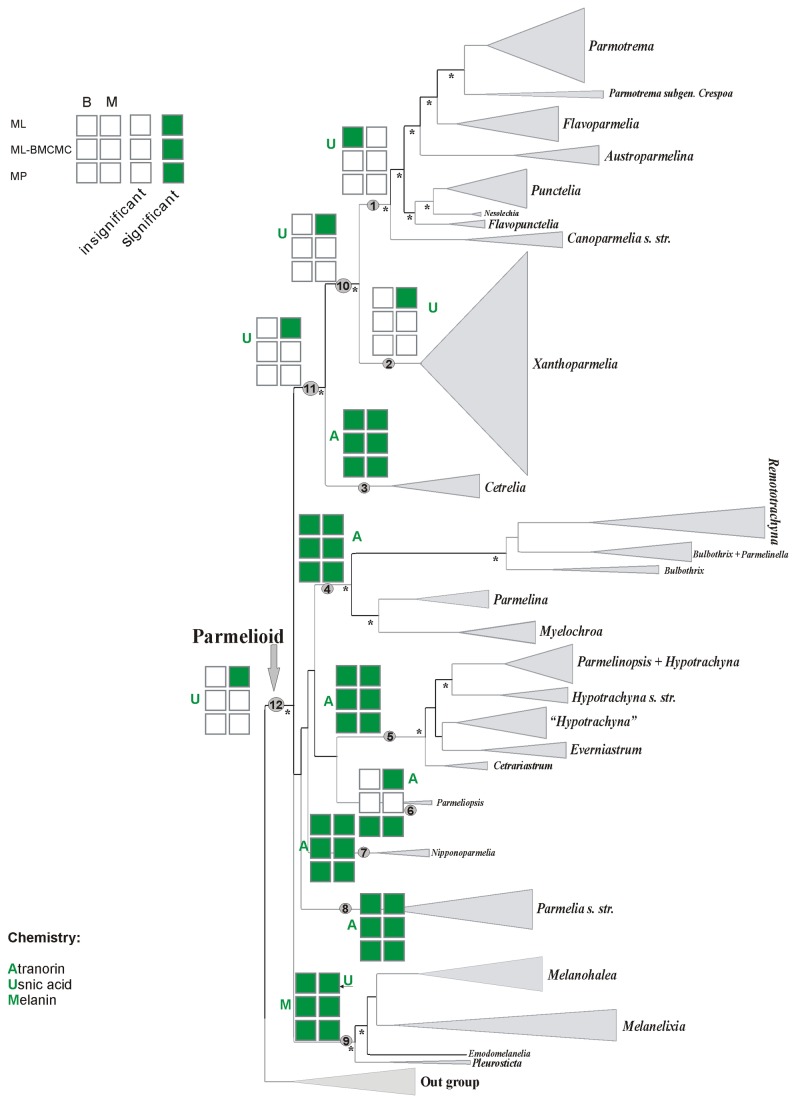
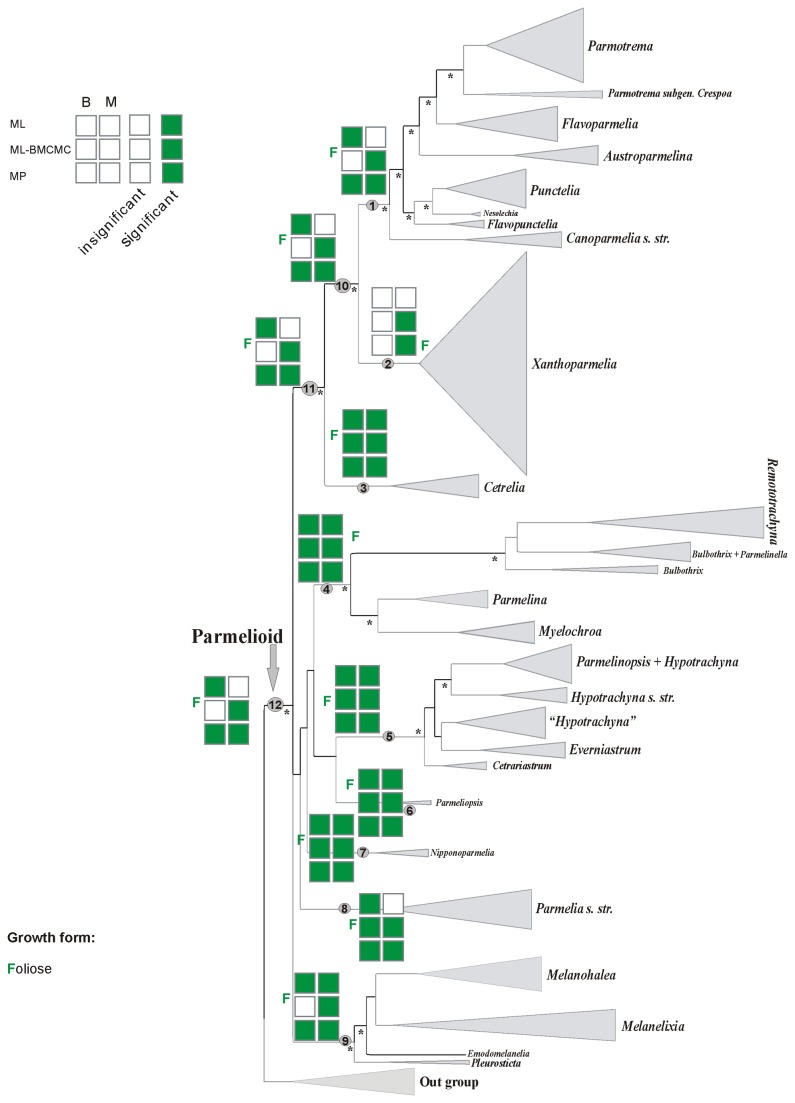
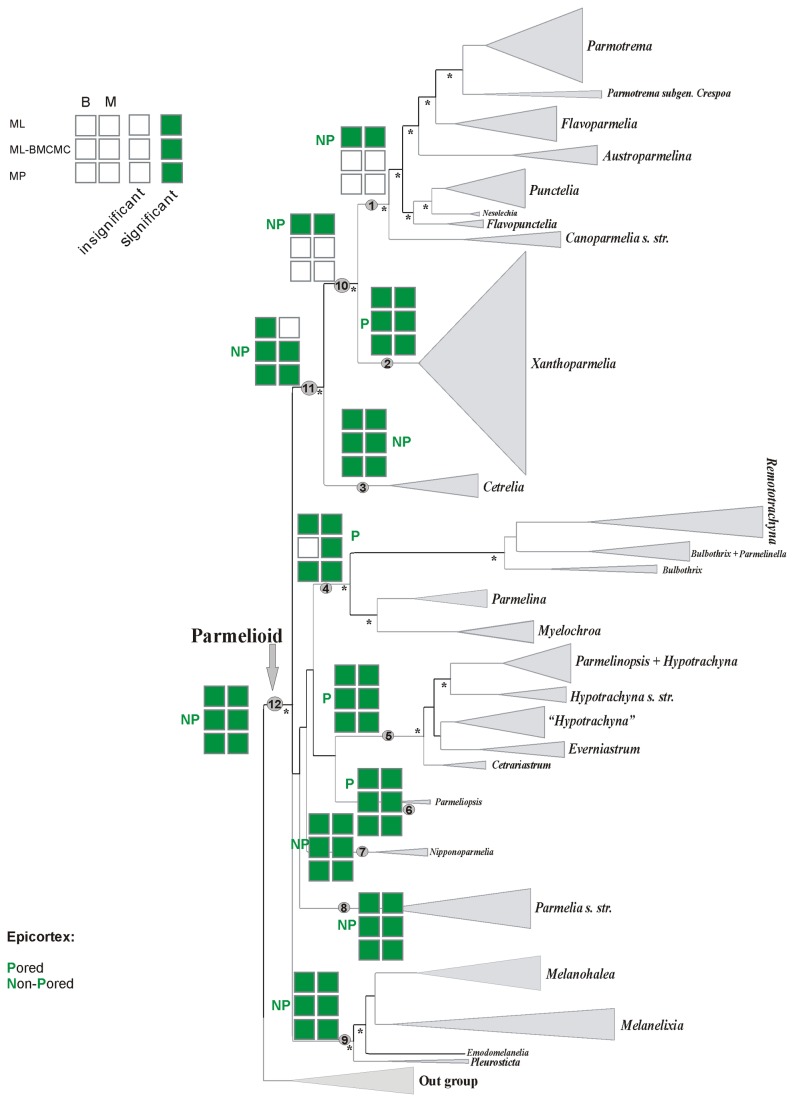
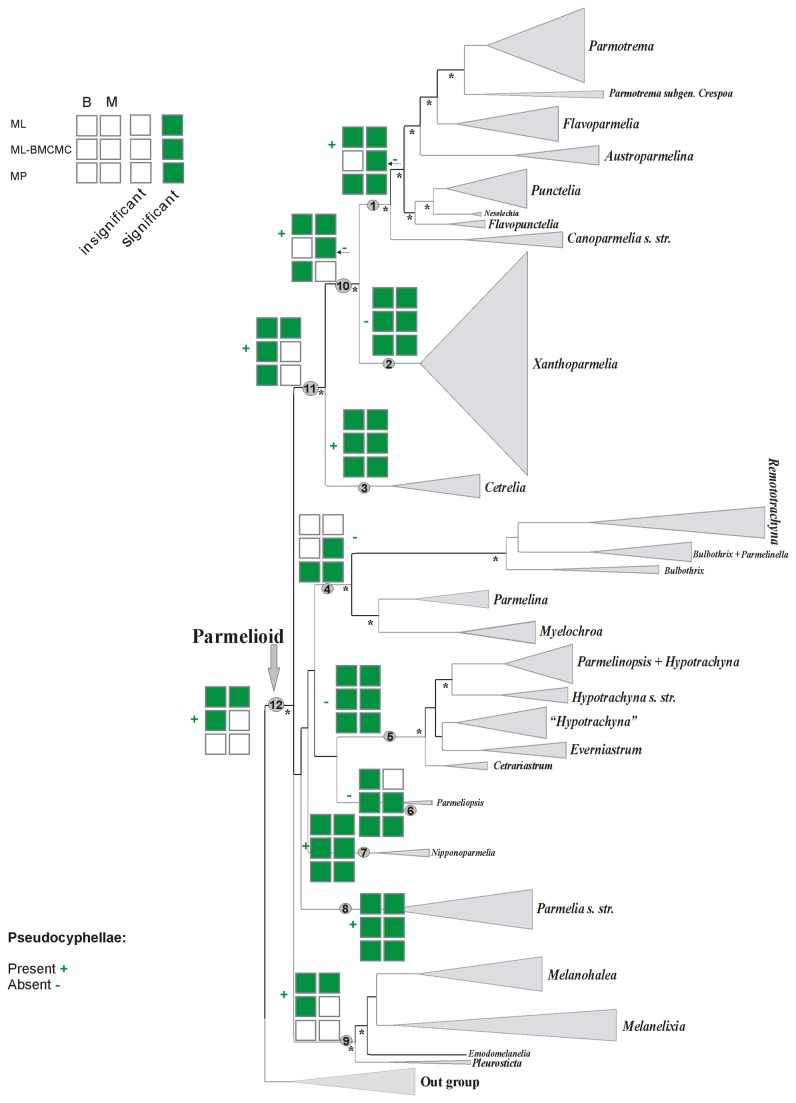
Parmelioid lichens form a species-rich group of predominantly foliose and fruticose lichenized fungi encompassing a broad range of morphological and chemical diversity. Using a multilocus approach, we reconstructed a phylogeny including 323 OTUs of parmelioid lichens and employed ancestral character reconstruction methods to understand the phenotypical evolution within this speciose group of lichen-forming fungi. Specifically, we were interested in the evolution of growth form, epicortex structure, and cortical chemistry. Since previous studies have shown that results may differ depending on the reconstruction method used, here we employed both maximum-parsimony and maximum-likelihood approaches to reconstruct ancestral character states. We have also implemented binary and multistate coding of characters and performed parallel analyses with both coding types to assess for potential coding-based biases. We reconstructed the ancestral states for nine well-supported major clades in the parmelioid group, two higher-level sister groups and the ancestral character state for all parmelioid lichens. We found that different methods for coding phenotypical characters and different ancestral character state reconstruction methods mostly resulted in identical reconstructions but yield conflicting inferences of ancestral states, in some cases. However, we found support for the ancestor of parmelioid lichens having been a foliose lichen with a non-pored epicortex and pseudocyphellae. Our data suggest that some traits exhibit patterns of evolution consistent with adaptive radiation.
叶状和枝状的 Parmelioid 地衣真菌形成了一个物种丰富的群体,涵盖了广泛的形态和化学多样性。我们采用多基因座方法重建了 Parmelioid 地衣的系统发育,运用祖先特征重建方法来理解这个多样的地衣真菌群的表型进化。具体来说,我们对生长形式、外皮层结构和皮层化学的进化感兴趣。由于之前的研究表明,结果可能因所使用的重建方法而异,因此我们采用了最大简约法和最大似然法来重建祖先特征状态。我们还对特征进行了二进制和多态编码,并对两种编码类型进行了平行分析,以评估潜在的基于编码的偏差。我们重建了 Parmelioid 地衣中九个有支持的主要分支、两个更高层次的姐妹群以及所有 Parmelioid 地衣的祖先特征状态。我们发现,不同的方法编码表型特征和不同的祖先特征状态重建方法主要导致了相同的重建,但在某些情况下产生了冲突的祖先状态推断。然而,我们发现 Parmelioid 地衣的祖先可能是具有非多孔外皮层和假壳的叶状地衣。我们的数据表明,一些特征的进化模式与适应性辐射一致。