Fan Wei, Chen Jie, Wang Xiao-Yan, Cai Ronghua, Tan Qianbao, Chen Yun, Yang Qingsong, Zhang Shanming, Wu Yun, Yang Zilu, Wang Xi-Ai, Zhong Yiping
Department of Psychology, Hunan Normal University, Changsha, China ; Institute of Psychology, Hunan Normal University, Changsha, China.
PLoS One. 2013 Dec 2;8(12):e80289. doi: 10.1371/journal.pone.0080289. eCollection 2013.
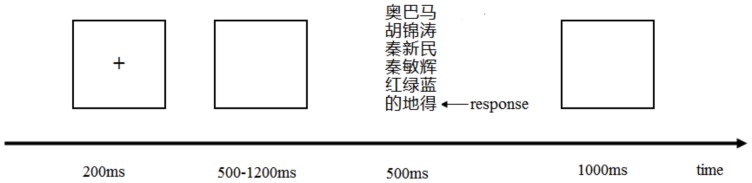
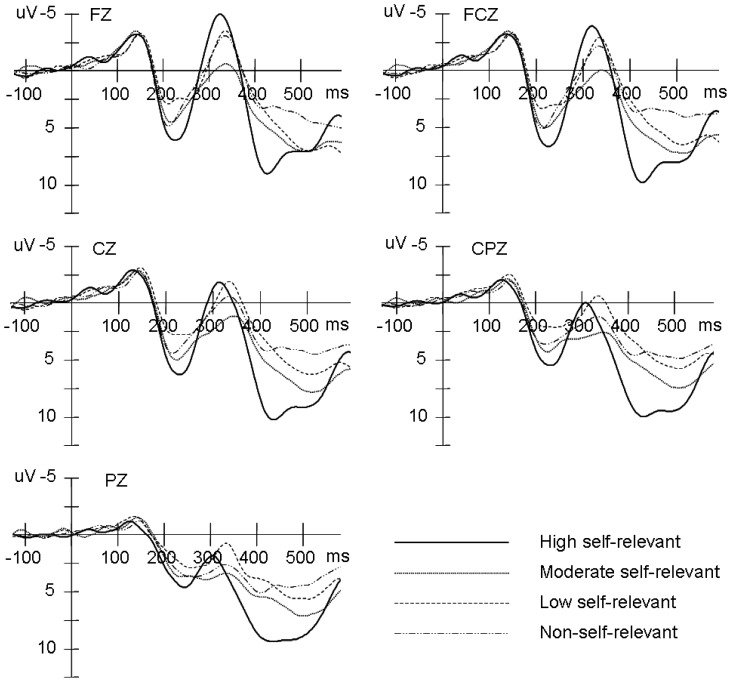
The present study investigated neural correlations underlying the psychological processing of stimuli with various degrees of self-relevance. Event-related potentials were recorded for names that differ in their extent of relevance to the study participant. Participants performed a three-stimulus oddball task. ERP results showed larger P2 averaged amplitudes for highly self-relevant names than for moderately self-relevant, minimally self-relevant, and non-self-relevant names. N2 averaged amplitudes were larger for the highly self-relevant names than for the moderately self-relevant, minimally self-relevant, and non-self-relevant names. Highly self-relevant names elicited larger P3 averaged amplitudes than the moderately self-relevant names which, in turn, had larger P3 values than for minimally self-relevant names. Minimally self-relevant stimuli elicited larger P3 averaged amplitudes than non-self-relevant stimuli. These results demonstrate a degree effect of self-reference, which was indexed using electrophysiological activity.
本研究调查了不同程度自我相关性刺激的心理加工背后的神经相关性。针对与研究参与者相关性程度不同的名字记录了事件相关电位。参与者执行了三刺激Oddball任务。ERP结果显示,与中等自我相关、最低自我相关和非自我相关的名字相比,高度自我相关名字的P2平均波幅更大。高度自我相关名字的N2平均波幅大于中等自我相关、最低自我相关和非自我相关的名字。高度自我相关名字引发的P3平均波幅大于中等自我相关名字,而中等自我相关名字的P3值又大于最低自我相关名字。最低自我相关刺激引发的P3平均波幅大于非自我相关刺激。这些结果证明了自我参照的程度效应,该效应通过电生理活动来衡量。