• 文献检索
  • 文档翻译
  • 深度研究
  • 学术资讯
  • Suppr Zotero 插件Zotero 插件
  • 邀请有礼
  • 套餐&价格
  • 历史记录
应用&插件
Suppr Zotero 插件Zotero 插件浏览器插件Mac 客户端Windows 客户端微信小程序
定价
高级版会员购买积分包购买API积分包
服务
文献检索文档翻译深度研究API 文档MCP 服务
关于我们
关于 Suppr公司介绍联系我们用户协议隐私条款
关注我们

Suppr 超能文献

核心技术专利:CN118964589B侵权必究
粤ICP备2023148730 号-1Suppr @ 2026

文献检索

告别复杂PubMed语法,用中文像聊天一样搜索,搜遍4000万医学文献。AI智能推荐,让科研检索更轻松。

立即免费搜索

文件翻译

保留排版,准确专业,支持PDF/Word/PPT等文件格式,支持 12+语言互译。

免费翻译文档

深度研究

AI帮你快速写综述,25分钟生成高质量综述,智能提取关键信息,辅助科研写作。

立即免费体验

一种使用基因表达数据准确预测雌激素受体状态的机器学习分类器。

A machine learned classifier that uses gene expression data to accurately predict estrogen receptor status.

机构信息

Department of Computing Science, University of Alberta, Edmonton, Alberta, Canada.

出版信息

PLoS One. 2013 Dec 2;8(12):e82144. doi: 10.1371/journal.pone.0082144. eCollection 2013.

DOI:10.1371/journal.pone.0082144
PMID:24312637
原文链接:https://pmc.ncbi.nlm.nih.gov/articles/PMC3846850/
Abstract

BACKGROUND

Selecting the appropriate treatment for breast cancer requires accurately determining the estrogen receptor (ER) status of the tumor. However, the standard for determining this status, immunohistochemical analysis of formalin-fixed paraffin embedded samples, suffers from numerous technical and reproducibility issues. Assessment of ER-status based on RNA expression can provide more objective, quantitative and reproducible test results.

METHODS

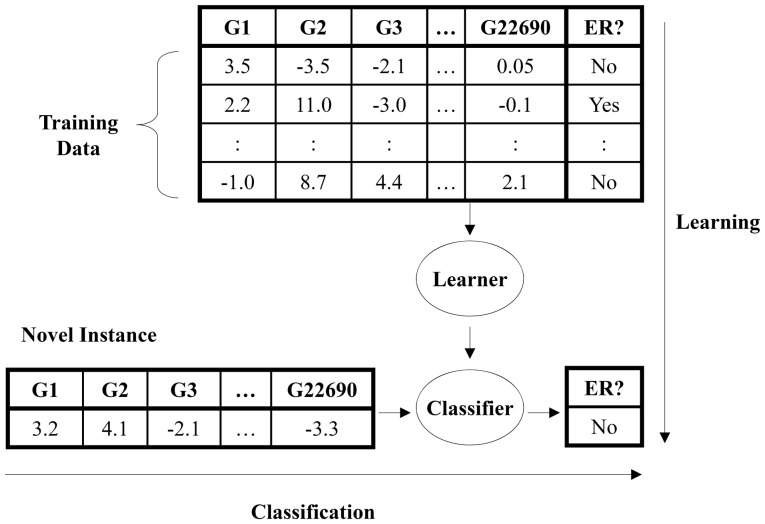
To learn a parsimonious RNA-based classifier of hormone receptor status, we applied a machine learning tool to a training dataset of gene expression microarray data obtained from 176 frozen breast tumors, whose ER-status was determined by applying ASCO-CAP guidelines to standardized immunohistochemical testing of formalin fixed tumor.

RESULTS

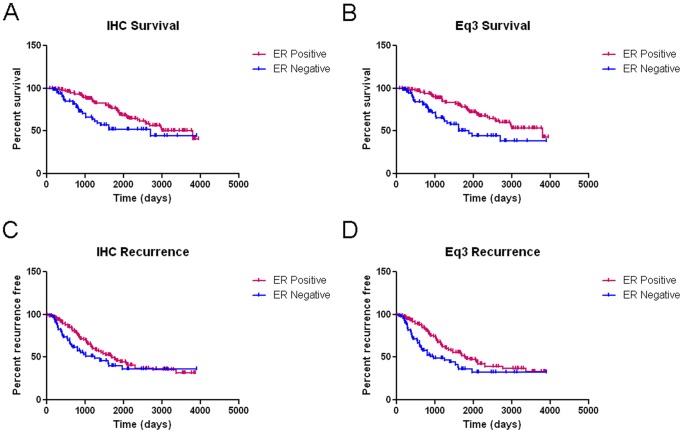
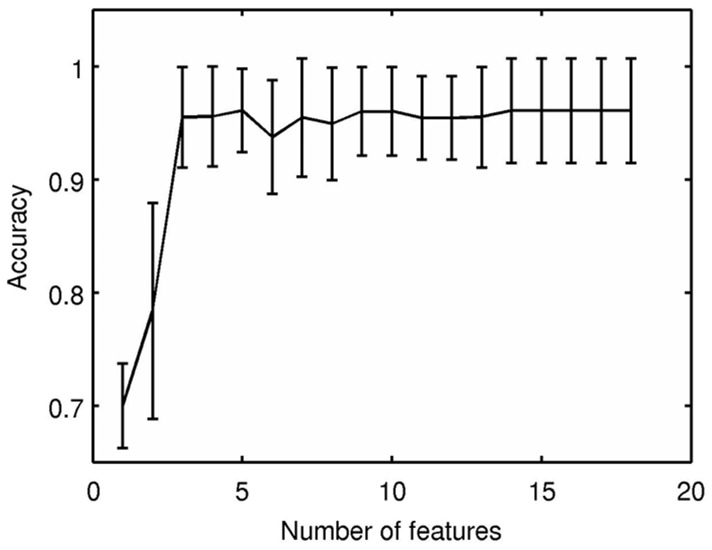
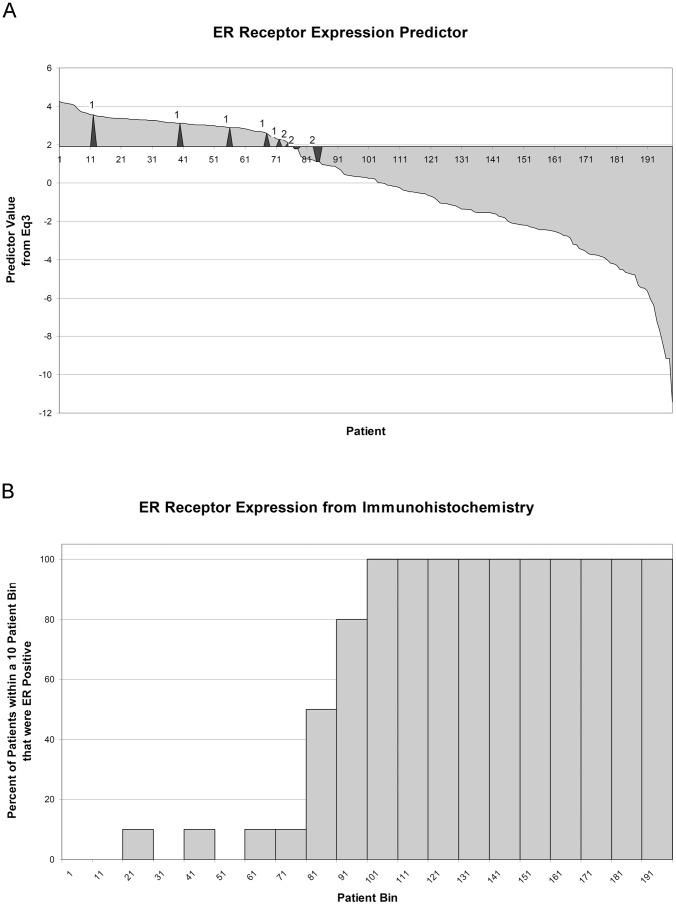
This produced a three-gene classifier that can predict the ER-status of a novel tumor, with a cross-validation accuracy of 93.17±2.44%. When applied to an independent validation set and to four other public databases, some on different platforms, this classifier obtained over 90% accuracy in each. In addition, we found that this prediction rule separated the patients' recurrence-free survival curves with a hazard ratio lower than the one based on the IHC analysis of ER-status.

CONCLUSIONS

Our efficient and parsimonious classifier lends itself to high throughput, highly accurate and low-cost RNA-based assessments of ER-status, suitable for routine high-throughput clinical use. This analytic method provides a proof-of-principle that may be applicable to developing effective RNA-based tests for other biomarkers and conditions.

摘要

背景

选择乳腺癌的适当治疗方法需要准确确定肿瘤的雌激素受体(ER)状态。然而,确定这种状态的标准,即福尔马林固定石蜡包埋样本的免疫组织化学分析,存在许多技术和可重复性问题。基于 RNA 表达的 ER 状态评估可以提供更客观、定量和可重复的测试结果。

方法

为了学习激素受体状态的简约 RNA 分类器,我们将机器学习工具应用于 176 个冷冻乳腺癌的基因表达微阵列数据集的训练数据集,其 ER 状态通过应用 ASCO-CAP 指南对福尔马林固定肿瘤的标准化免疫组织化学测试来确定。

结果

这产生了一个可以预测新肿瘤 ER 状态的三基因分类器,其交叉验证准确率为 93.17±2.44%。当应用于独立验证集和另外四个公共数据库时,在每个数据库上的准确率都超过了 90%。此外,我们发现该预测规则通过危险比低于基于 ER 状态免疫组织化学分析的危险比来分离患者的无复发生存曲线。

结论

我们高效简约的分类器适用于高通量、高精度和低成本的基于 RNA 的 ER 状态评估,适合常规高通量临床使用。这种分析方法提供了一个原则性的证明,可能适用于开发其他生物标志物和疾病的有效基于 RNA 的测试。
https://cdn.ncbi.nlm.nih.gov/pmc/blobs/fe80/3846850/c3529a44b95f/pone.0082144.g005.jpg
https://cdn.ncbi.nlm.nih.gov/pmc/blobs/fe80/3846850/07391a748744/pone.0082144.g001.jpg
https://cdn.ncbi.nlm.nih.gov/pmc/blobs/fe80/3846850/5824c45d7b1b/pone.0082144.g002.jpg
https://cdn.ncbi.nlm.nih.gov/pmc/blobs/fe80/3846850/5770825f150d/pone.0082144.g003.jpg
https://cdn.ncbi.nlm.nih.gov/pmc/blobs/fe80/3846850/9039cc381cc6/pone.0082144.g004.jpg
https://cdn.ncbi.nlm.nih.gov/pmc/blobs/fe80/3846850/c3529a44b95f/pone.0082144.g005.jpg
https://cdn.ncbi.nlm.nih.gov/pmc/blobs/fe80/3846850/07391a748744/pone.0082144.g001.jpg
https://cdn.ncbi.nlm.nih.gov/pmc/blobs/fe80/3846850/5824c45d7b1b/pone.0082144.g002.jpg
https://cdn.ncbi.nlm.nih.gov/pmc/blobs/fe80/3846850/5770825f150d/pone.0082144.g003.jpg
https://cdn.ncbi.nlm.nih.gov/pmc/blobs/fe80/3846850/9039cc381cc6/pone.0082144.g004.jpg
https://cdn.ncbi.nlm.nih.gov/pmc/blobs/fe80/3846850/c3529a44b95f/pone.0082144.g005.jpg

相似文献

1
A machine learned classifier that uses gene expression data to accurately predict estrogen receptor status.一种使用基因表达数据准确预测雌激素受体状态的机器学习分类器。
PLoS One. 2013 Dec 2;8(12):e82144. doi: 10.1371/journal.pone.0082144. eCollection 2013.
2
72-gene classifier for predicting prognosis of estrogen receptor-positive and node-negative breast cancer patients using formalin-fixed, paraffin-embedded tumor tissues.使用福尔马林固定、石蜡包埋的肿瘤组织,72 基因分类器预测雌激素受体阳性且淋巴结阴性乳腺癌患者的预后。
Clin Breast Cancer. 2014 Jun;14(3):e73-80. doi: 10.1016/j.clbc.2013.11.006. Epub 2013 Nov 22.
3
Mixture classification model based on clinical markers for breast cancer prognosis.基于临床标志物的乳腺癌预后混合分类模型。
Artif Intell Med. 2010 Feb-Mar;48(2-3):129-37. doi: 10.1016/j.artmed.2009.07.008. Epub 2009 Dec 14.
4
A qualitative transcriptional signature to reclassify estrogen receptor status of breast cancer patients.一种重新分类乳腺癌患者雌激素受体状态的定性转录特征。
Breast Cancer Res Treat. 2018 Jul;170(2):271-277. doi: 10.1007/s10549-018-4758-2. Epub 2018 Mar 23.
5
Clinical relevance of DNA microarray analyses using archival formalin-fixed paraffin-embedded breast cancer specimens.使用存档福尔马林固定石蜡包埋乳腺癌标本进行 DNA 微阵列分析的临床相关性。
BMC Cancer. 2011 Jun 16;11:253:1-13. doi: 10.1186/1471-2407-11-253.
6
Development of 95-gene classifier as a powerful predictor of recurrences in node-negative and ER-positive breast cancer patients.95 基因分类器的开发是一种强大的预测工具,可用于预测淋巴结阴性和雌激素受体阳性乳腺癌患者的复发情况。
Breast Cancer Res Treat. 2011 Aug;128(3):633-41. doi: 10.1007/s10549-010-1145-z. Epub 2010 Aug 29.
7
Artificial Intelligence Algorithms to Assess Hormonal Status From Tissue Microarrays in Patients With Breast Cancer.人工智能算法评估乳腺癌患者组织微阵列中的激素状态。
JAMA Netw Open. 2019 Jul 3;2(7):e197700. doi: 10.1001/jamanetworkopen.2019.7700.
8
Effect of ASCO/CAP guidelines for determining ER status on molecular subtype.ASCO/CAP 指南对 ER 状态测定的影响与分子亚型。
Ann Surg Oncol. 2013 Jan;20(1):87-93. doi: 10.1245/s10434-012-2588-8. Epub 2012 Aug 9.
9
Accurate Estrogen Receptor Quantification in Patients with Negative and Low-Positive Estrogen-Receptor-Expressing Breast Tumors: Sub-Analyses of Data from Two Clinical Studies.在雌激素受体阴性和低表达的乳腺癌患者中准确进行雌激素受体定量检测:两项临床研究数据的亚组分析。
Adv Ther. 2019 Apr;36(4):828-841. doi: 10.1007/s12325-019-0896-0. Epub 2019 Mar 11.
10
Gene expression of estrogen receptor, progesterone receptor and microtubule-associated protein Tau in high-risk early breast cancer: a quest for molecular predictors of treatment benefit in the context of a Hellenic Cooperative Oncology Group trial.高危早期乳腺癌中雌激素受体、孕激素受体和微管相关蛋白Tau的基因表达:在希腊合作肿瘤学组试验背景下寻找治疗获益的分子预测指标
Breast Cancer Res Treat. 2009 Jul;116(1):131-43. doi: 10.1007/s10549-008-0144-9. Epub 2008 Jul 31.

引用本文的文献

1
LMNB1 regulates breast cancer cell senescence and migration through PPAR signaling pathway.层黏连蛋白β1通过过氧化物酶体增殖物激活受体信号通路调控乳腺癌细胞衰老和迁移。
Discov Oncol. 2025 Jun 14;16(1):1103. doi: 10.1007/s12672-025-02709-7.
2
Systematic Characterization of p53-Regulated Long Noncoding RNAs across Human Cancers Reveals Remarkable Heterogeneity among Different Tumor Types.系统分析人类癌症中 p53 调控的长非编码 RNA,揭示不同肿瘤类型间显著的异质性。
Mol Cancer Res. 2024 Jun 4;22(6):555-571. doi: 10.1158/1541-7786.MCR-23-0295.
3
How Reliable Are Gene Expression-Based and Immunohistochemical Biomarkers Assessed on a Core-Needle Biopsy? A Study of Paired Core-Needle Biopsies and Surgical Specimens in Early Breast Cancer.

本文引用的文献

1
Effects of sample size on differential gene expression, rank order and prediction accuracy of a gene signature.样本量对差异基因表达、基因特征的排序及预测准确性的影响。
PLoS One. 2013 Jun 3;8(6):e65380. doi: 10.1371/journal.pone.0065380. Print 2013.
2
Down-regulation of ECRG4, a candidate tumor suppressor gene, in human breast cancer.ECRG4 下调,一种候选肿瘤抑制基因,在人乳腺癌中。
PLoS One. 2011;6(11):e27656. doi: 10.1371/journal.pone.0027656. Epub 2011 Nov 16.
3
Relevance of breast cancer hormone receptors and other factors to the efficacy of adjuvant tamoxifen: patient-level meta-analysis of randomised trials.
在粗针活检中评估的基于基因表达和免疫组化的生物标志物有多可靠?早期乳腺癌粗针活检与手术标本配对研究。
Cancers (Basel). 2022 Aug 18;14(16):4000. doi: 10.3390/cancers14164000.
4
RNA sequencing-based single sample predictors of molecular subtype and risk of recurrence for clinical assessment of early-stage breast cancer.基于RNA测序的早期乳腺癌临床评估中分子亚型和复发风险的单样本预测指标
NPJ Breast Cancer. 2022 Aug 16;8(1):94. doi: 10.1038/s41523-022-00465-3.
5
'On the Spot' Digital Pathology of Breast Cancer Based on Single-Cell Mass Spectrometry Imaging.基于单细胞质谱成像的乳腺癌“即时”数字病理学。
Anal Chem. 2022 Apr 26;94(16):6180-6190. doi: 10.1021/acs.analchem.1c05238. Epub 2022 Apr 12.
6
Maximizing the reusability of gene expression data by predicting missing metadata.通过预测缺失的元数据来最大化基因表达数据的可重用性。
PLoS Comput Biol. 2020 Nov 6;16(11):e1007450. doi: 10.1371/journal.pcbi.1007450. eCollection 2020 Nov.
7
Clinical Value of RNA Sequencing-Based Classifiers for Prediction of the Five Conventional Breast Cancer Biomarkers: A Report From the Population-Based Multicenter Sweden Cancerome Analysis Network-Breast Initiative.基于RNA测序的分类器对五种传统乳腺癌生物标志物预测的临床价值:来自基于人群的多中心瑞典癌症基因组分析网络-乳腺癌倡议的报告
JCO Precis Oncol. 2018 Mar 9;2. doi: 10.1200/PO.17.00135. eCollection 2018.
8
Identification of Platform-Independent Diagnostic Biomarker Panel for Hepatocellular Carcinoma Using Large-Scale Transcriptomics Data.利用大规模转录组学数据鉴定肝细胞癌的平台无关诊断生物标志物组
Front Genet. 2020 Jan 10;10:1306. doi: 10.3389/fgene.2019.01306. eCollection 2019.
9
Prediction and Analysis of Skin Cancer Progression using Genomics Profiles of Patients.利用患者基因组特征预测和分析皮肤癌进展。
Sci Rep. 2019 Oct 31;9(1):15790. doi: 10.1038/s41598-019-52134-4.
10
A machine learning classifier trained on cancer transcriptomes detects NF1 inactivation signal in glioblastoma.一种基于癌症转录组训练的机器学习分类器可检测胶质母细胞瘤中的NF1失活信号。
BMC Genomics. 2017 Feb 6;18(1):127. doi: 10.1186/s12864-017-3519-7.
乳腺癌激素受体及其他因素与辅助他莫昔芬疗效的相关性:随机试验的患者水平荟萃分析。
Lancet. 2011 Aug 27;378(9793):771-84. doi: 10.1016/S0140-6736(11)60993-8. Epub 2011 Jul 28.
4
Genomic analysis identifies unique signatures predictive of brain, lung, and liver relapse.基因组分析确定了预测脑、肺和肝复发的独特特征。
Breast Cancer Res Treat. 2012 Apr;132(2):523-35. doi: 10.1007/s10549-011-1619-7. Epub 2011 Jun 14.
5
DEAD box 1: a novel and independent prognostic marker for early recurrence in breast cancer.DEAD 框 1:乳腺癌早期复发的新型独立预后标志物。
Breast Cancer Res Treat. 2011 May;127(1):53-63. doi: 10.1007/s10549-010-0943-7. Epub 2010 May 25.
6
American Society of Clinical Oncology/College Of American Pathologists guideline recommendations for immunohistochemical testing of estrogen and progesterone receptors in breast cancer.美国临床肿瘤学会/美国病理学家学会关于乳腺癌雌激素和孕激素受体免疫组织化学检测的指南建议。
J Clin Oncol. 2010 Jun 1;28(16):2784-95. doi: 10.1200/JCO.2009.25.6529. Epub 2010 Apr 19.
7
Amplification of LAPTM4B and YWHAZ contributes to chemotherapy resistance and recurrence of breast cancer.LAPTM4B 和 YWHAZ 的扩增导致乳腺癌的化疗耐药和复发。
Nat Med. 2010 Feb;16(2):214-8. doi: 10.1038/nm.2090. Epub 2010 Jan 24.
8
An online survival analysis tool to rapidly assess the effect of 22,277 genes on breast cancer prognosis using microarray data of 1,809 patients.一个在线生存分析工具,用于使用 1809 名患者的微阵列数据快速评估 22277 个基因对乳腺癌预后的影响。
Breast Cancer Res Treat. 2010 Oct;123(3):725-31. doi: 10.1007/s10549-009-0674-9. Epub 2009 Dec 18.
9
Stromal gene expression predicts clinical outcome in breast cancer.基质基因表达可预测乳腺癌的临床结局。
Nat Med. 2008 May;14(5):518-27. doi: 10.1038/nm1764. Epub 2008 Apr 27.
10
Prediction of breast cancer prognosis by gene expression profile of TP53 status.通过TP53状态的基因表达谱预测乳腺癌预后
Cancer Sci. 2008 Feb;99(2):324-32. doi: 10.1111/j.1349-7006.2007.00691.x.