Section of Geriatrics and Palliative Medicine, University of Chicago, Chicago, Illinois.
Division of Geriatric Medicine, Dalhousie University, Halifax, Nova Scotia, Canada.
J Am Geriatr Soc. 2013 Dec;61(12):2135-2141. doi: 10.1111/jgs.12554. Epub 2013 Dec 9.
To assess the association between self-reported noncancer pain and 5-year mortality.
Cohort.
Community-dwelling older adults.
Canadian Study of Health and Aging 1996 wave.
Registrar of Vital Statistics-established 5-year mortality. Noncancer pain was assessed using the 5-point verbal descriptor scale, dichotomized into no or very mild versus moderate, severe, or very severe pain. Frailty was the accumulation of health deficits. Cognitive status (Modified Mini-Mental State Examination) and depressed mood (five-item mental health screening questionnaire) were also assessed. Multivariable logistic regression and Cox proportional hazards were used to analyze the relationship between pain and 5-year mortality.
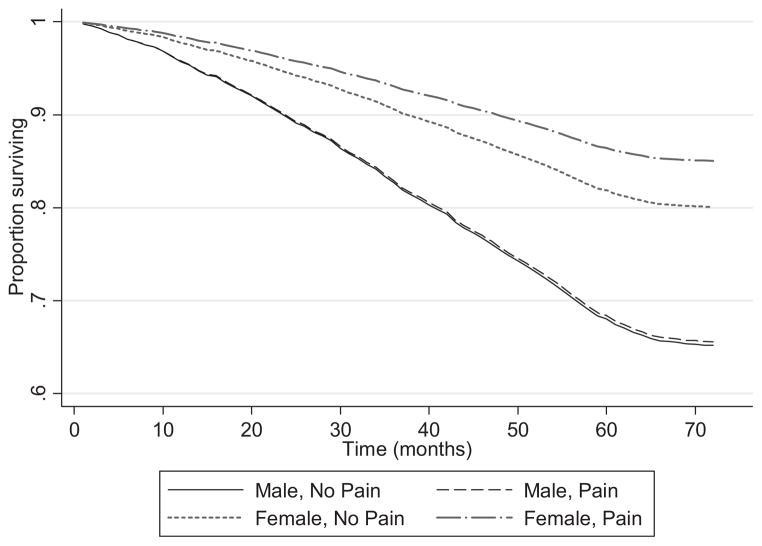
Of 5,703 participants, 4,694 (82.3%) had complete data for analysis; 1,663 of these (35.4%) reported moderate, severe, or very severe pain, and 1,343 (28.6%) had died at 5-year follow-up. Four hundred ninety-six of those who died (29.8%) reported moderate, severe, or very severe pain and 847 (27.9%) no or very mild pain. Multivariate logistic analysis found that individuals with moderate, severe, or very severe pain had lower odds of 5-year mortality than those with no or very mild pain (odds ratio=0.78, 95% confidence interval (CI)=0.66-0.92; P<.001). The risk of death was lower in persons reporting moderate or greater pain than in those with no or very mild pain (HR=0.85, 95% CI=0.75-0.96; P=.01). An interaction between pain and sex explained this effect. Men with pain were not significantly more likely than men without pain to die (HR=1.00, 95% CI=0.84-1.19; P=.99), whereas women without pain (HR=0.54, 95% CI=0.47-0.63; P<0.01) and women with pain (HR=0.40; CI=0.33-0.47; P<.01) had less risk of death than men without and with pain, respectively.
Older women with pain were less likely to die within 5 years than older women without pain, men in pain, or men without pain.
评估自我报告的非癌症疼痛与 5 年死亡率之间的关联。
队列研究。
社区居住的老年人。
加拿大健康老龄化研究 1996 年波。
由注册统计员确定的 5 年死亡率。非癌症疼痛使用 5 点言语描述量表评估,分为无或轻度疼痛与中度、重度或极重度疼痛。衰弱是健康缺陷的累积。还评估了认知状态(改良的简易精神状态检查)和抑郁情绪(五项心理健康筛查问卷)。多变量逻辑回归和 Cox 比例风险用于分析疼痛与 5 年死亡率之间的关系。
在 5703 名参与者中,有 4694 名(82.3%)完成了完整的数据分析;其中 1663 名(35.4%)报告了中度、重度或极重度疼痛,1343 名(28.6%)在 5 年随访时死亡。在死亡者中,有 496 人(29.8%)报告了中度、重度或极重度疼痛,847 人(27.9%)报告了无或轻度疼痛。多变量逻辑分析发现,与无或轻度疼痛相比,中度、重度或极重度疼痛患者 5 年死亡率的可能性较低(比值比=0.78,95%置信区间(CI)=0.66-0.92;P<.001)。与无或轻度疼痛相比,报告中度或更严重疼痛的人死亡风险较低(HR=0.85,95% CI=0.75-0.96;P=.01)。疼痛与性别之间的相互作用解释了这一效果。疼痛男性与无疼痛男性相比,死亡可能性无显著差异(HR=1.00,95% CI=0.84-1.19;P=.99),而无疼痛女性(HR=0.54,95% CI=0.47-0.63;P<.01)和疼痛女性(HR=0.40;CI=0.33-0.47;P<.01)的死亡风险均低于无疼痛男性和有疼痛男性。
与无疼痛的老年女性相比,有疼痛的老年女性在 5 年内死亡的可能性较小,而疼痛男性和无疼痛男性。