Duke Clinical Research Institute, Durham, NC, USA.
BMJ. 2013 Dec 9;347:f6745. doi: 10.1136/bmj.f6745.
To examine the degree to which use of β blockers, statins, and diuretics in patients with impaired glucose tolerance and other cardiovascular risk factors is associated with new onset diabetes.
Reanalysis of data from the Nateglinide and Valsartan in Impaired Glucose Tolerance Outcomes Research (NAVIGATOR) trial.
NAVIGATOR trial.
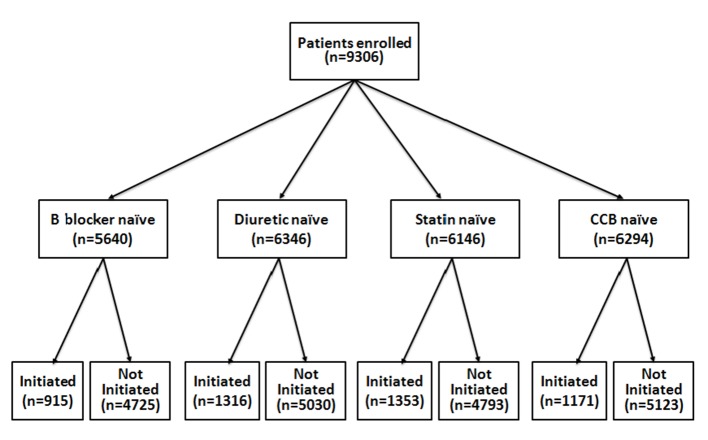
Patients who at baseline (enrolment) were treatment naïve to β blockers (n=5640), diuretics (n=6346), statins (n=6146), and calcium channel blockers (n=6294). Use of calcium channel blocker was used as a metabolically neutral control.
Development of new onset diabetes diagnosed by standard plasma glucose level in all participants and confirmed with glucose tolerance testing within 12 weeks after the increased glucose value was recorded. The relation between each treatment and new onset diabetes was evaluated using marginal structural models for causal inference, to account for time dependent confounding in treatment assignment.
During the median five years of follow-up, β blockers were started in 915 (16.2%) patients, diuretics in 1316 (20.7%), statins in 1353 (22.0%), and calcium channel blockers in 1171 (18.6%). After adjusting for baseline characteristics and time varying confounders, diuretics and statins were both associated with an increased risk of new onset diabetes (hazard ratio 1.23, 95% confidence interval 1.06 to 1.44, and 1.32, 1.14 to 1.48, respectively), whereas β blockers and calcium channel blockers were not associated with new onset diabetes (1.10, 0.92 to 1.31, and 0.95, 0.79 to 1.13, respectively).
Among people with impaired glucose tolerance and other cardiovascular risk factors and with serial glucose measurements, diuretics and statins were associated with an increased risk of new onset diabetes, whereas the effect of β blockers was non-significant.
ClinicalTrials.gov NCT00097786.
研究在葡萄糖耐量受损和其他心血管危险因素患者中,使用β受体阻滞剂、他汀类药物和利尿剂与新发糖尿病之间的关联程度。
对那格列奈和缬沙坦在葡萄糖耐量受损患者中的疗效研究(NAVIGATOR)的数据分析进行再分析。
NAVIGATOR 试验。
基线(入组时)时对β受体阻滞剂(n=5640)、利尿剂(n=6346)、他汀类药物(n=6146)和钙通道阻滞剂(n=6294)治疗无反应的患者。钙通道阻滞剂的使用作为代谢中性对照。
所有参与者根据标准血浆葡萄糖水平诊断新发糖尿病,在记录葡萄糖值升高后 12 周内通过葡萄糖耐量试验确认。使用边缘结构模型进行因果推断来评估每种治疗方法与新发糖尿病之间的关系,以解释治疗分配中与时间相关的混杂因素。
在中位数为 5 年的随访期间,915 名(16.2%)患者开始使用β受体阻滞剂,1316 名(20.7%)患者开始使用利尿剂,1353 名(22.0%)患者开始使用他汀类药物,1171 名(18.6%)患者开始使用钙通道阻滞剂。调整基线特征和随时间变化的混杂因素后,利尿剂和他汀类药物均与新发糖尿病风险增加相关(风险比分别为 1.23、95%置信区间为 1.06 至 1.44 和 1.32、1.14 至 1.48),而β受体阻滞剂和钙通道阻滞剂与新发糖尿病无关(风险比分别为 1.10、95%置信区间为 0.92 至 1.31 和 0.95、95%置信区间为 0.79 至 1.13)。
在葡萄糖耐量受损和其他心血管危险因素的人群中,并且进行了连续血糖测量,利尿剂和他汀类药物与新发糖尿病风险增加相关,而β受体阻滞剂的作用无统计学意义。
ClinicalTrials.gov NCT00097786。