Brain Research Institute, School of Medicine and Health Sciences, Monash University Malaysia , Petaling Jaya , Malaysia.
Front Endocrinol (Lausanne). 2013 Nov 25;4:184. doi: 10.3389/fendo.2013.00184. eCollection 2013.
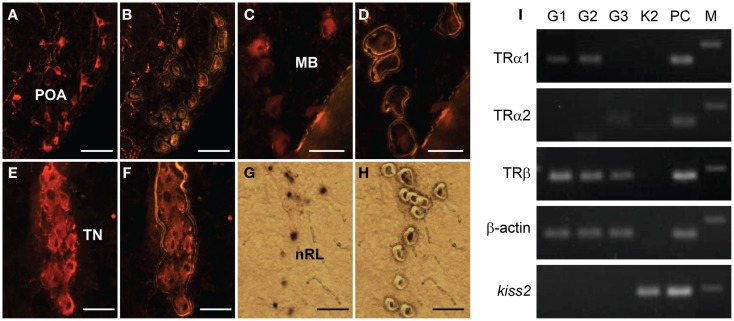
Kisspeptin has recently been recognized as a critical regulator of reproductive function in vertebrates. During the sexual development, kisspeptin neurons receive sex steroids feedback to trigger gonadotropin-releasing hormone (GnRH) neurons. In teleosts, a positive correlation has been found between the thyroid status and the reproductive status. However, the role of thyroid hormone in the regulation of kisspeptin system remains unknown. We cloned and characterized a gene encoding kisspeptin (kiss2) in a cichlid fish, the Nile tilapia (Oreochromis niloticus). Expression of kiss2 mRNA in the brain was analyzed by in situ hybridization. The effect of thyroid hormone (triiodothyronine, T3) and hypothyroidism with methimazole (MMI) on kiss2 and the three GnRH types (gnrh1, gnrh2, and gnrh3) mRNA expression was analyzed by real-time PCR. Expression of thyroid hormone receptor mRNAs were analyzed in laser-captured kisspeptin and GnRH neurons by RT-PCR. The kiss2 mRNA expressing cells were seen in the nucleus of the lateral recess in the hypothalamus. Intraperitoneal administration of T3 (5 μg/g body weight) to sexually mature male tilapia significantly increased kiss2 and gnrh1 mRNA levels at 24 h post injection (P < 0.001), while the treatment with an anti-thyroid, MMI (100 ppm for 6 days) significantly reduced kiss2 and gnrh1 mRNA levels (P < 0.05). gnrh2, gnrh3, and thyrotropin-releasing hormone mRNA levels were insensitive to the thyroid hormone manipulations. Furthermore, RT-PCR showed expression of thyroid hormone receptor mRNAs in laser-captured GnRH neurons but not in kiss2 neurons. This study shows that GnRH1 may be directly regulated through thyroid hormone, while the regulation of Kiss2 by T3 is more likely to be indirect.
Kisspeptin 最近被认为是脊椎动物生殖功能的关键调节因子。在性发育过程中,kisspeptin 神经元接收性激素反馈以触发促性腺激素释放激素 (GnRH) 神经元。在鱼类中,已经发现甲状腺状态与生殖状态之间存在正相关关系。然而,甲状腺激素在 kisspeptin 系统调节中的作用仍不清楚。我们克隆并鉴定了一种丽鱼科鱼类,尼罗罗非鱼(Oreochromis niloticus)中的 kisspeptin(kiss2)基因。通过原位杂交分析了 kiss2 mRNA 在大脑中的表达。通过实时 PCR 分析了甲状腺激素(三碘甲状腺原氨酸,T3)和甲状腺功能减退症(甲巯咪唑,MMI)对 kiss2 和三种 GnRH 类型(gnrh1、gnrh2 和 gnrh3)mRNA 表达的影响。通过 RT-PCR 分析了激光捕获的 kisspeptin 和 GnRH 神经元中的甲状腺激素受体 mRNA 的表达。在视交叉上核的外侧隐窝核中观察到 kiss2 mRNA 表达细胞。向性成熟雄性罗非鱼腹腔内注射 T3(5μg/g 体重)显著增加 kiss2 和 gnrh1 mRNA 水平,在注射后 24 小时(P<0.001),而用抗甲状腺素 MMI(100ppm 处理 6 天)显著降低 kiss2 和 gnrh1 mRNA 水平(P<0.05)。gnrh2、gnrh3 和促甲状腺素释放激素 mRNA 水平对甲状腺激素处理不敏感。此外,RT-PCR 显示在激光捕获的 GnRH 神经元中表达甲状腺激素受体 mRNAs,但在 kiss2 神经元中不表达。这项研究表明 GnRH1 可能直接受到甲状腺激素的调节,而 T3 对 Kiss2 的调节更可能是间接的。