Li Wei, Yi Lina, Su Juan, Lu Jing, Ke Changwen, Zeng Hanri, Guan Dawei, Ma Cong, Zhang Wanly, Xiao Hong, Li Hui, Lin Jinyan, Zhang Yonghui
Center of Pathogen Detection Research for Emerging Infectious Diseases, Guangdong Provincial Center for Disease Control and Prevention, Guangzhou, China ; Key Laboratory of Pathogen Detection for Emergency Response, Guangdong Provincial Center for Disease Control and Prevention, Guangzhou, China ; Key Laboratory of Depository and Application for Pathogenic Microbiology, Guangdong Provincial Centre for Disease Control and Prevention, Guangzhou, China.
PLoS One. 2013 Dec 4;8(12):e80515. doi: 10.1371/journal.pone.0080515. eCollection 2013.
Human Enterovirus 71 and Coxsackie A16 have caused many outbreaks in the last decade in mainland China, resulting in thousands of fatal cases. Seroepidemiology which provides important information to document population immunity is rare in China.
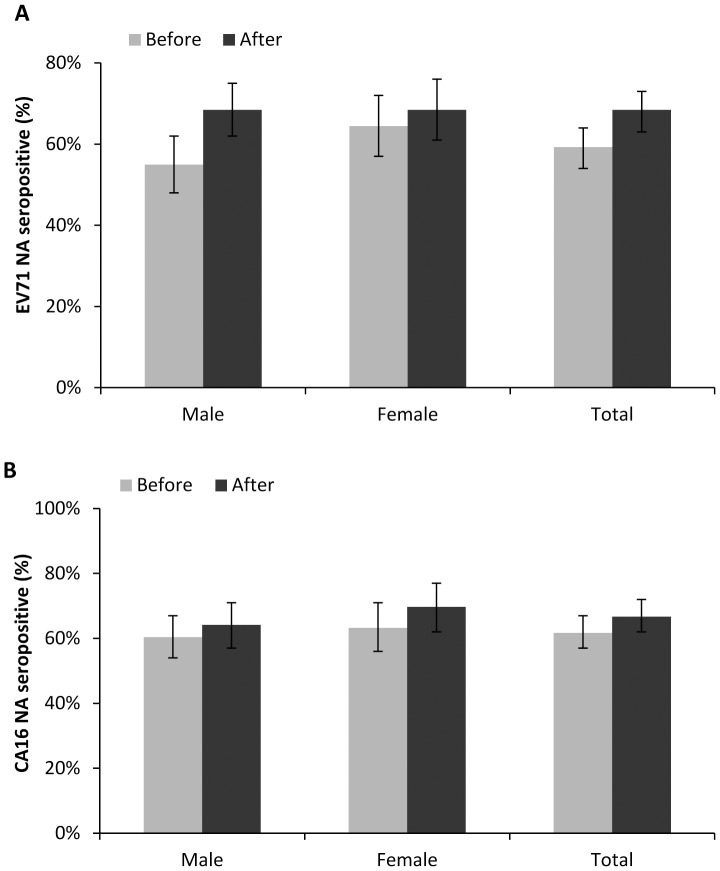
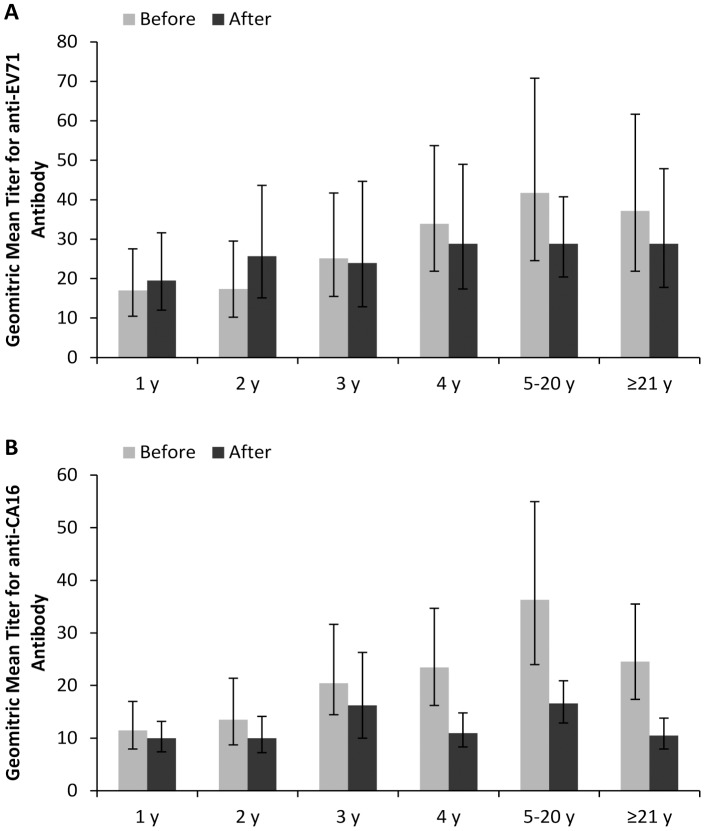
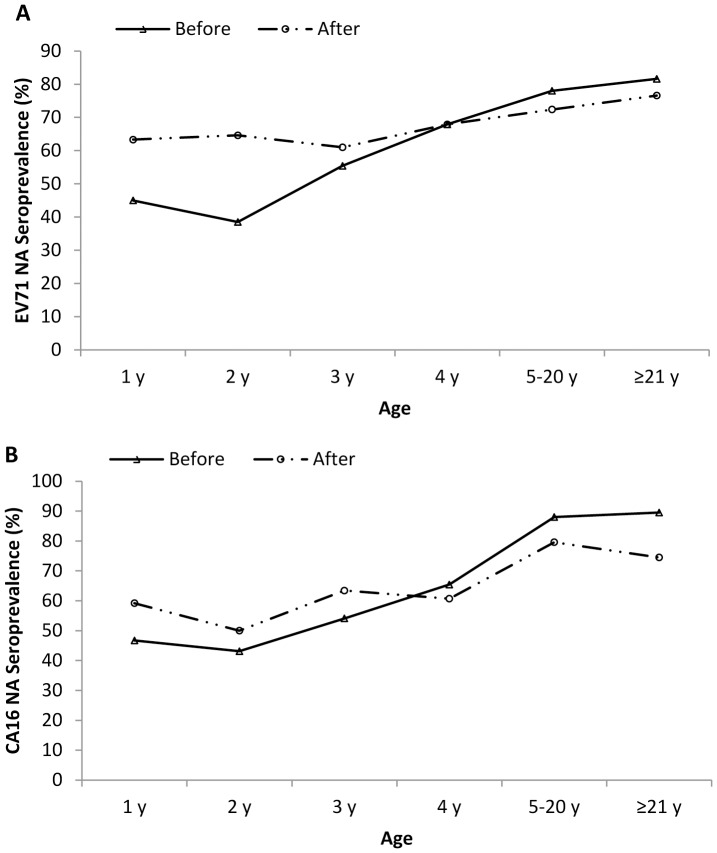
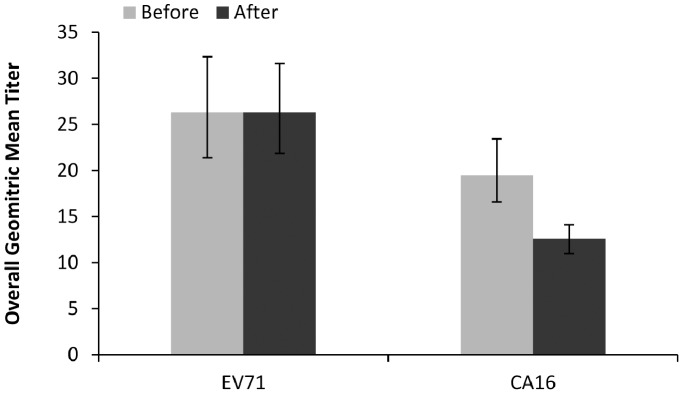
METHODOLOGY/PRINCIPAL FINDINGS: A cross sectional study of Enterovirus 71 (EV71) and Coxsackie A16 (CA16) seroprevalence was carried out in Guangdong, China, pre- and post- the 2010 hand, foot and mouth disease (HFMD) epidemic period. The levels of EV71 and CA16 specific antibodies were evaluated by a microneutralization test and the geometric mean titer (GMT) was calculated and compared. Our results indicated frequent infection by EV71 and CA16 in Guangdong before the 2010 epidemic. Only EV71 neutralizing antibody but not CA16 seroprevalence was significantly increased after the 2010 HFMD epidemic. Children less than 3 years old especially those aged 2 years showed the lowest positive rates for EV71 and CA16 NA before epidemic and the most significantly increased EV71 seroprevalence after epidemic. CA16 GMT values declined after the 2010 epidemic.
These results indicate EV71 was the major pathogen of HFMD in Guangdong during the 2010 epidemic. The infection occurs largely in children less than 3 years, who should have first priority to receive an EV71 vaccine.
在过去十年中,肠道病毒71型(Human Enterovirus 71,EV71)和柯萨奇病毒A16型(Coxsackie A16,CA16)在中国内地引发了多次疫情,导致数千例死亡病例。血清流行病学研究可为了解人群免疫力提供重要信息,但在中国此类研究较少。
方法/主要发现:在中国广东,于2010年手足口病(hand, foot and mouth disease,HFMD)流行期前后开展了一项关于EV71和CA16血清流行率的横断面研究。通过微量中和试验评估EV71和CA16特异性抗体水平,并计算和比较几何平均滴度(geometric mean titer,GMT)。我们的结果表明,在2010年疫情之前,广东地区EV71和CA16感染较为频繁。2010年手足口病疫情后,仅EV71中和抗体而非CA16血清流行率显著上升。3岁以下儿童,尤其是2岁儿童,在疫情前EV71和CA16中和抗体阳性率最低,疫情后EV71血清流行率上升最为显著。2010年疫情后CA16的GMT值下降。
这些结果表明,EV71是2010年广东手足口病的主要病原体。感染主要发生在3岁以下儿童中,这些儿童应优先接种EV71疫苗。