Department of Epidemiology, University of Washington, Seattle, Washington, United States of America.
PLoS One. 2013 Dec 4;8(12):e81915. doi: 10.1371/journal.pone.0081915. eCollection 2013.
Traditional methods using microscopy for the detection of helminth infections have limited sensitivity. Polymerase chain reaction (PCR) assays enhance detection of helminths, particularly low burden infections. However, differences in test performance may modify the ability to detect associations between helminth infection, risk factors, and sequelae. We compared these associations using microscopy and PCR.
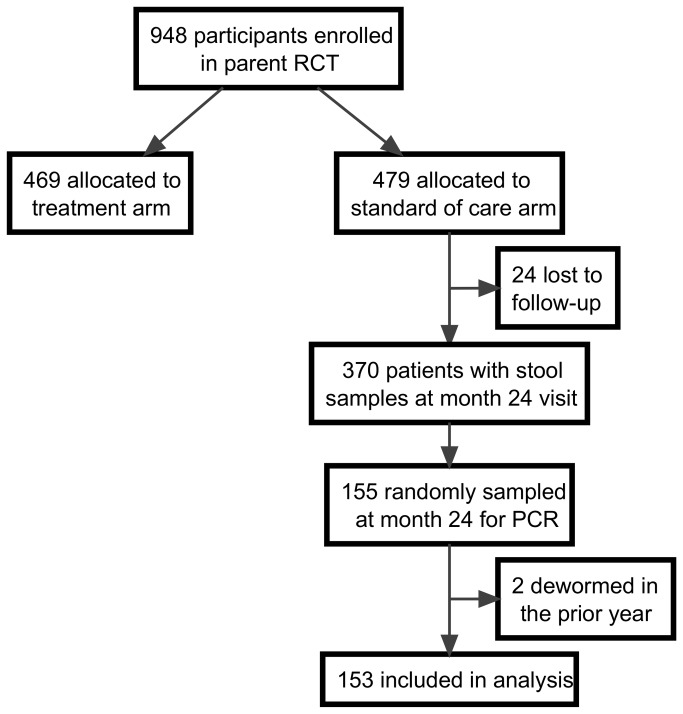
This cross-sectional study was nested within a randomized clinical trial conducted at 3 sites in Kenya. We performed microscopy and real-time multiplex PCR for the stool detection and quantification of Ascaris lumbricoides, Necator americanus, Ancylostoma duodenale, Strongyloides stercoralis, and Schistosoma species. We utilized regression to evaluate associations between potential risk factors or outcomes and infection as detected by either method.
Of 153 HIV-positive adults surveyed, 55(36.0%) and 20(13.1%) were positive for one or more helminth species by PCR and microscopy, respectively (p<0.001). PCR-detected infections were associated with farming (Prevalence Ratio 1.57, 95% CI: 1.02, 2.40), communal water source (PR 3.80, 95% CI: 1.01, 14.27), and no primary education (PR 1.54, 95% CI: 1.14, 2.33), whereas microscopy-detected infections were not associated with any risk factors under investigation. Microscopy-detected infections were associated with significantly lower hematocrit and hemoglobin (means of -3.56% and -0.77 g/dl) and a 48% higher risk of anemia (PR 1.48, 95% CI: 1.17, 1.88) compared to uninfected. Such associations were absent for PCR-detected infections unless infection intensity was considered, Infections diagnosed with either method were associated with increased risk of eosinophilia (PCR PR 2.42, 95% CI: 1.02, 5.76; microscopy PR 2.92, 95% CI: 1.29, 6.60).
Newer diagnostic methods, including PCR, improve the detection of helminth infections. This heightened sensitivity may improve the identification of risk factors for infection while reducing ability to discriminate infections associated with adverse clinical outcomes. Quantitative assays can be used to differentiate infection loads and discriminate infections associated with sequelae.
传统的显微镜检测方法对寄生虫感染的检测灵敏度有限。聚合酶链反应(PCR)检测可提高寄生虫的检测能力,特别是对低负担感染的检测能力。然而,检测性能的差异可能会改变检测寄生虫感染、危险因素和后遗症之间关联的能力。我们使用显微镜和 PCR 比较了这些关联。
这项横断面研究嵌套在肯尼亚 3 个地点进行的一项随机临床试验中。我们对粪便进行显微镜检查和实时多重 PCR 检测,以检测和定量检测蛔虫、美洲钩虫、十二指肠钩虫、粪类圆线虫和血吸虫种。我们利用回归来评估潜在危险因素或结局与两种方法检测到的感染之间的关联。
在接受调查的 153 名 HIV 阳性成年人中,分别有 55 名(36.0%)和 20 名(13.1%)通过 PCR 和显微镜检测到一种或多种寄生虫种,差异有统计学意义(P<0.001)。PCR 检测到的感染与农业(优势比 1.57,95%可信区间:1.02,2.40)、公共水源(优势比 3.80,95%可信区间:1.01,14.27)和未接受过小学教育(优势比 1.54,95%可信区间:1.14,2.33)有关,而显微镜检测到的感染与任何调查中的危险因素无关。与未感染者相比,显微镜检测到的感染与显著较低的红细胞压积和血红蛋白(平均值分别为-3.56%和-0.77 g/dl)和 48%更高的贫血风险(优势比 1.48,95%可信区间:1.17,1.88)相关。PCR 检测到的感染也存在这种关联,除非考虑感染强度。两种方法诊断的感染与嗜酸性粒细胞增多症的风险增加有关(PCR 优势比 2.42,95%可信区间:1.02,5.76;显微镜优势比 2.92,95%可信区间:1.29,6.60)。
包括 PCR 在内的新诊断方法提高了寄生虫感染的检测能力。这种更高的灵敏度可能会提高对感染危险因素的识别能力,同时降低对与不良临床结局相关的感染的区分能力。定量检测可用于区分感染负荷,并区分与后遗症相关的感染。