College of Medicine and Health Sciences, Bahir Dar University, Bahir Dar City, Ethiopia P.O. Box 79.
Biology Department, Science College, Bahir Dar University, Bahir Dar City, Ethiopia P.O. Box 79.
Biomed Res Int. 2020 Nov 15;2020:2868564. doi: 10.1155/2020/2868564. eCollection 2020.
is an intestinal parasitic infection mainly caused by . Although it is a predominant parasite in tropics and subtropics where sanitation and hygiene are poorly practiced, the true prevalence of s is not known due to low-sensitivity diagnostic methods.
This systematic review and meta-analysis is aimed at determining the pooled prevalence of s in African countries, stratified by diagnostic methods, study settings, and patients.
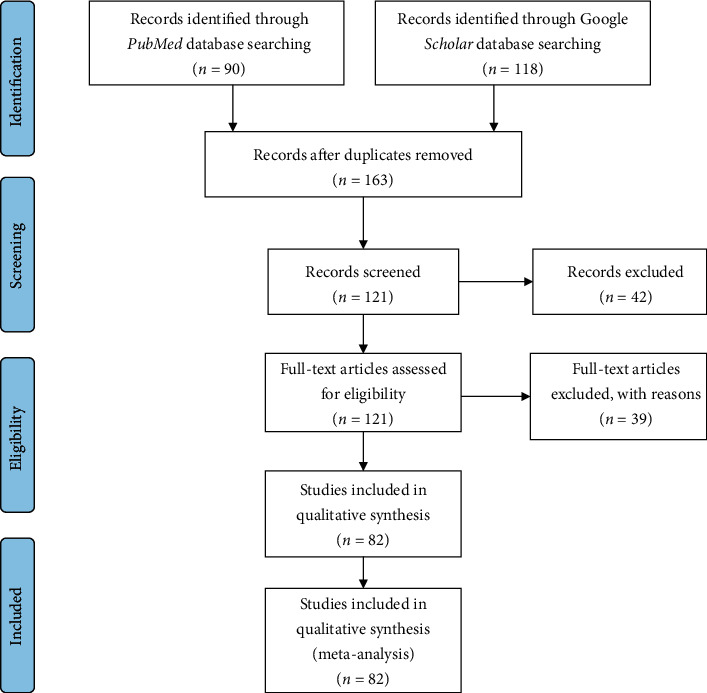
Cross-sectional studies on strongyloidiasis published in African countries from the year 2008 up to 2018 in PubMed and Google Scholar databases and which reported at least one spp. infection were included. Identification and screening of eligible articles were also done. Articles whose focus was on in animals, soil, and foreigners infected by spp. in Africa were excluded. The random effects model was used to calculate the pooled prevalence of s across African countries as well as by diagnostic methods and study settings. The heterogeneity between studies was also computed.
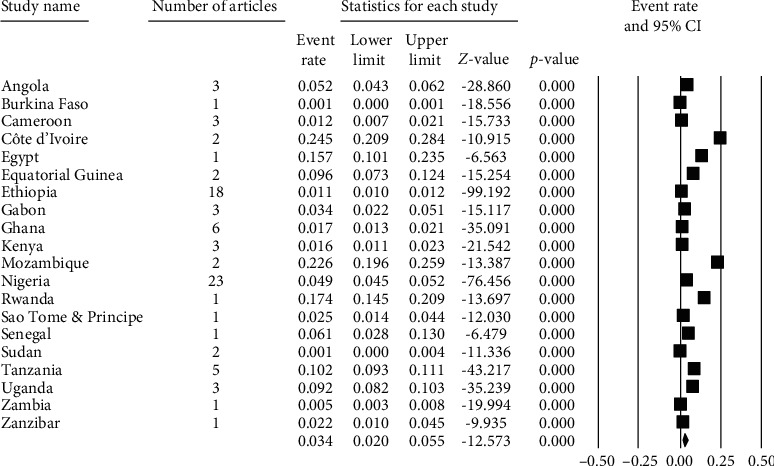
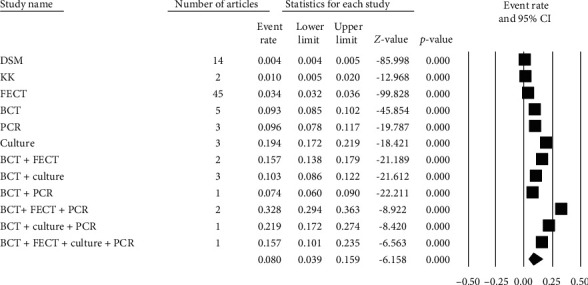
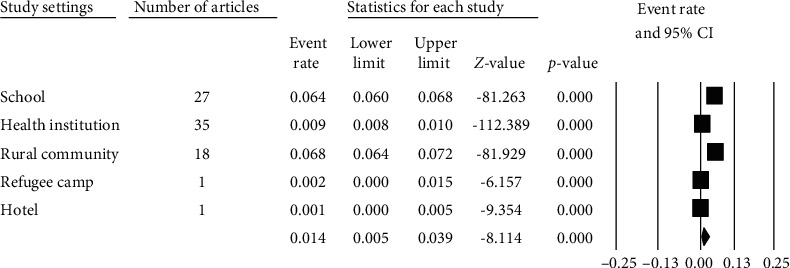
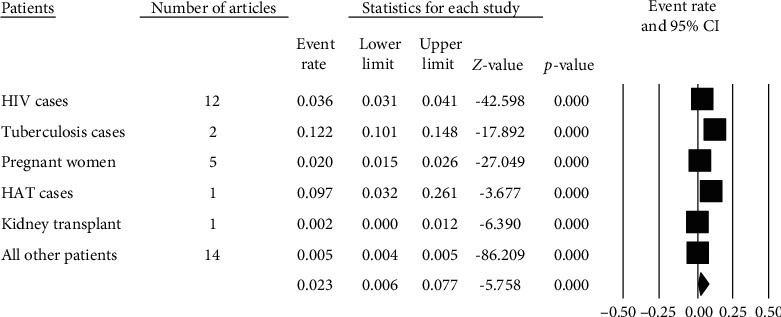
A total of 82 studies were included. The overall pooled prevalence of s was 2.7%. By individual techniques, the pooled prevalence of strongyloidiasis was 0.4%, 1.0%, 3.4%, 9.3%, 9.6%, and 19.4% by the respective direct saline microscopy, Kato-Katz, formol ether concentration, polymerase chain reaction, Baermann concentration, and culture diagnostic techniques. The prevalence rates of strongyloidiasis among rural community, school, and health institution studies were 6.8%, 6.4%, and 0.9%, respectively. The variation on the effect size comparing African countries, diagnostic methods, study settings, and patients was significant ( ≤ 0.001).
This review shows that strongyloidiasis is overlooked and its prevalence is estimated to be low in Africa due to the use of diagnostic methods with low sensitivity. Therefore, there is a need for using a combination of appropriate diagnostic methods to approach the actual rates in Africa.
是一种主要由 引起的肠道寄生虫感染。尽管它是热带和亚热带地区卫生条件较差地区的主要寄生虫,但由于诊断方法灵敏度低,其实际流行率尚不清楚。
本系统评价和荟萃分析旨在确定非洲国家按诊断方法、研究环境和患者分层的 感染的总流行率。
检索 2008 年至 2018 年在 PubMed 和 Google Scholar 数据库中发表的关于非洲国家 感染的横断面研究,这些研究报告了至少一种 spp. 感染。还进行了合格文章的识别和筛选。排除关注非洲动物、土壤和被 spp. 感染的外国人的文章。使用随机效应模型计算整个非洲国家 感染的总流行率以及按诊断方法和研究环境分层的流行率。还计算了研究之间的异质性。
共纳入 82 项研究。 的总体流行率为 2.7%。按个体技术,直接盐水显微镜、加藤氏法、福尔马林乙醚浓缩法、聚合酶链反应、贝曼氏浓缩法和培养诊断技术的 感染的总流行率分别为 0.4%、1.0%、3.4%、9.3%、9.6%和 19.4%。农村社区、学校和医疗机构研究中的 感染率分别为 6.8%、6.4%和 0.9%。比较非洲国家、诊断方法、研究环境和患者的效果大小变化具有显著性(≤0.001)。
本综述表明,由于使用灵敏度低的诊断方法, 感染在非洲被忽视,其流行率估计较低。因此,需要结合使用适当的诊断方法来了解非洲的实际流行率。