School of Biology, Georgia Institute of Technology Atlanta, Georgia, 30332 ; Department of Ecology and Evolutionary Biology University of Michigan, 2019 Kraus Natural Science Building, 830 North University, Ann Arbor, MI 48109-1048.
Ecol Evol. 2013 Oct;3(12):4129-38. doi: 10.1002/ece3.777. Epub 2013 Sep 23.
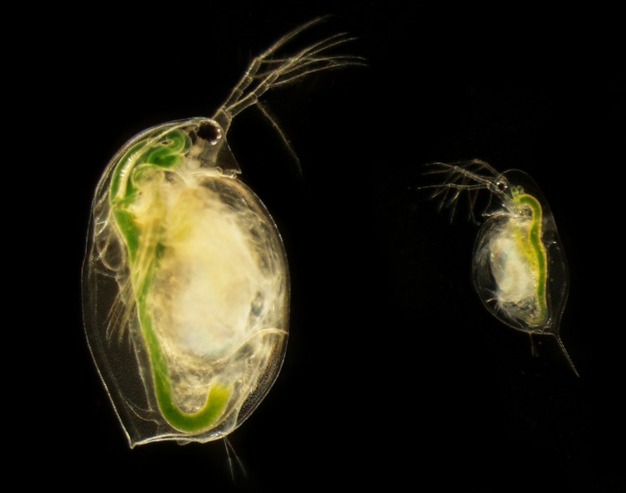
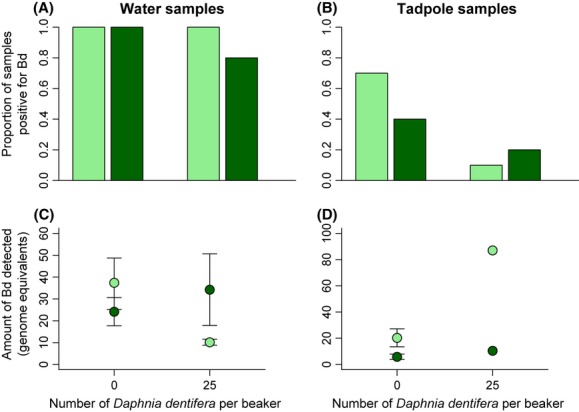
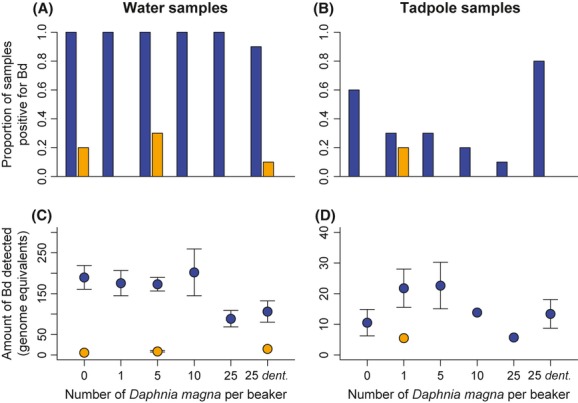
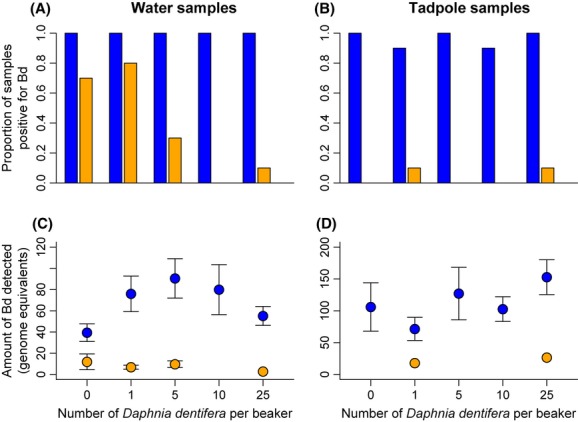
Direct predation upon parasites has the potential to reduce infection in host populations. For example, the fungal parasite of amphibians, Batrachochytrium dendrobatidis (Bd), is commonly transmitted through a free-swimming zoospore stage that may be vulnerable to predation. Potential predators of Bd include freshwater zooplankton that graze on organisms in the water column. We tested the ability of two species of freshwater crustacean (Daphnia magna and D. dentifera) to consume Bd and to reduce Bd density in water and infection in tadpoles. In a series of laboratory experiments, we allowed Daphnia to graze in water containing Bd while manipulating Daphnia densities, Daphnia species identity, grazing periods and concentrations of suspended algae (Ankistrodesmus falcatus). We then exposed tadpoles to the grazed water. We found that high densities of D. magna reduced the amount of Bd detected in water, leading to a reduction in the proportion of tadpoles that became infected. Daphnia dentifera, a smaller species of Daphnia, also reduced Bd in water samples, but did not have an effect on tadpole infection. We also found that algae affected Bd in complex ways. When Daphnia were absent, less Bd was detected in water and tadpole samples when concentrations of algae were higher, indicating a direct negative effect of algae on Bd. When Daphnia were present, however, the amount of Bd detected in water samples showed the opposite trend, with less Bd when densities of algae were lower. Our results indicate that Daphnia can reduce Bd levels in water and infection in tadpoles, but these effects vary with species, algal concentration, and Daphnia density. Therefore, the ability of predators to consume parasites and reduce infection is likely to vary depending on ecological context.
直接捕食寄生虫有可能减少宿主群体中的感染。例如,两栖动物的真菌寄生虫——蛙壶菌(Batrachochytrium dendrobatidis,Bd)通常通过自由游动的游动孢子阶段传播,游动孢子可能容易受到捕食。Bd 的潜在捕食者包括以水柱中的生物为食的淡水浮游动物。我们测试了两种淡水甲壳类动物(大型溞和弯额溞)消耗 Bd 的能力,以及它们降低水中 Bd 密度和感染蝌蚪的能力。在一系列实验室实验中,我们让大型溞在含有 Bd 的水中放牧,同时操纵大型溞的密度、大型溞和弯额溞的物种身份、放牧时间和悬浮藻类(安克斯特拉德斯姆斯 falcatus)的浓度。然后,我们将蝌蚪暴露于放牧过的水中。我们发现,大型溞的高密度降低了水中检测到的 Bd 数量,从而降低了感染蝌蚪的比例。较小的弯额溞也降低了水样中的 Bd,但对蝌蚪感染没有影响。我们还发现藻类以复杂的方式影响 Bd。当大型溞不存在时,藻类浓度较高时,水中和蝌蚪样本中检测到的 Bd 较少,表明藻类对 Bd 有直接的负面影响。然而,当大型溞存在时,水样中检测到的 Bd 数量则呈现相反的趋势,藻类密度较低时,Bd 较少。我们的结果表明,大型溞可以降低水中的 Bd 水平和蝌蚪的感染,但这些影响因物种、藻类浓度和大型溞密度而异。因此,捕食者消耗寄生虫和减少感染的能力可能取决于生态背景。