Arquint M, Roder J, Chia L S, Down J, Wilkinson D, Bayley H, Braun P, Dunn R
Proc Natl Acad Sci U S A. 1987 Jan;84(2):600-4. doi: 10.1073/pnas.84.2.600.
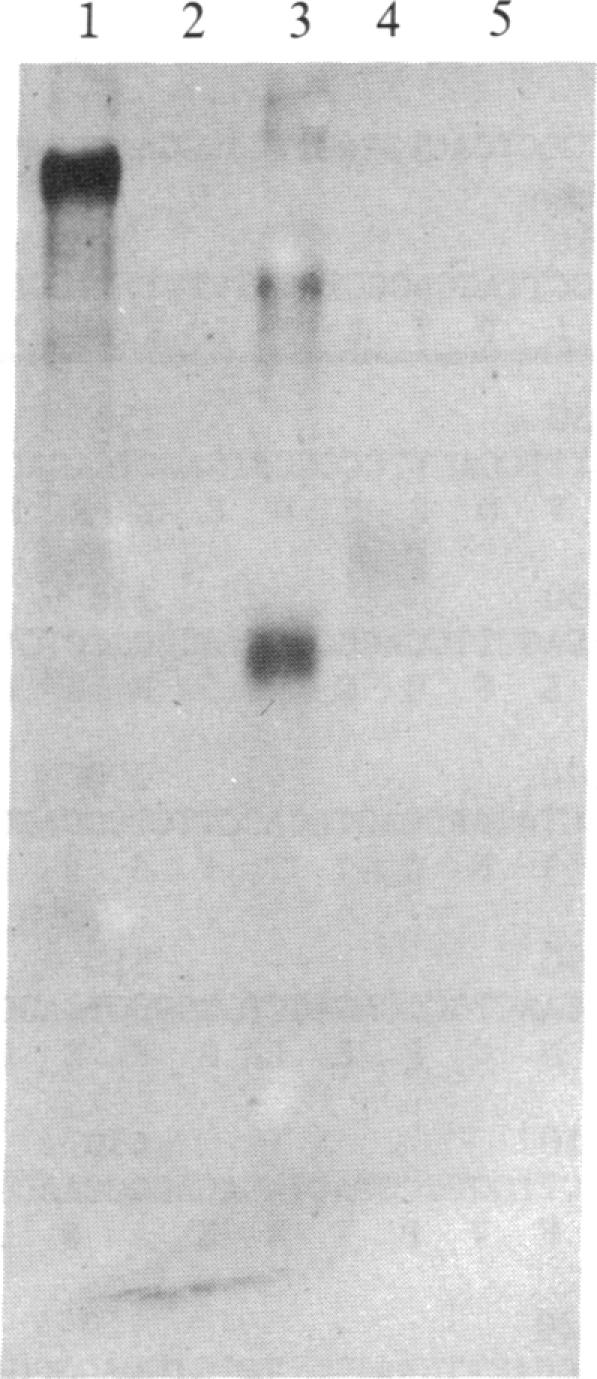
Myelin-associated glycoprotein (MAG) may play a role in the cellular interactions leading to myelination. Using monoclonal antibodies and conventional antisera against MAG, we have isolated a cDNA clone from an expression library prepared from rat brain mRNA. The identity of the clone was confirmed by the exact match between its nucleotide sequence and two peptide sequences of 13 and 9 amino acids that we obtained by Edman degradation of two CNBr fragments of MAG. The cDNA clone hybridized to two size species of mRNA in rat approximately 3.5 kilobases in length. These mRNAs were present in brain but not liver and were expressed most abundantly at the time of active myelination (day 14). The mRNA for MAG was present at barely detectable levels in hypomyelinating jimpy mice compared to normal littermate controls. Therefore the MAG cDNA clone is both brain and myelin specific. DNA sequence analysis revealed that our MAG cDNA was derived from the same mRNA as clone p1B236, a randomly selected, brain-specific, partial cDNA isolated by Sutcliffe et al. [Sutcliffe, J. G., Milner, R. J., Shinnick, T. M. & Bloom, F. E. (1983) Cell 33, 671-682]. Analysis of the predicted protein sequence suggests that MAG has a long extracellular domain (499 amino acids), followed by a short transmembrane segment (20 amino acids) and an intracellular carboxyl-terminal domain (90 amino acids). The molecule has several glycosylation sites, three internal repeats homologous to a repeat in the neural cell adhesion molecule (N-CAM), and sites for phosphorylation near the carboxyl terminus. The primary structure reported here provides a molecular framework for further investigations into the function of the MAG molecule.
髓鞘相关糖蛋白(MAG)可能在导致髓鞘形成的细胞相互作用中发挥作用。利用针对MAG的单克隆抗体和传统抗血清,我们从大鼠脑mRNA制备的表达文库中分离出一个cDNA克隆。通过其核苷酸序列与我们通过对MAG的两个溴化氰片段进行埃德曼降解获得的13个和9个氨基酸的两个肽序列的精确匹配,证实了该克隆的身份。该cDNA克隆与大鼠中两种长度约为3.5千碱基的mRNA大小种类杂交。这些mRNA存在于脑中而非肝脏中,并且在活跃髓鞘形成时(第14天)表达最为丰富。与正常同窝对照相比,在髓鞘形成不足的jimpy小鼠中,MAG的mRNA水平几乎检测不到。因此,MAG cDNA克隆具有脑和髓鞘特异性。DNA序列分析表明,我们的MAG cDNA与克隆p1B236源自相同的mRNA,p1B236是由Sutcliffe等人随机选择的、脑特异性的部分cDNA [Sutcliffe, J. G., Milner, R. J., Shinnick, T. M. & Bloom, F. E. (1983) Cell 33, 671 - 682]。对预测的蛋白质序列的分析表明,MAG具有一个长的细胞外结构域(499个氨基酸),随后是一个短的跨膜片段(20个氨基酸)和一个细胞内羧基末端结构域(90个氨基酸)。该分子有几个糖基化位点、三个与神经细胞粘附分子(N-CAM)中的一个重复序列同源的内部重复序列,以及靠近羧基末端的磷酸化位点。此处报道的一级结构为进一步研究MAG分子的功能提供了分子框架。