Department of Medicine, Geriatric Medicine Division, Indiana University School of Medicine, Indianapolis, IN, USA.
Department of Psychiatry, Institute of Psychiatric Research, Indiana University School of Medicine, Indianapolis, IN, USA.
J Alzheimers Dis. 2014;40(1):1-17. doi: 10.3233/JAD-131544.
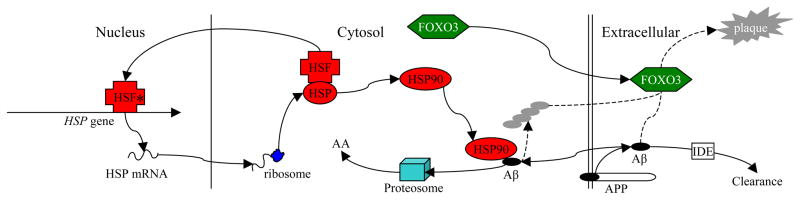
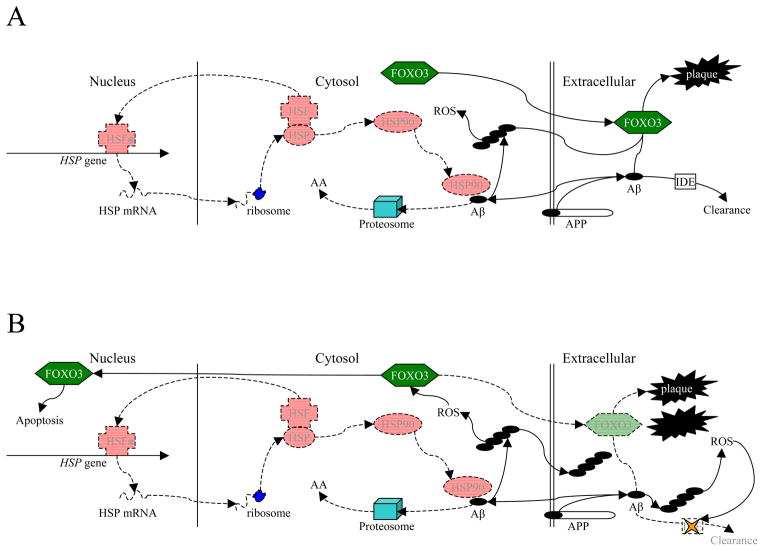
Late-onset Alzheimer's disease (LOAD) is the most common neurodegenerative disorder in older adults, affecting over 50% of those over age 85. Aging is the most important risk factor for the development of LOAD. Aging is associated with the decrease in the ability of cells to cope with cellular stress, especially protein aggregation. Here we describe how the process of aging affects pathways that control the processing and degradation of abnormal proteins including amyloid-β (Aβ). Genetic association studies in LOAD have successfully identified a large number of genetic variants involved in the development of the disease. However, there is a gap in understanding the interconnections between these pathomolecular events that prevent us from discovering therapeutic targets. We propose novel, pertinent links to elucidate how the biology of aging affects the sequence of events in the development of LOAD. Furthermore we analyze and synthesize the molecular-pathologic-clinical correlations of the aging process, involving the HSF1 and FOXO family pathways, Aβ metabolic pathway, and the different clinical stages of LOAD. Our new model postulates that the aging process would precede Aβ accumulation, and attenuation of HSF1 is an "upstream" event in the cascade that results in excess Aβ and synaptic dysfunction, which may lead to cognitive impairment and/or trigger "downstream" neurodegeneration and synaptic loss. Specific host factors, such as the activity of FOXO family pathways, would mediate the response to Aβ toxicity and the pace of progression toward the clinical manifestations of AD.
迟发性阿尔茨海默病(LOAD)是老年人中最常见的神经退行性疾病,影响超过 85 岁的人群的 50%以上。衰老时 LOAD 发生的最重要危险因素。衰老与细胞应对细胞应激的能力下降有关,尤其是蛋白聚集。在这里,我们描述了衰老过程如何影响控制异常蛋白(包括淀粉样β(Aβ))加工和降解的途径。LOAD 中的遗传关联研究成功鉴定了许多涉及疾病发展的遗传变异。然而,我们对于这些阻止我们发现治疗靶点的病理分子事件之间的相互联系存在理解上的差距。我们提出了新的、相关的联系,以阐明衰老生物学如何影响 LOAD 发展过程中的事件顺序。此外,我们分析和综合了涉及 HSF1 和 FOXO 家族途径、Aβ代谢途径和 LOAD 不同临床阶段的衰老过程的分子病理临床相关性。我们的新模型假设衰老过程会先于 Aβ 积累,而 HSF1 的衰减是导致 Aβ 过量和突触功能障碍的级联反应中的“上游”事件,这可能导致认知障碍和/或触发“下游”神经退行性变和突触丧失。特定的宿主因素,如 FOXO 家族途径的活性,将介导对 Aβ 毒性的反应以及向 AD 临床表现进展的速度。