Laboratório de Imunologia e Biologia Molecular, Departamento de Biointeração, Instituto de Ciências da Saúde, Universidade Federal da Bahia, Av, Reitor Miguel Calmon, S/N - Vale do Canela, Salvador, BA CEP 40140-100, Brazil.
BMC Vet Res. 2013 Dec 13;9:254. doi: 10.1186/1746-6148-9-254.
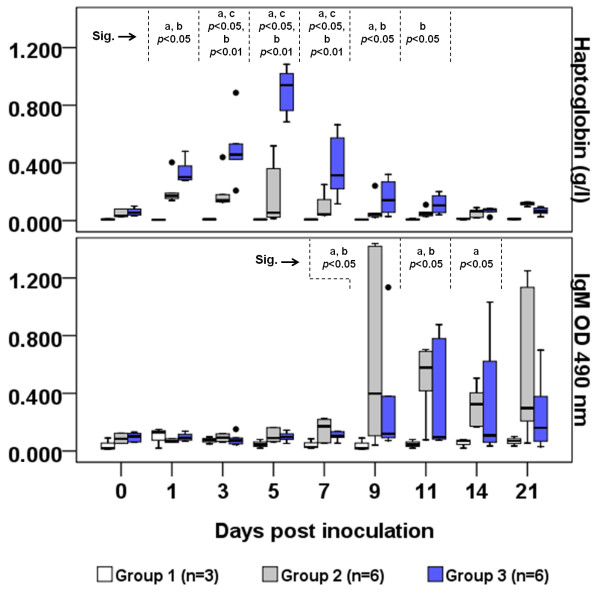
Sheep caseous lymphadenitis (CLA), caused by Corynebacterium pseudotuberculosis (Cp), is associated with direct economic losses and presents significant zoonotic potential. Despite the importance of the disease, a satisfactory vaccine model has not been developed. Thus, this study aimed to investigate the association between haptoglobin (Hp) and IgM levels and the clinical progression of CLA in primarily infected sheep and in sheep immunized with Cp- secreted antigens adjuvanted with Quillaja saponaria saponins. These animals were kept with CLA-positive sheep to simulate natural exposure that occurs in field conditions. During the experiment, the Hp and IgM levels were monitored for 21 days, and the development of internal CLA lesions was investigated through necropsies on day182 post-immunization.
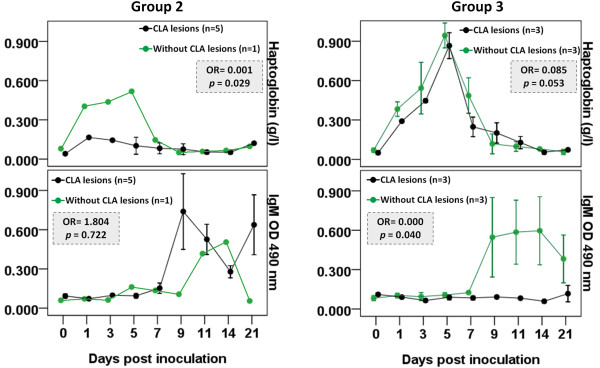
Primarily infected sheep in Group 2 (inoculated with 2x10⁵ Cp virulent strain) had higher Hp values between the first and ninth days post inoculation (PI) than sheep in Group 1 (control; P < 0.05). Immunized animals in Group 3 had significantly higher Hp values between the third and seventh days PI, compared with the control group (P < 0.01). Binary logistic regression (BLR) analysis of primarily infected sheep indicated an association between Hp concentration and CLA clinical progression: animals with high Hp values had 99.9% less risk of having CLA abscesses than animals with low Hp levels (Odds ratio = 0.001, P < 0.05). Both experimental groups had significantly higher IgM titers than the control group around the ninth and eleventh days PI (P < 0.05). The BLR analysis for immunized sheep indicated an association between IgM levels and clinical progression: sheep with high IgM titers had 100.0% less risk of having CLA abscesses than animals with low IgM levels (Odds ratio = 0.000, P < 0.05).
Resistance to C. pseudotuberculosis infection is supported by the early acute phase response, in which up-regulation of Hp and IgM were predictive of a lower risk of CLA lesion development. Because the immunogen used in this study induced a high production of both Hp and IgM, Q. saponaria saponin should be considered a promising candidate in vaccine formulations against sheep CLA.
绵羊干酪性淋巴结炎(CLA)由棒状杆菌伪结核亚种(Cp)引起,与直接经济损失有关,并具有重要的人畜共患潜力。尽管该疾病很重要,但尚未开发出令人满意的疫苗模型。因此,本研究旨在探讨绵羊感染 Cp 分泌抗原后,结合皂树皮皂苷作为佐剂,与感染初期绵羊和绵羊的触珠蛋白(Hp)和 IgM 水平与 CLA 临床进展的关系。这些动物被与 CLA 阳性绵羊一起饲养,以模拟野外条件下发生的自然暴露。在实验过程中,监测了 21 天的 Hp 和 IgM 水平,并在免疫后第 182 天通过剖检研究了内部 CLA 病变的发展。
接种 2x10⁵Cp 强毒株的第 2 组(感染组)绵羊在接种后第 1 天至第 9 天的 Hp 值高于第 1 组(对照组;P<0.05)。接种第 3 组的免疫动物在接种后第 3 天至第 7 天的 Hp 值明显高于对照组(P<0.01)。对感染初期绵羊进行二元逻辑回归(BLR)分析表明,Hp 浓度与 CLA 临床进展之间存在关联:Hp 值高的动物发生 CLA 脓肿的风险比 Hp 值低的动物低 99.9%(优势比=0.001,P<0.05)。接种组和对照组在接种后第 9 天和第 11 天的 IgM 滴度均显著高于对照组(P<0.05)。免疫绵羊的 BLR 分析表明,IgM 水平与临床进展之间存在关联:IgM 滴度高的绵羊发生 CLA 脓肿的风险比 IgM 滴度低的动物低 100.0%(优势比=0.000,P<0.05)。
感染 C. pseudotuberculosis 的抵抗力取决于早期急性相反应,其中 Hp 和 IgM 的上调预示着 CLA 病变发展风险较低。由于本研究中使用的免疫原诱导了 Hp 和 IgM 的高产量,因此皂树皮皂苷应该被认为是针对绵羊 CLA 的疫苗制剂的有前途的候选物。