Jia Yitao, Jin Guixing, Guo Shangwei, Gu Bin, Jin Zujian, Gao Xing, Li Zhongxin
Oncology Department, Hebei General Hospital, Shijiazhuang, Hebei, China,
Langenbecks Arch Surg. 2014 Jan;399(1):77-84. doi: 10.1007/s00423-013-1151-9. Epub 2013 Dec 13.
This study aims to investigate the role of fast-track surgery in preventing the development of postoperative delirium and other complications in elderly patients with colorectal carcinoma.
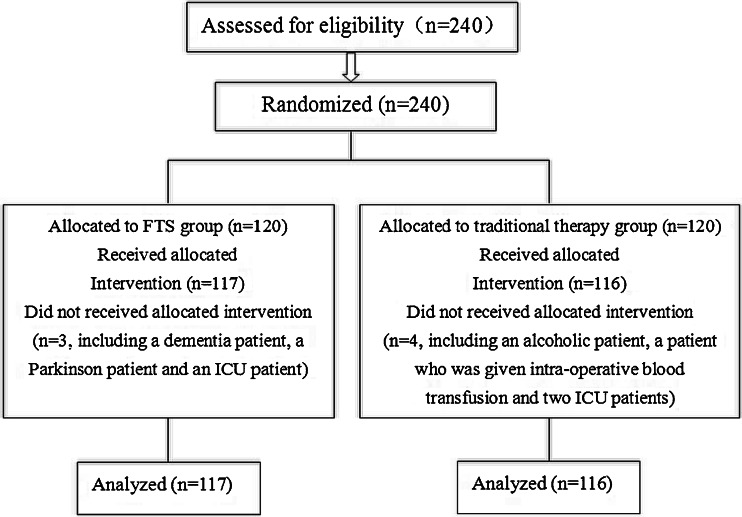
A total of 240 elderly patients with colorectal carcinoma (aged ≥70 years) undergoing open colorectal surgery was randomly assigned into two groups, in which the patients were managed perioperatively either with traditional or fast-track approaches. The length of hospital stay (LOS) and time to pass flatus were compared. The incidence of postoperative delirium and other complications were evaluated. Serum interleukin-6 (IL-6) levels were determined before and after surgery.
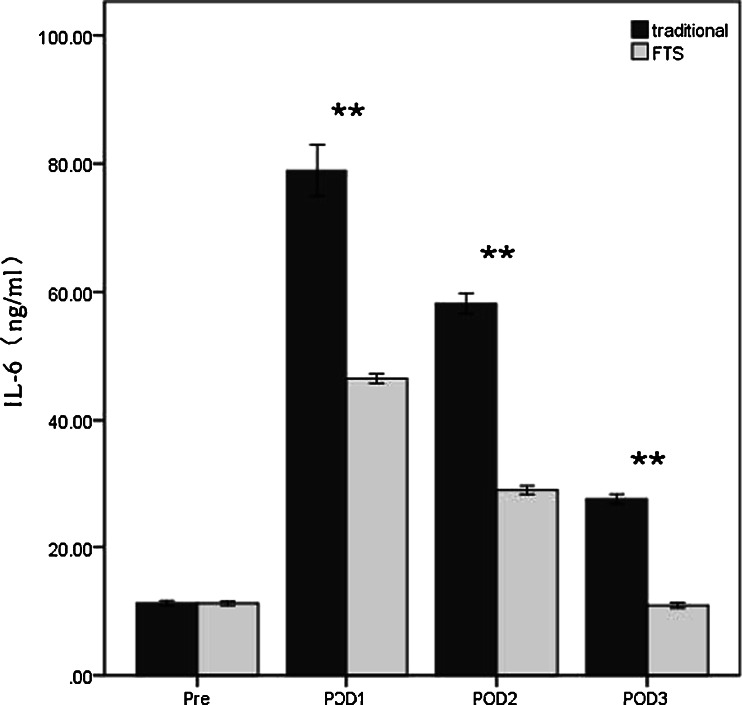
The LOS was significantly shorter in the fast-track surgery (FTS) group than that in the traditional group. The recovery of bowel movement (as indicated by the time to pass flatus) was faster in the FTS group. The postoperative complications including pulmonary infection, urinary infection and heart failure were significantly less frequent in the FTS group. Notably, the incidence of postoperative delirium was significantly lower in patients with the fast track therapy (4/117, 3.4 %) than with the traditional therapy (15/116, 12.9 %; p = 0.008). The serum IL-6 levels on postoperative days 1, 2, and 3 in patients with the fast-track therapy were significantly lower than those with the traditional therapy (p < 0.001).
Compared to traditional perioperative management, fast-track surgery decreases the LOS, facilitates the recovery of bowel movement, and reduces occurrence of postoperative delirium and other complications in elderly patients with colorectal carcinoma. The lower incidence of delirium is at least partly attributable to the reduced systemic inflammatory response mediated by IL-6.
本研究旨在探讨快速康复外科手术在预防老年结直肠癌患者术后谵妄及其他并发症发生中的作用。
将240例接受开放性结直肠手术的老年结直肠癌患者(年龄≥70岁)随机分为两组,分别采用传统围手术期管理方法或快速康复方法。比较两组患者的住院时间(LOS)和排气时间。评估术后谵妄及其他并发症的发生率。测定手术前后血清白细胞介素-6(IL-6)水平。
快速康复外科手术(FTS)组的住院时间显著短于传统组。FTS组肠道运动恢复更快(以排气时间表示)。FTS组术后包括肺部感染、尿路感染和心力衰竭在内的并发症明显较少。值得注意的是,快速康复治疗组患者术后谵妄的发生率显著低于传统治疗组(4/117,3.4% 对比 15/116,12.9%;p = 0.008)。快速康复治疗组患者术后第1、2和3天的血清IL-6水平显著低于传统治疗组(p < 0.001)。
与传统围手术期管理相比,快速康复外科手术可缩短老年结直肠癌患者的住院时间,促进肠道运动恢复,并减少术后谵妄及其他并发症的发生。谵妄发生率较低至少部分归因于IL-6介导的全身炎症反应减轻。