Scholkmann Felix, Holper Lisa, Wolf Ursula, Wolf Martin
Biomedical Optics Research Laboratory, Division of Neonatology, University Hospital Zurich Zurich, Switzerland ; Institute for Complementary Medicine, University of Bern Bern, Switzerland.
Biomedical Optics Research Laboratory, Division of Neonatology, University Hospital Zurich Zurich, Switzerland.
Front Hum Neurosci. 2013 Nov 27;7:813. doi: 10.3389/fnhum.2013.00813.
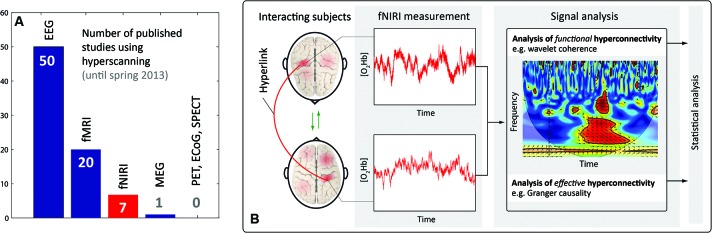
Since the first demonstration of how to simultaneously measure brain activity using functional magnetic resonance imaging (fMRI) on two subjects about 10 years ago, a new paradigm in neuroscience is emerging: measuring brain activity from two or more people simultaneously, termed "hyperscanning". The hyperscanning approach has the potential to reveal inter-personal brain mechanisms underlying interaction-mediated brain-to-brain coupling. These mechanisms are engaged during real social interactions, and cannot be captured using single-subject recordings. In particular, functional near-infrared imaging (fNIRI) hyperscanning is a promising new method, offering a cost-effective, easy to apply and reliable technology to measure inter-personal interactions in a natural context. In this short review we report on fNIRI hyperscanning studies published so far and summarize opportunities and challenges for future studies.
大约10年前首次展示了如何使用功能磁共振成像(fMRI)同时测量两名受试者的大脑活动,神经科学领域正在出现一种新的范式:同时测量两个或更多人的大脑活动,即“超扫描”。超扫描方法有可能揭示人际互动介导的脑对脑耦合背后的人际大脑机制。这些机制在真实的社交互动中发挥作用,无法通过单受试者记录来捕捉。特别是,功能近红外成像(fNIRI)超扫描是一种很有前景的新方法,它提供了一种经济高效、易于应用且可靠的技术,用于在自然环境中测量人际互动。在这篇简短的综述中,我们报告了迄今为止发表的fNIRI超扫描研究,并总结了未来研究的机遇与挑战。