Department of Clinical Laboratory, Peking University People's Hospital, Beijing, China.
Department of Clinical Laboratory, the First Hospital of China Medical University, Shenyang, Liaoning, China.
PLoS One. 2013 Dec 11;8(12):e82361. doi: 10.1371/journal.pone.0082361. eCollection 2013.
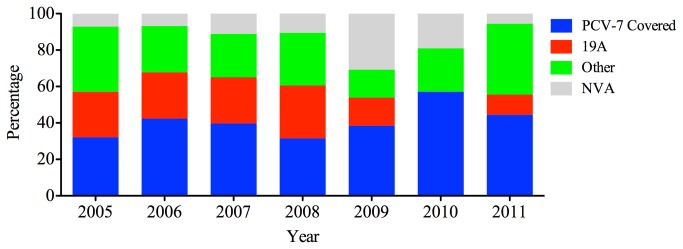
Streptococcus pneumoniae is an important pathogen in both children and the elderly, but previous studies in China have provided limited information about invasive pneumococcal disease (IPD). A total of 240 IPD S. pneumoniae strains (from 105 children and 135 adults) were collected from 12 cities in China in 2005-2011. Their phenotypes and genetic characteristics were analyzed. Streptococcus pneumoniae remained highly resistant to macrolides, tetracycline, and cotrimoxazole each year. Serotypes were assigned to the 240 isolates, and 19A (22.1%), 19F (21.7%), 14 (7.5%), 3 (7.1%), and 23F (5.4%) were the most prevalent, accounting for 63.8% of all strains. Serogroup 19 strains were significantly more common among children than among adults (58.7% vs 32.4%, respectively; P < 0.001). Serotypes 19F and 19A demonstrated higher resistance to β-lactams and cephalosporins than the other serotypes. The coverage of PCV13 was superior to that calculated for PCV7 and PCV10 (77.9% vs 40.8% and 47.1%, respectively), and coverage was higher in children than in adults (85.6% vs 72.1%, respectively; P = 0.012). A multilocus sequence typing analysis revealed great diversity, with nine clonal complexes and 83 singletons among all the strains. Specifically, CC271 was more common in children, whereas singletons were more prevalent in adults. Among the serogroup 19 strains, 84.7% were ST271, ST320, or ST236, belonging to CC271. The homogeneous genetic background of 19F and 19A, together with the high resistance of these strains, suggests that clonal spread is responsible for the high prevalence of serogroup 19 in IPD. This is the first large study to investigate IPD strains in both children and adults in China.
肺炎链球菌是儿童和老年人的重要病原体,但中国之前的研究提供了有限的侵袭性肺炎球菌病(IPD)信息。2005-2011 年,从中国 12 个城市收集了 240 株 IPD 肺炎链球菌(105 例儿童和 135 例成人)。分析了它们的表型和遗传特征。肺炎链球菌对大环内酯类、四环素和复方磺胺甲噁唑的耐药率每年都很高。对 240 株分离株进行血清型分析,19A(22.1%)、19F(21.7%)、14(7.5%)、3(7.1%)和 23F(5.4%)最为常见,占所有菌株的 63.8%。19 群菌株在儿童中明显比在成人中更为常见(分别为 58.7%和 32.4%;P<0.001)。血清型 19F 和 19A 对β-内酰胺类和头孢菌素的耐药性高于其他血清型。PCV13 的覆盖率优于 PCV7 和 PCV10(分别为 77.9%、40.8%和 47.1%),且在儿童中的覆盖率高于成人(分别为 85.6%和 72.1%;P=0.012)。多位点序列分型分析显示存在很大的多样性,所有菌株中有 9 个克隆复合体和 83 个单克隆。具体而言,CC271 在儿童中更为常见,而单克隆在成人中更为常见。在 19 群菌株中,84.7%为 ST271、ST320 或 ST236,属于 CC271。19F 和 19A 的同源遗传背景,加上这些菌株的高耐药性,表明克隆传播是导致 19 群血清型在 IPD 中高流行的原因。这是首次在中国对儿童和成人 IPD 菌株进行的大型研究。