Key Laboratory of Major Diseases in Children and National Key Discipline of Pediatrics-Capital Medical University, Ministry of Education, Beijing Pediatric Research Institute, Beijing Children's Hospital, Capital Medical University, No. 56 Nan-li-shi Road, Beijing 100045, China.
BMC Microbiol. 2012 Oct 9;12:228. doi: 10.1186/1471-2180-12-228.
Streptococcus pneumoniae is the main pathogen that causes respiratory infections in children younger than five years. The increasing incidence of macrolide- and tetracycline-resistant pneumococci among children has been a serious problem in China for many years. The molecular characteristics of erythromycin-resistant pneumococcal isolates that were collected from pediatric patients younger than five years in Beijing in 2010 were analyzed in this study.
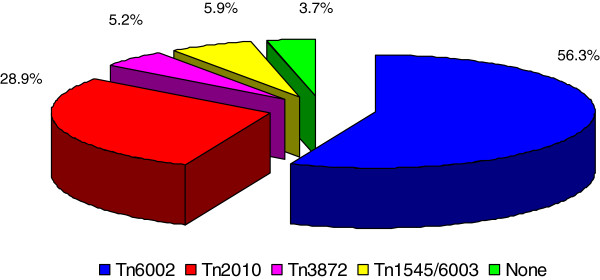
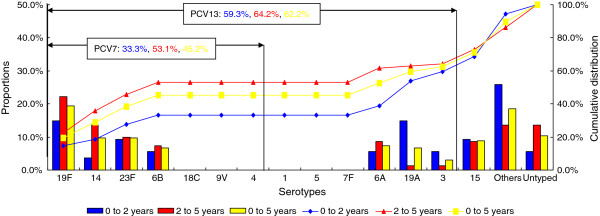
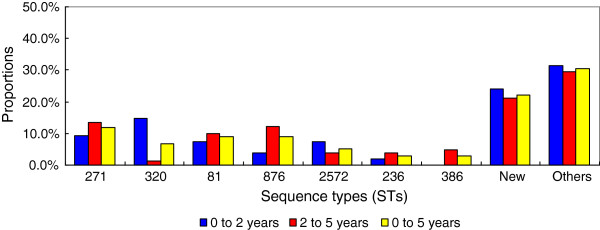
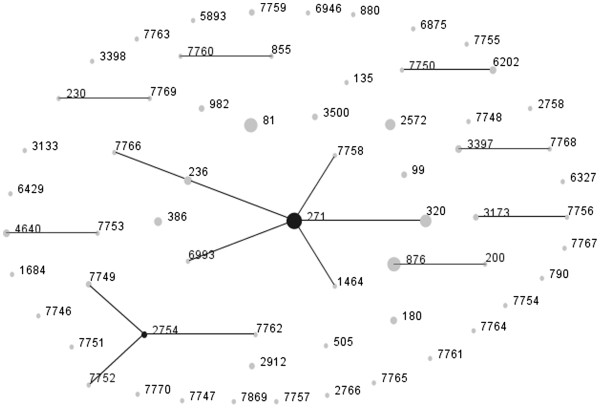
A total of 140 pneumococcal isolates were collected. The resistance rates of all isolates to erythromycin and tetracycline were 96.4% and 79.3%, respectively. Of the 135 erythromycin-resistant pneumococci, 91.1% were non-susceptible to tetracycline. In addition, 30.4% of the erythromycin-resistant isolates expressed both the ermB and mef genes, whereas 69.6% expressed the ermB gene but not the mef gene. Up to 98.5% of the resistant isolates exhibited the cMLSB phenotype, and Tn6002 was the most common transposon present in approximately 56.3% of the resistant isolates, followed by Tn2010, with a proportion of 28.9%. The dominant sequence types (STs) in all erythromycin-resistant S. pneumoniae were ST271 (11.9%), ST81 (8.9%), ST876 (8.9%), and ST320 (6.7%), whereas the prevailing serotypes were 19F (19.3%), 23F (9.6%), 14 (9.6%), 15 (8.9%), and 6A (7.4%). The 7-valent pneumococcal conjugate vaccine (PCV7) and 13-valent pneumococcal conjugate vaccine (PCV13) coverage of the erythromycin-resistant pneumococci among the children younger than five years were 45.2% and 62.2%, respectively. ST320 and serotype 19A pneumococci were common in children aged 0 to 2 years. CC271 was the most frequent clonal complex (CC), which accounts for 24.4% of all erythromycin-resistant isolates.
The non-invasive S. pneumoniae in children younger than five years in Beijing presented high and significant resistance rates to erythromycin and tetracycline. The expressions of ermB and tetM genes were the main factors that influence pneumococcal resistance to erythromycin and tetracycline, respectively. Majority of the erythromycin-resistant non-invasive isolates exhibited the cMLSB phenotype and carried the ermB, tetM, xis, and int genes, suggesting the spread of the transposons of the Tn916 family. PCV13 provided higher serotype coverage in the childhood pneumococcal diseases caused by the erythromycin-resistant isolates better than PCV7. Further long-term surveys are required to monitor the molecular characteristics of the erythromycin-resistant S. pneumoniae in children.
肺炎链球菌是导致 5 岁以下儿童呼吸道感染的主要病原体。多年来,中国儿童中耐大环内酯类和四环素类肺炎链球菌的发生率不断上升,一直是一个严重的问题。本研究分析了 2010 年北京 5 岁以下儿科患者分离的红霉素耐药肺炎链球菌分离株的分子特征。
共收集了 140 株肺炎链球菌。所有分离株对红霉素和四环素的耐药率分别为 96.4%和 79.3%。在 135 株红霉素耐药肺炎链球菌中,91.1%对四环素不敏感。此外,30.4%的红霉素耐药株同时表达 ermB 和 mef 基因,而 69.6%表达 ermB 基因而不表达 mef 基因。高达 98.5%的耐药株表现出 cMLSB 表型,tn6002 是最常见的转座子,约占 56.3%的耐药株,tn2010 次之,占 28.9%。所有红霉素耐药肺炎链球菌的主要序列类型(STs)为 ST271(11.9%)、ST81(8.9%)、ST876(8.9%)和 ST320(6.7%),而主要血清型为 19F(19.3%)、23F(9.6%)、14(9.6%)、15(8.9%)和 6A(7.4%)。7 价肺炎球菌结合疫苗(PCV7)和 13 价肺炎球菌结合疫苗(PCV13)对 5 岁以下儿童红霉素耐药肺炎球菌的覆盖率分别为 45.2%和 62.2%。ST320 和血清型 19A 肺炎球菌在 0 至 2 岁儿童中较为常见。CC271 是最常见的克隆群(CC),占所有红霉素耐药分离株的 24.4%。
北京 5 岁以下儿童的非侵袭性肺炎链球菌对红霉素和四环素的耐药率较高且显著。ermB 和 tetM 基因的表达是影响肺炎链球菌对红霉素和四环素耐药性的主要因素。大多数红霉素耐药的非侵袭性分离株表现出 cMLSB 表型,并携带 ermB、tetM、xis 和 int 基因,提示 Tn916 家族转座子的传播。PCV13 对红霉素耐药肺炎球菌引起的儿童肺炎球菌疾病的血清型覆盖率高于 PCV7。需要进一步进行长期监测,以监测儿童中红霉素耐药肺炎链球菌的分子特征。