School of Public Health, The University of Hong Kong, Hong Kong SAR, China.
Center for Community-Based Research, Dana-Farber Cancer Institute/Department of Social and Behavioral Sciences, Harvard School of Public Health, Boston, Massachusetts, United States of America.
PLoS One. 2013 Dec 13;8(12):e82720. doi: 10.1371/journal.pone.0082720. eCollection 2013.
Poor self-rated health (SRH) is socially patterned with health communication inequalities, arguably, serving as one mechanisms. This study investigated the effects of health information seeking on SRH, and its mediation effects on disparities in SRH.
We conducted probability-based telephone surveys administered over telephone in 2009, 2010/11 and 2012 to monitor health information use among 4553 Chinese adults in Hong Kong. Frequency of information seeking from television, radio, newspapers/magazines and Internet was dichotomised as <1 time/month and ≥ 1 time/month. Adjusted odds ratios (aOR) for poor SRH were calculated for health information seeking from different sources and socioeconomic status (education and income). Mediation effects of health information seeking on the association between SES and poor SRH was estimated.
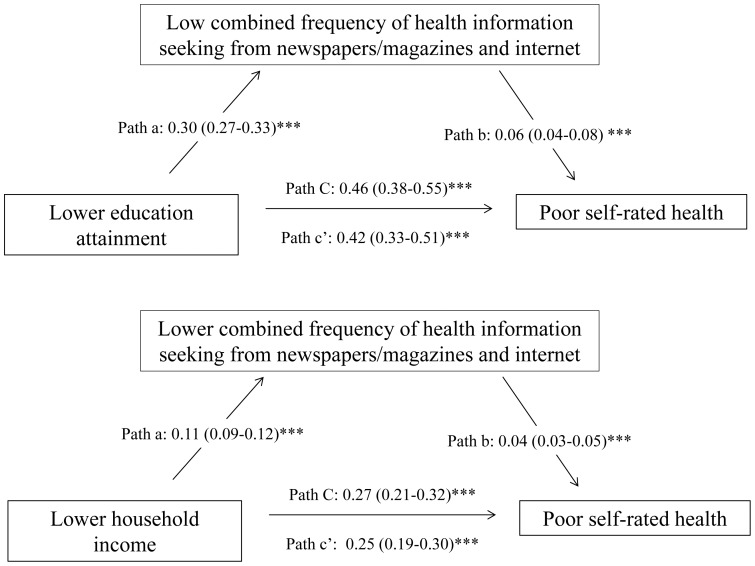
Poor SRH was associated with lower socioeconomic status (P for trend <0.001), and less than monthly health information seeking from newspapers/magazines (aOR = 1.23, 95% CI 1.07-1.42) and Internet (aOR = 1.13, 95% CI 0.98-1.31). Increasing combined frequency of health information seeking from newspapers/magazines and Internet was linearly associated with better SRH (P for trend <0.01). Health information seeking from these two sources contributed 9.2% and 7.9% of the total mediation effects of education and household income on poor SRH, respectively.
Poor SRH was associated with lower socioeconomic status, and infrequent health information seeking from newspapers/magazines and Internet among Hong Kong Chinese. Disparities in SRH may be partially mediated by health information seeking from newspapers/magazines and Internet.
较差的自我报告健康状况(SRH)在社会上存在模式化,健康传播不平等可以说是其中一个机制。本研究调查了健康信息寻求对 SRH 的影响,以及其对 SRH 差异的中介作用。
我们于 2009 年、2010/11 年和 2012 年进行了基于概率的电话调查,以监测香港 4553 名成年人的健康信息使用情况。电视、广播、报纸/杂志和互联网的信息寻求频率被分为<1 次/月和≥1 次/月。使用不同来源和社会经济地位(教育和收入)的健康信息寻求来计算较差 SRH 的调整优势比(aOR)。估计了健康信息寻求对 SES 和较差 SRH 之间关联的中介作用。
较差的 SRH 与较低的社会经济地位相关(趋势 P<0.001),以及较少的每月从报纸/杂志(aOR=1.23,95%CI 1.07-1.42)和互联网(aOR=1.13,95%CI 0.98-1.31)获取健康信息。报纸/杂志和互联网上的健康信息寻求频率增加与 SRH 改善呈线性相关(趋势 P<0.01)。这两个来源的健康信息寻求分别对教育和家庭收入对较差 SRH 的总中介效应贡献了 9.2%和 7.9%。
较差的 SRH 与香港华人中较低的社会经济地位以及较少的从报纸/杂志和互联网获取健康信息有关。SRH 的差异可能部分通过从报纸/杂志和互联网获取健康信息来介导。