Kim Ji Young, Ko Young-Jin, Rhee Chul Woo, Park Byung-Joo, Kim Dong-Hyun, Bae Jong-Myon, Shin Myung-Hee, Lee Moo-Song, Li Zhong Min, Ahn Yoon-Ok
Department of Preventive Medicine, Seoul National University College of Medicine, Seoul, Korea.
Department of Preventive Medicine, Seoul National University College of Medicine, Seoul, Korea. ; Korea Institute of Drug Safety and Risk Management, Seoul, Korea.
J Prev Med Public Health. 2013 Nov;46(6):319-28. doi: 10.3961/jpmph.2013.46.6.319. Epub 2013 Nov 28.
This study estimated the association of cardiovascular health behaviors with the risk of all-cause and cardiovascular disease (CVD) mortality in middle-aged men in Korea.
In total, 12 538 men aged 40 to 59 years were enrolled in 1993 and followed up through 2011. Cardiovascular health metrics defined the following lifestyle behaviors proposed by the American Heart Association: smoking, physical activity, body mass index, diet habit score, total cholesterol, blood pressure, and fasting blood glucose. The cardiovascular health metrics score was calculated as a single categorical variable, by assigning 1 point to each ideal healthy behavior. A Cox proportional hazards regression model was used to estimate the hazard ratio of cardiovascular health behavior. Population attributable risks (PARs) were calculated from the significant cardiovascular health metrics.
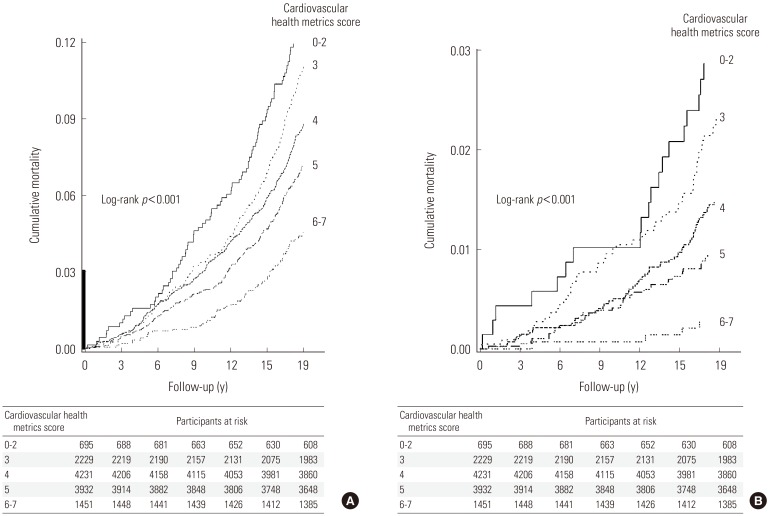
There were 1054 total and 171 CVD deaths over 230 690 person-years of follow-up. The prevalence of meeting all 7 cardiovascular health metrics was 0.67%. Current smoking, elevated blood pressure, and high fasting blood glucose were significantly associated with all-cause and CVD mortality. The adjusted PARs for the 3 significant metrics combined were 35.2% (95% confidence interval [CI], 21.7 to 47.4) and 52.8% (95% CI, 22.0 to 74.0) for all-cause and CVD mortality, respectively. The adjusted hazard ratios of the groups with a 6-7 vs. 0-2 cardiovascular health metrics score were 0.42 (95% CI, 0.31 to 0.59) for all-cause mortality and 0.10 (95% CI, 0.03 to 0.29) for CVD mortality.
Among cardiovascular health behaviors, not smoking, normal blood pressure, and recommended fasting blood glucose levels were associated with reduced risks of all-cause and CVD mortality. Meeting a greater number of cardiovascular health metrics was associated with a lower risk of all-cause and CVD mortality.
本研究评估了韩国中年男性心血管健康行为与全因死亡及心血管疾病(CVD)死亡风险之间的关联。
1993年共纳入12538名年龄在40至59岁的男性,并随访至2011年。心血管健康指标定义了美国心脏协会提出的以下生活方式行为:吸烟、身体活动、体重指数、饮食习惯评分、总胆固醇、血压和空腹血糖。心血管健康指标得分作为一个单一分类变量进行计算,每项理想健康行为赋予1分。采用Cox比例风险回归模型估计心血管健康行为的风险比。从显著的心血管健康指标计算人群归因风险(PARs)。
在230690人年的随访中,共有1054例全因死亡和171例CVD死亡。符合所有7项心血管健康指标的患病率为0.67%。当前吸烟、血压升高和空腹血糖升高与全因死亡和CVD死亡显著相关。这3项显著指标合并后的调整PARs分别为全因死亡35.2%(95%置信区间[CI],21.7至47.4)和CVD死亡52.8%(95%CI,22.0至74.0)。心血管健康指标得分为6 - 7分与0 - 2分的组,调整后的全因死亡风险比为0.42(95%CI,0.31至0.59),CVD死亡风险比为0.10(95%CI,0.03至0.29)。
在心血管健康行为中,不吸烟、血压正常和空腹血糖水平达标与全因死亡和CVD死亡风险降低相关。符合更多心血管健康指标与全因死亡和CVD死亡风险降低相关。