
坦桑尼亚认证药店中补贴型青蒿素复方疗法的推广:库存的决定因素以及早期和晚期采用者的特征。
Diffusion of subsidized ACTs in accredited drug shops in Tanzania: determinants of stocking and characteristics of early and late adopters.
机构信息
Department of Epidemiology, School of Public Health, University of Michigan, 1415 Washington Heights, Ann Arbor, MI 48109-2029, USA.
出版信息
BMC Health Serv Res. 2013 Dec 18;13:526. doi: 10.1186/1472-6963-13-526.
BACKGROUND
Many households in sub-Saharan Africa utilize the private sector as a primary source of treatment for malaria episodes. Expanding access to effective treatment in private drug shops may help reduce incidence of severe disease and mortality. This research leveraged a longitudinal survey of stocking of subsidized artemisinin combination therapies (ACTs), an effective anti-malarial, in Accredited Drug Dispensing Outlets (ADDOs) in two regions of Tanzania. This provided a unique opportunity to explore shop and market level determinants of product diffusion in a developing country retail market.
METHODS
356 ADDOs in the Rukwa and Mtwara regions of Tanzania were surveyed at seven points between Feb 2011 and May 2012. Shop level audits were used to measure the availability of subsidized ACTs at each shop. Data on market and shop level factors were collected during the survey and also extracted from GIS layers. Regression and network based methodologies were used. Shops classified as early and late adopters, following Rogers' model of product diffusion, were compared. The Bass model of product diffusion was applied to determine whether shops stocked ACTs out of a need to imitate market competitors or a desire to satisfy customer needs.
RESULTS
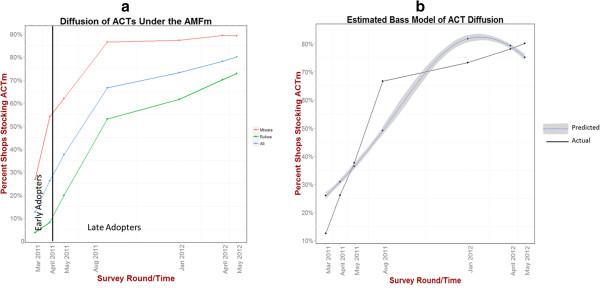
Following the introduction of a subsidy for ACTs, stocking increased from 12% to nearly 80% over the seven survey rounds. Stocking was influenced by higher numbers of proximal shops and clinics, larger customer traffic and the presence of a licensed pharmacist. Early adopters were characterized by a larger percentage of customers seeking care for malaria, a larger catchment and sourcing from specific wholesalers/suppliers. The Bass model of product diffusion indicated that shops were adopting products in response to competitor behavior, rather than customer demand.
CONCLUSIONS
Decisions to stock new pharmaceutical products in Tanzanian ADDOs are influenced by a combination of factors related to both market competition and customer demand, but are particularly influenced by the behavior of competing shops. Efforts to expand access to new pharmaceutical products in developing country markets could benefit from initial targeting of high profile shops in competitive markets and wholesale suppliers to encourage faster product diffusion across all drug retailers.
背景
撒哈拉以南非洲的许多家庭将私营部门作为治疗疟疾的主要来源。在私营药店扩大获得有效治疗的机会可能有助于降低严重疾病和死亡率。这项研究利用了坦桑尼亚两个地区的经认证的药品销售网点(ADDO)中补贴的青蒿素联合疗法(ACT)储备的纵向调查,这是一种有效的抗疟药物,为探索发展中国家零售市场中产品扩散的商店和市场层面决定因素提供了独特的机会。
方法
在 2011 年 2 月至 2012 年 5 月期间的七个时间点,对坦桑尼亚鲁夸和姆特瓦拉地区的 356 家 ADDO 进行了调查。通过商店审计来衡量每个商店补贴的 ACT 的供应情况。调查期间收集了有关市场和商店层面因素的数据,并从 GIS 层中提取了数据。采用了回归和基于网络的方法。根据罗格斯的产品扩散模型,将商店分为早期和晚期采用者进行比较。采用巴斯产品扩散模型来确定商店是否出于模仿市场竞争对手的需要还是出于满足客户需求的愿望而储备 ACT。
结果
在 ACT 补贴推出后,在七个调查回合中,储备量从 12%增加到近 80%。储备受到附近商店和诊所数量增加、客流量增加以及有持牌药剂师的影响。早期采用者的特点是寻求疟疾治疗的患者比例较大,服务范围较大,并且从特定批发商/供应商处采购。巴斯产品扩散模型表明,商店采用产品是为了应对竞争对手的行为,而不是客户的需求。
结论
在坦桑尼亚 ADDO 储备新的药品的决定受到与市场竞争和客户需求相关的一系列因素的影响,但尤其受到竞争商店行为的影响。在发展中国家市场扩大获得新药品的机会可以从针对竞争激烈的市场中的知名商店和批发商的初始目标开始,以鼓励所有药品零售商更快地推广产品。



 Zotero 插件