Center for Watershed Ecology, Institute of Life Science, Nanchang University, Nanchang, P. R. China ; School of Life Sciences and Food Engineering, Nanchang University, Nanchang, P. R. China.
Center for Watershed Ecology, Institute of Life Science, Nanchang University, Nanchang, P. R. China.
PLoS One. 2013 Dec 17;8(12):e84352. doi: 10.1371/journal.pone.0084352. eCollection 2013.
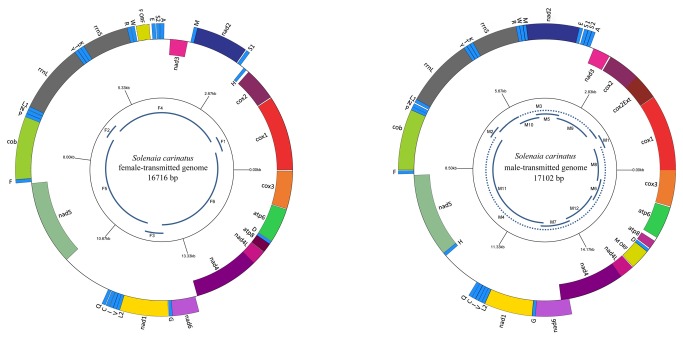
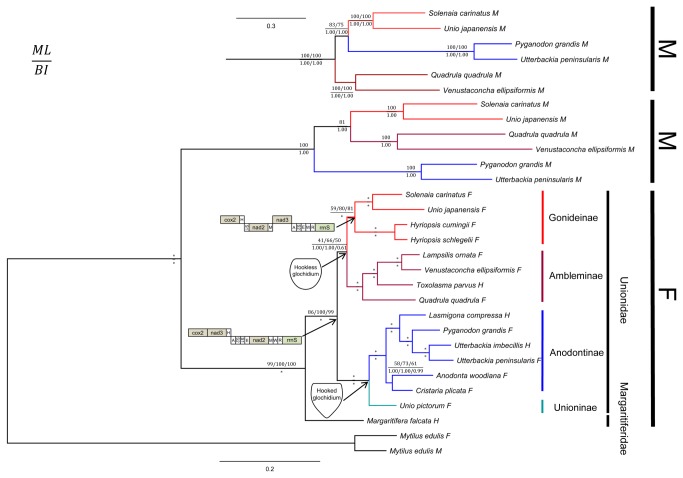
Doubly uniparental inheritance (DUI) is an exception to the typical maternal inheritance of mitochondrial (mt) DNA in Metazoa, and found only in some bivalves. In species with DUI, there are two highly divergent gender-associated mt genomes: maternal (F) and paternal (M), which transmit independently and show different tissue localization. Solenaia carinatus is an endangered freshwater mussel species exclusive to Poyang Lake basin, China. Anthropogenic events in the watershed greatly threaten the survival of this species. Nevertheless, the taxonomy of S. carinatus based on shell morphology is confusing, and the subfamilial placement of the genus Solenaia remains unclear. In order to clarify the taxonomic status and discuss the phylogenetic implications of family Unionidae, the entire F and M mt genomes of S. carinatus were sequenced and compared with the mt genomes of diverse freshwater mussel species. The complete F and M mt genomes of S. carinatus are 16716 bp and 17102 bp in size, respectively. The F and M mt genomes of S. carinatus diverge by about 40% in nucleotide sequence and 48% in amino acid sequence. Compared to F counterparts, the M genome shows a more compact structure. Different gene arrangements are found in these two gender-associated mt genomes. Among these, the F genome cox2-rrnS gene order is considered to be a genome-level synapomorphy for female lineage of the subfamily Gonideinae. From maternal and paternal mtDNA perspectives, the phylogenetic analyses of Unionoida indicate that S. carinatus belongs to Gonideinae. The F and M clades in freshwater mussels are reciprocal monophyly. The phylogenetic trees advocate the classification of sampled Unionidae species into four subfamilies: Gonideinae, Ambleminae, Anodontinae, and Unioninae, which is supported by the morphological characteristics of glochidia.
双重单亲遗传 (DUI) 是 Metazoa 中线粒体 (mt) DNA 典型母系遗传的例外,仅在一些双壳类动物中发现。在具有 DUI 的物种中,有两个高度分化的性别相关 mt 基因组:母系 (F) 和父系 (M),它们独立传递,并显示出不同的组织定位。中华圆田螺是中国鄱阳湖流域特有的濒危淡水贻贝物种。流域内的人为活动极大地威胁了该物种的生存。然而,基于壳形态的中华圆田螺的分类学是混乱的,并且 Solenaia 属的亚科位置仍然不清楚。为了澄清分类学地位并讨论贻贝科的系统发育意义,我们对中华圆田螺的整个 F 和 M mt 基因组进行了测序,并与不同淡水贻贝物种的 mt 基因组进行了比较。中华圆田螺的完整 F 和 M mt 基因组大小分别为 16716 bp 和 17102 bp。F 和 M mt 基因组在核苷酸序列上差异约 40%,在氨基酸序列上差异约 48%。与 F 相比,M 基因组具有更紧凑的结构。在这两个性别相关的 mt 基因组中发现了不同的基因排列。其中,F 基因组 cox2-rrnS 基因顺序被认为是 Gonideinae 亚科雌性谱系的基因组水平的synapomorphy。从母系和父系 mtDNA 的角度来看,Unionoida 的系统发育分析表明中华圆田螺属于 Gonideinae。淡水贻贝的 F 和 M 支系是相互单系的。系统发育树支持将采样的贻贝科物种分为四个亚科:Gonideinae、Ambleminae、Anodontinae 和 Unioninae,这与钩介幼虫的形态特征是一致的。