Department of Molecular and Cellular Pharmacology, University of Miami Miller School of Medicine, Miami, Florida, United States of America.
PLoS One. 2013 Dec 17;8(12):e84575. doi: 10.1371/journal.pone.0084575. eCollection 2013.
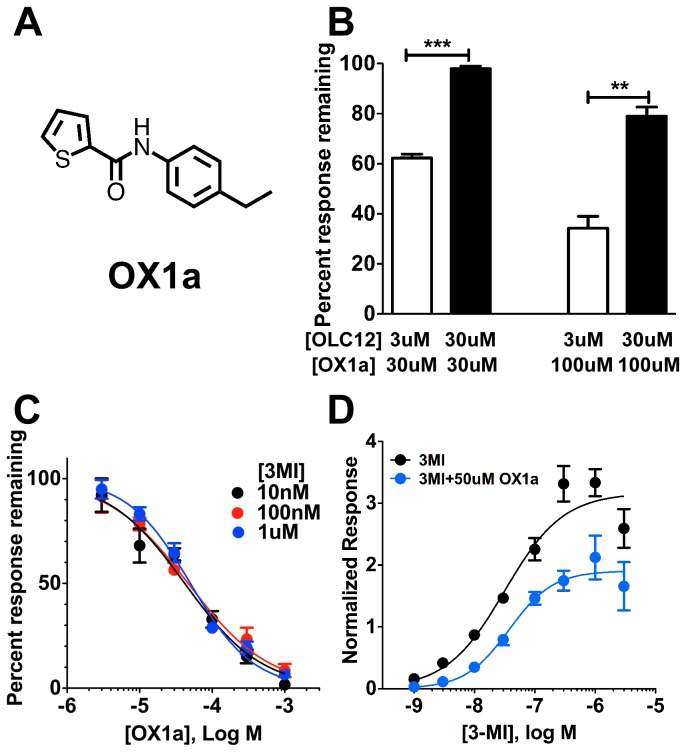
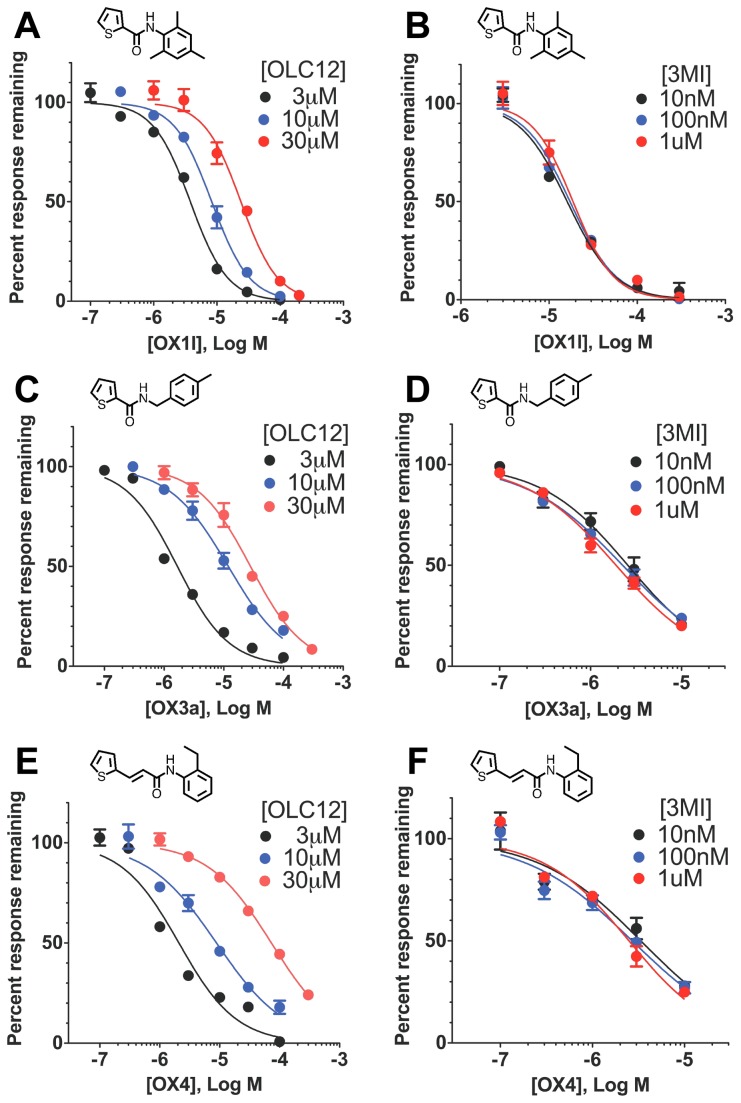
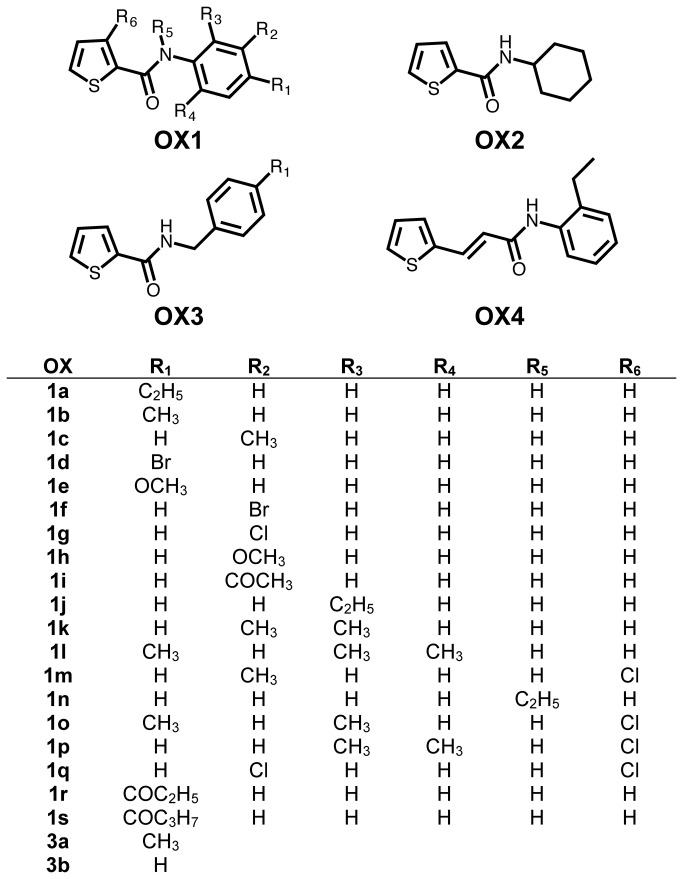
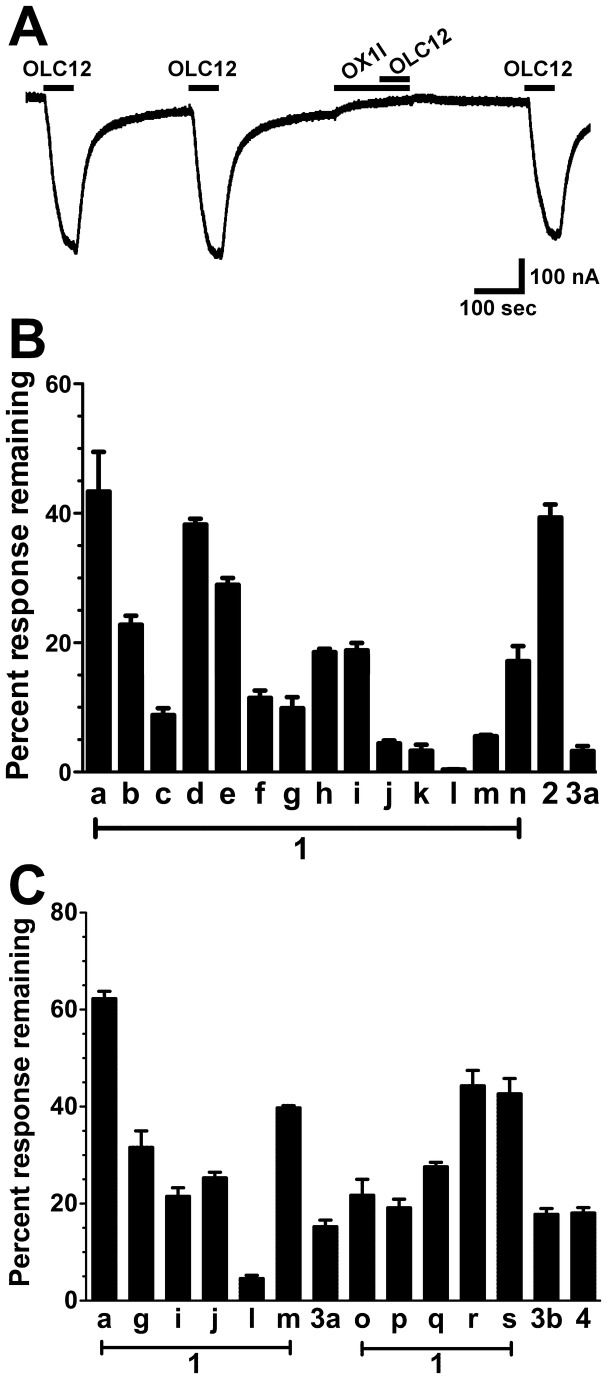
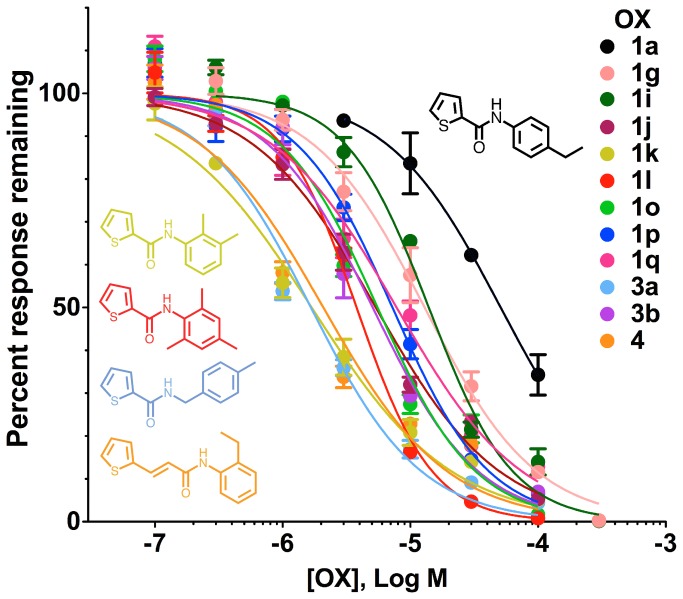
Insects detect environmental chemicals using chemosensory receptors, such as the ORs, a family of odorant-gated ion channels. Insect ORs are multimeric complexes of unknown stoichiometry, formed by a common subunit (the odorant receptor co-receptor subunit, Orco) and one of many variable subunits that confer odorant specificity. The recent discovery of Orco directed ligands, including both agonists and antagonists, suggests Orco as a promising target for chemical control of insects. In addition to competitively inhibiting OR activation by Orco agonists, several Orco antagonists have been shown to act through a non-competitive mechanism to inhibit OR activation by odorants. We previously identified a series of Orco antagonists, including N-(4-ethylphenyl)-2-thiophenecarboxamide (OX1a, previously referred to as OLC20). Here, we explore the chemical space around the OX1a structure to identify more potent Orco antagonists. Cqui\Orco+Cqui\Or21, an OR from Culex quinquefasciatus (the Southern House Mosquito) that responds to 3-methylindole (skatole) and is thought to mediate oviposition behavior, was expressed in Xenopus oocytes and receptor function assayed by two-electrode voltage clamp electrophysiology. 22 structural analogs of OX1a were screened for antagonism of OR activation by an Orco agonist. By varying the moieties decorating the phenyl and thiophene rings, and altering the distance between the rings, we were able to identify antagonists with improved potency. Detailed examination of three of these compounds (N-mesityl-2-thiophenecarboxamide, N-(4-methylbenzyl)-2-thiophenecarboxamide and N-(2-ethylphenyl)-3-(2-thienyl)-2-propenamide) demonstrated competitive inhibition of receptor activation by an Orco agonist and non-competitive inhibition of receptor activation by an odorant. The ability to inhibit OR activation by odorants may be a general property of this class of Orco antagonist, suggesting that odorant mediated behaviors can be manipulated through Orco antagonism. The high conservation of Orco across insect species and previous demonstrations that various Orco ligands are active at ORs derived from several different insect orders suggests that Orco antagonists may have broad applicability.
昆虫利用化学感觉受体(如 ORs)来检测环境中的化学物质,ORs 是一类气味门控离子通道。昆虫 ORs 是未知化学计量的多聚体复合物,由一个共同的亚基(气味受体共受体亚基,Orco)和许多赋予气味特异性的可变亚基之一组成。最近发现的 Orco 导向配体,包括激动剂和拮抗剂,表明 Orco 是昆虫化学控制的一个有前途的靶标。除了竞争性抑制 OR 被 Orco 激动剂的激活外,几种 Orco 拮抗剂已被证明通过非竞争性机制抑制气味剂激活 OR。我们之前鉴定了一系列 Orco 拮抗剂,包括 N-(4-乙基苯基)-2-噻吩甲酰胺(OX1a,以前称为 OLC20)。在这里,我们探索了 OX1a 结构周围的化学空间,以确定更有效的 Orco 拮抗剂。Cqui\Orco+Cqui\Or21,一种来自 Culex quinquefasciatus(南方家蚊)的 OR,对 3-甲基吲哚(粪臭素)有反应,被认为介导产卵行为,在非洲爪蟾卵母细胞中表达,并通过双电极电压钳电生理学测定受体功能。筛选了 22 种 OX1a 的结构类似物,以拮抗 Orco 激动剂对 OR 的激活。通过改变苯环和噻吩环上的取代基,并改变环之间的距离,我们能够鉴定出具有更高效力的拮抗剂。对其中三种化合物(N-间甲苯基-2-噻吩甲酰胺、N-(4-甲基苄基)-2-噻吩甲酰胺和 N-(2-乙基苯基)-3-(2-噻吩基)-2-丙烯酰胺)进行了详细考察,结果表明它们竞争性抑制 OR 被 Orco 激动剂激活,非竞争性抑制 OR 被气味剂激活。抑制 OR 被气味剂激活的能力可能是这类 Orco 拮抗剂的一般特性,这表明通过 Orco 拮抗作用可以操纵气味介导的行为。Orco 在昆虫中的高度保守性,以及各种 Orco 配体在来自几个不同昆虫目的 OR 上都具有活性的先前证明表明,Orco 拮抗剂可能具有广泛的适用性。