Queensland University of Technology, Victoria Park Road, Kelvin Grove, Queensland 4059, Australia.
Int Breastfeed J. 2013 Dec 20;8(1):18. doi: 10.1186/1746-4358-8-18.
Breastfeeding self-efficacy (BFSE) supports breastfeeding initiation and duration. Challenges to breastfeeding may undermine BFSE, but second-line strategies including nipple shields, syringe, cup, supply line and bottle feeding may support breastfeeding until challenges are resolved. The primary aim of this study was to examine BFSE in a sample of women using second-line strategies for feeding healthy term infants in the first week postpartum.
A retrospective self-report study was conducted using the Breastfeeding Self-Efficacy Scale - Short Form (BSES-SF), demographic and infant feeding questionnaires. Breastfeeding women who gave birth to a singleton healthy term infant at one private metropolitan birthing facility in Australia from November 2008 to February 2009 returned anonymous questionnaires by mail.
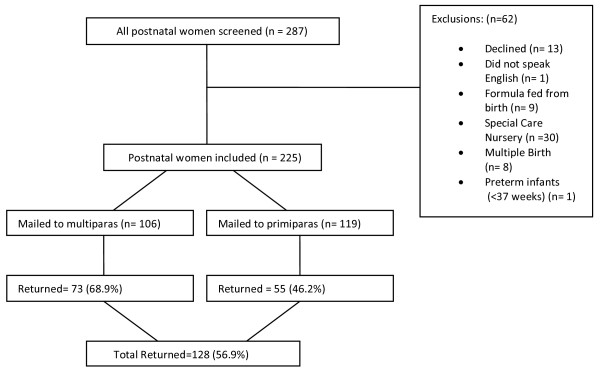
A total of 128 (73 multiparous, 55 primiparous) women participated in the study. The mean BSES-SF score was 51.18 (Standard deviation, SD: 12.48). The median BSES-SF score was 53. Of women using a second-line strategy, 16 exceeded the median, and 42 were below. Analyses using Kruskal-Wallis tests confirmed this difference was statistically significant (H = 21.569, p = 0.001). The rate of second-line strategy use was 48%. The four most commonly used second-line strategies were: bottles with regular teats (77%); syringe feeding (44%); bottles with wide teats (34%); and nipple shields (27%). Seven key challenges were identified that contributed to the decision to use second-line strategies, including: nipple pain (40%); unsettled infant (40%); insufficient milk supply (37%); fatigue (37%); night nursery care (25%); infant weight loss > 10% (24%); and maternal birth associated pain (20%). Skin-to-skin contact at birth was commonly reported (93%). At seven days postpartum 124 women (97%) were continuing to breastfeed.
The high rate of use of second-line strategies identified in this study and high rate of breastfeeding at day seven despite lower BFSE indicate that such practices should not be overlooked by health professionals. The design of this study does not enable determination of cause-effect relationships to identify factors which contribute to use of second-line strategies. Nevertheless, the significantly lower BSES-SF score of women using a second-line strategy highlights this group of women have particular needs that require attention.
母乳喂养自我效能(BFSE)支持母乳喂养的开始和持续时间。母乳喂养的挑战可能会削弱 BFSE,但二线策略,包括奶嘴、注射器、杯子、供应线和奶瓶喂养,可能会支持母乳喂养,直到挑战得到解决。本研究的主要目的是检查在使用二线策略为产后第一周健康足月婴儿喂养的样本中 BFSE。
使用母乳喂养自我效能量表-短表(BSES-SF)、人口统计学和婴儿喂养问卷,对 2008 年 11 月至 2009 年 2 月期间在澳大利亚一家私立大都市分娩机构分娩的单胎健康足月婴儿的母乳喂养妇女进行回顾性自我报告研究。
共有 128 名(47 名经产妇,55 名初产妇)妇女参加了这项研究。BSES-SF 的平均得分是 51.18(标准差,SD:12.48)。中位数 BSES-SF 得分为 53。使用二线策略的妇女中,16 人超过中位数,42 人低于中位数。Kruskal-Wallis 检验分析证实了这一差异具有统计学意义(H = 21.569,p = 0.001)。二线策略的使用率为 48%。最常用的四种二线策略是:带有普通奶嘴的奶瓶(77%);注射器喂养(44%);宽奶嘴奶瓶(34%);奶嘴(27%)。确定了导致使用二线策略的七个关键挑战,包括:乳头疼痛(40%);婴儿不安(40%);乳汁供应不足(37%);疲劳(37%);夜间护理(25%);婴儿体重减轻超过 10%(24%);与母亲分娩相关的疼痛(20%)。出生时普遍报告了皮肤接触(93%)。产后七天,124 名妇女(97%)继续母乳喂养。
本研究中二线策略的高使用率和尽管 BFSE 较低但在第七天仍有较高的母乳喂养率表明,卫生专业人员不应忽视这些做法。本研究的设计不能确定因果关系,以确定导致使用二线策略的因素。尽管如此,使用二线策略的妇女的 BSES-SF 得分显著较低,突出了这组妇女有特殊需求需要关注。